
Learning Resources:
Celebrating Black History Everyday
Highlighting the achievements of Black people in local, national, and global history #CelebratingBlackHistoryEveryday
Curated by Jordin Harris and Lucy Niewolny
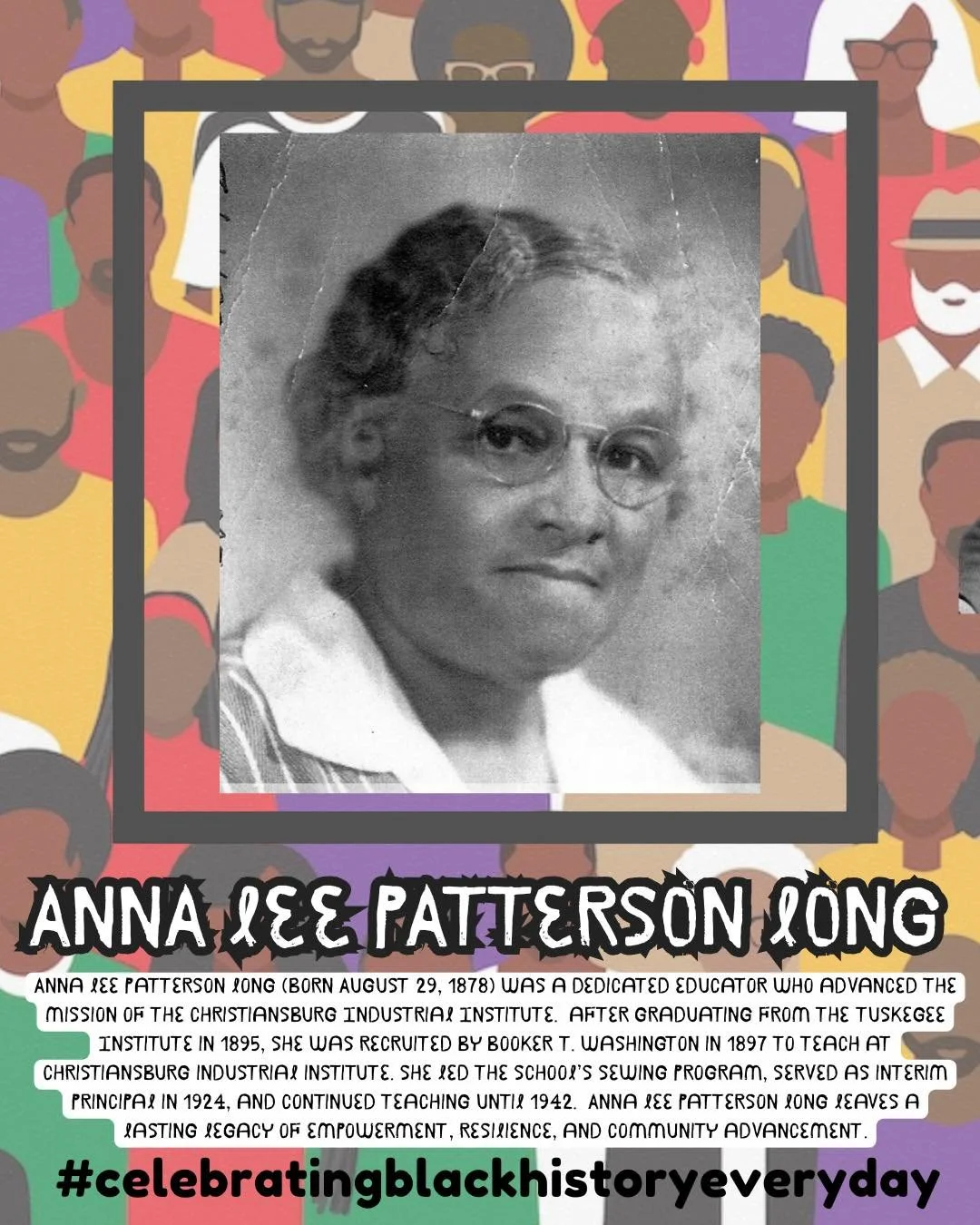
Anna Lee Patterson Long, born August 29, 1878, to Edward L. and Anna M. Robinson Patterson, was a Black woman and educator who carried forward the legacy of Christiansburg Industrial Institute (CII). As the second oldest child of her family, Anna began her education in Montgomery County, Alabama, before continuing her studies at Tuskegee Institute, where she graduated with the class of 1895.
Then just two years later in 1897, she, alongside Tuskegee classmates Edgar A. Long and Charles Marshall, were recruited by Booker T Washington to serve at Christiansburg Industrial Institute as leaders and educators. Embracing the technical education she received at Tuskegee, Anna Lee Patterson Long led the sewing program at CII, transforming it into an instrumental site of skill-building, economic possibility, and empowerment. Her work did more than teach a trade, it cultivated entrepreneurship and self-sufficiency among Black students who were navigating a society tangled with the implications of emancipation, the constraints of Jim Crow, and the ongoing debate of Black advancement.
When her husband Edgar A. Long, who had served as principal of CII since 1906, passed in 1924, Anna became the interim principal for the remainder of the year- marking the only time a woman served as principal in CII’s history. She continued to teach at the school until 1942, dedicating decades of service to the school and its students.
So, Anna Lee Patterson Long was foundational in the growth and expansion of the Christiansburg Industrial Institute. Through her instruction, leadership, and commitment to industrial education, she ensured that the future of the Black community was equipped not only with the means to survive but also to thrive. Her work reflects a broader tradition of Black women whose labor not only sustained institutions but also shaped generations of possibility, resilience, and self-determination.
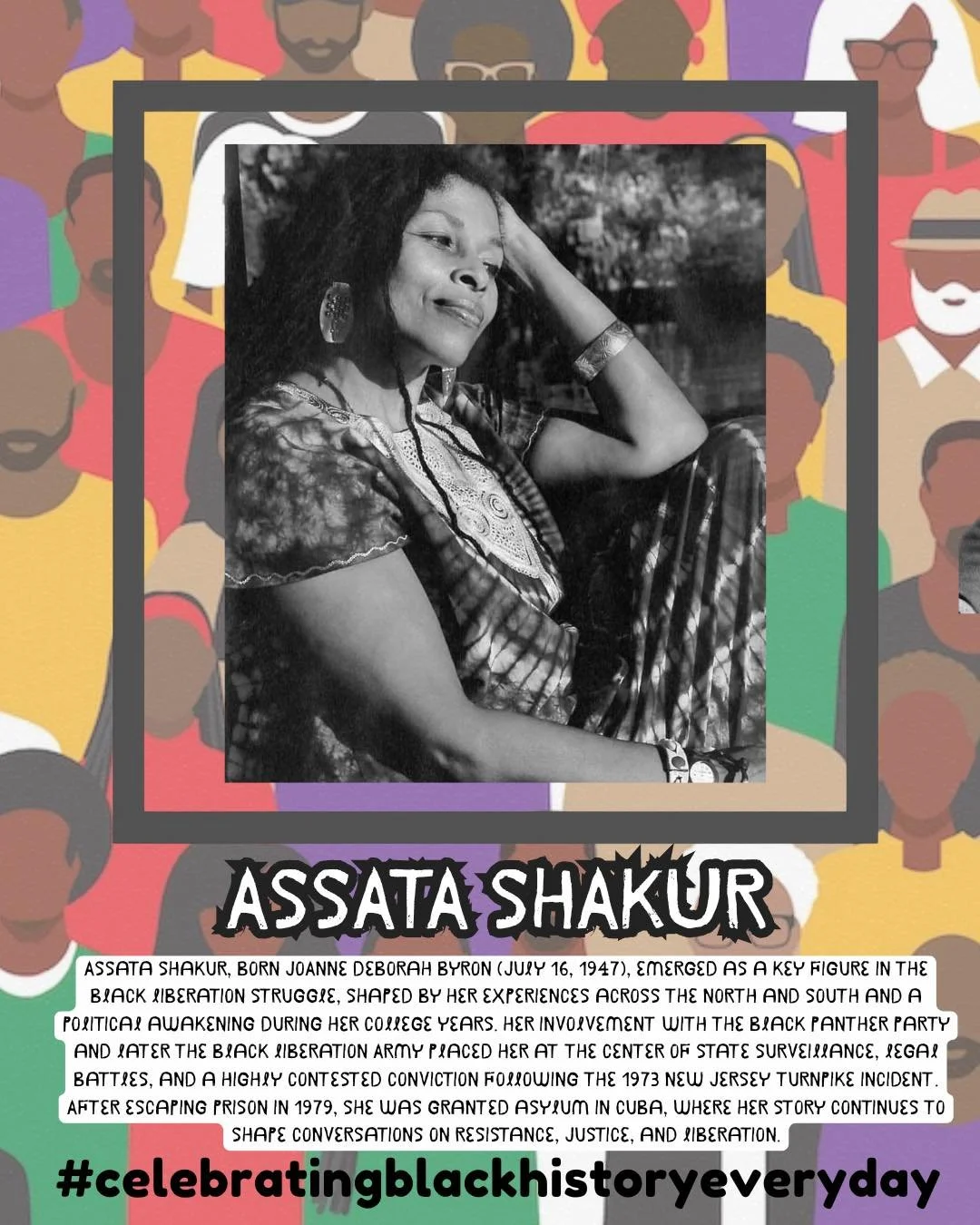
Born JoAnne Deborah Byron (July 16,1947), Shakur emerged as a powerful and polarizing figure in the struggle for Black liberation, whose life invites us to grapple with questions of resistance, justice, and the meaning of freedom.
In her early years, Assata Shakur spent time between the North and the South, more specifically New York and North Carolina. Her education can be acknowledged as one that was complete through formal schooling, but also by lived experiences, community, and political awakening. From a young age, Assata had the power to name injustice and understand struggle, however, her own vision for Black advancement and liberation was yet to be fully grounded until she attended Manhattan Community College and then City College of New York. Through exposure to many different ideological groups from socialists, Garveyites, to the Golden Drums (the group she chose to participate within), the ideas and frameworks that she had been taught began to be consistently challenged in a significant way. These experiences expanded her knowledge, deepened her commitment to activism, and strengthened her connection to community and self. This is the era in her life that she would then change her name to Assata “She who struggles” Olugbala “Love for the people” Shakur “Thankful.”
Assata joined the Black Panther Party in 1970, an organized militant coalition that saw that Black power came from global revolution and included actions of confronting existing political institutions and actors, challenging the police force, and protecting the Black community through “survival programs.” Shortly after joining, Shakur did step away from the Party and subsequently sought membership with the Black Liberation Army (she would be named as a leader of the organization by government forces). From 1971-1973, Assata was charged with multiple crimes amongst other members which included bank robberies, kidnappings, and murder.
On May 3, 1973, Assata Shakur among Zayd Malik Shakur and Sundiata Acoli were pulled over on the New Jersey Turnpike for “a faulty tail light:” a tactic of pulling over Black revolutionary leaders for minor traffic violations was followed closely in COINTELPRO operations. Gunfire would then ensue leading to the deaths of Zayd Malik Shakur and Trooper Werner Foerster. Shakur suffered from gunshot wounds and would be arrested and charged with first-degree murder, second-degree murder, and various counts of assault and battery. Upon arrest, Assata was indicted ten times for previous charges to which she would go to trial for resulting in acquittals, dismissals, a mistrial, and a hung jury. In 1977, Assata was convicted on all eight counts: both murder charges and six assault charges. Two years later in 1979, members of the Black Liberation Army plotted and aided the escape of Shakur from Clinton Correctional Facility. She would then later be granted political asylum in Cuba granted by Fidel Castro.
Assata Shakur’s life and legacy continue to challenge, inspire, and provoke critical reflection on the nature of resistance and justice.
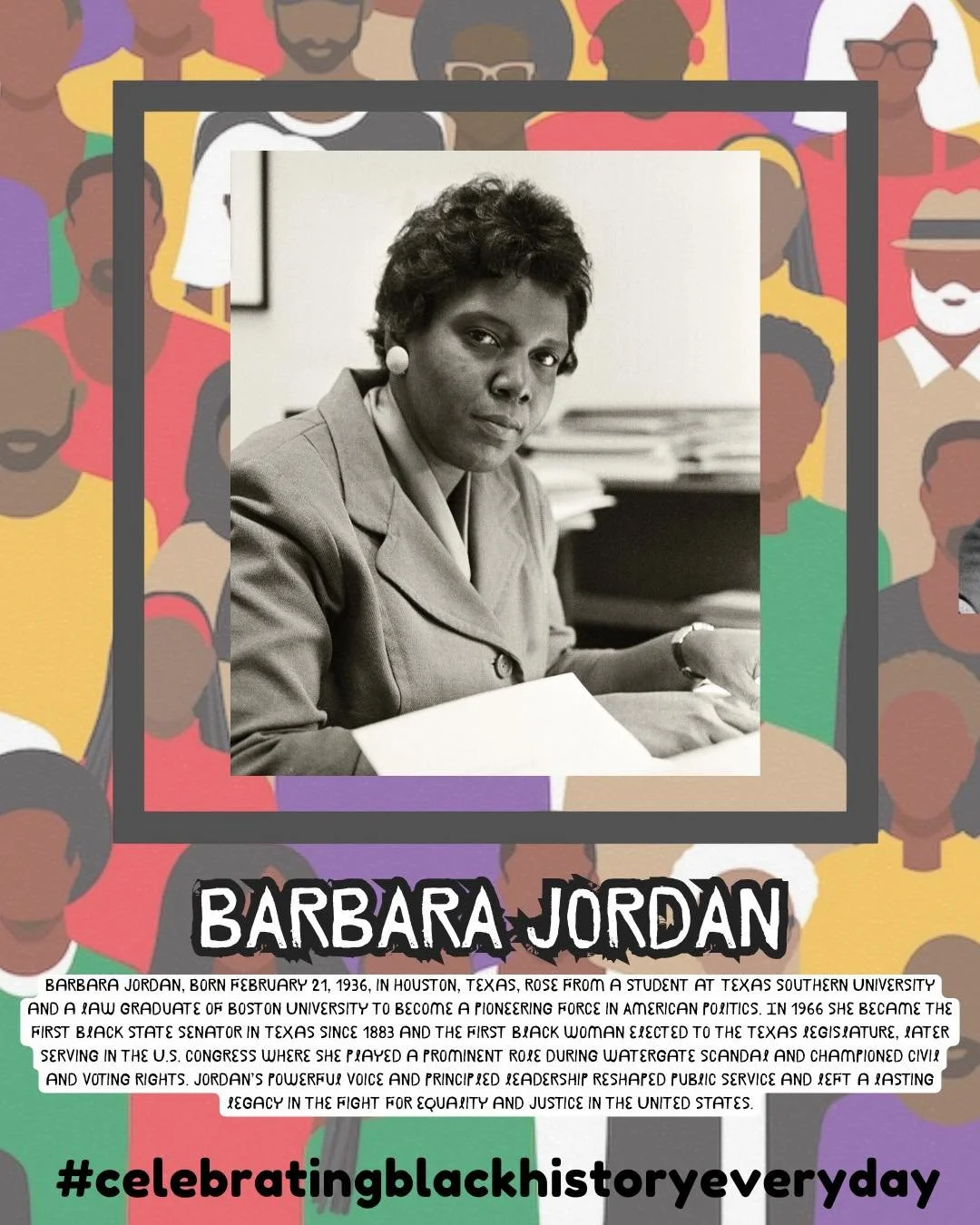
Barbara Jordan was born in Houston Texas, on February 21, 1936, a Black woman destined to change the political sphere. Growing up she attended Houston public schools, graduating from Phillis Wheatley High School in 1952. Jordan, an HBCU alum at Texas Southern University earned her bachelor's degree in 1956. She then pursued her Juris Doctor at Boston University and after receiving her degree she sat for the Massachusetts and Texas bar exams where she was admitted to both and began practicing law in Houston in 1960.
At the beginning of her legal career, Black Americans were tirelessly fighting for the recognition of their civil rights within the nation’s systems and institutions. Thus, she not only took on the role as a lawyer but she also served as an emerging political activist and figure. She began working on Kennedy’s presidential campaign, organizing a substantial get-out-the-vote program that covered Houston’s 40 African-American dominant precincts. In 1962 and 1964, she took action and ran herself for the Texas House of Representatives. However, it was 1966 when she made great defining history as she became the first Black state senator since 1883 and the first Black woman to be elected to the Texas state legislature.
Jordan was then elected to serve in Congress in 1971, one of the first Black Americans to be elected to Congress from the Deep South in the twentieth century. And in the following cycles, she swept her opponent capturing 85 percent of the total vote in both general elections. The U.S. House, she had a powerful role in committee work, gave the opening remarks for impeachment per the Watergate scandal, and she championed protecting and expanding the reach of both the Civil Rights and Votings Rights Acts. In her career she also accomplished: president pro tempore of the Texas senate which when executed made her the first Black chief executive in the country, the first woman and the first Black keynote speaker at the Democratic National Convention, and worked closely with Jimmy Carter who offered her a job as ambassador of the United Nations.
So, Barabara Jordan remains a towering figure in American political history whose voice, intellect, and courage shaped the possibilities of public service and the United States. Through her advocacy work, and commitment to democratic ideals, she challenged various institutions to grow in a direction that honored equality and justice. Her legacy is rooted in principled leadership, integrity, and a steadfast conviction that she and the law could serve and protect every American.
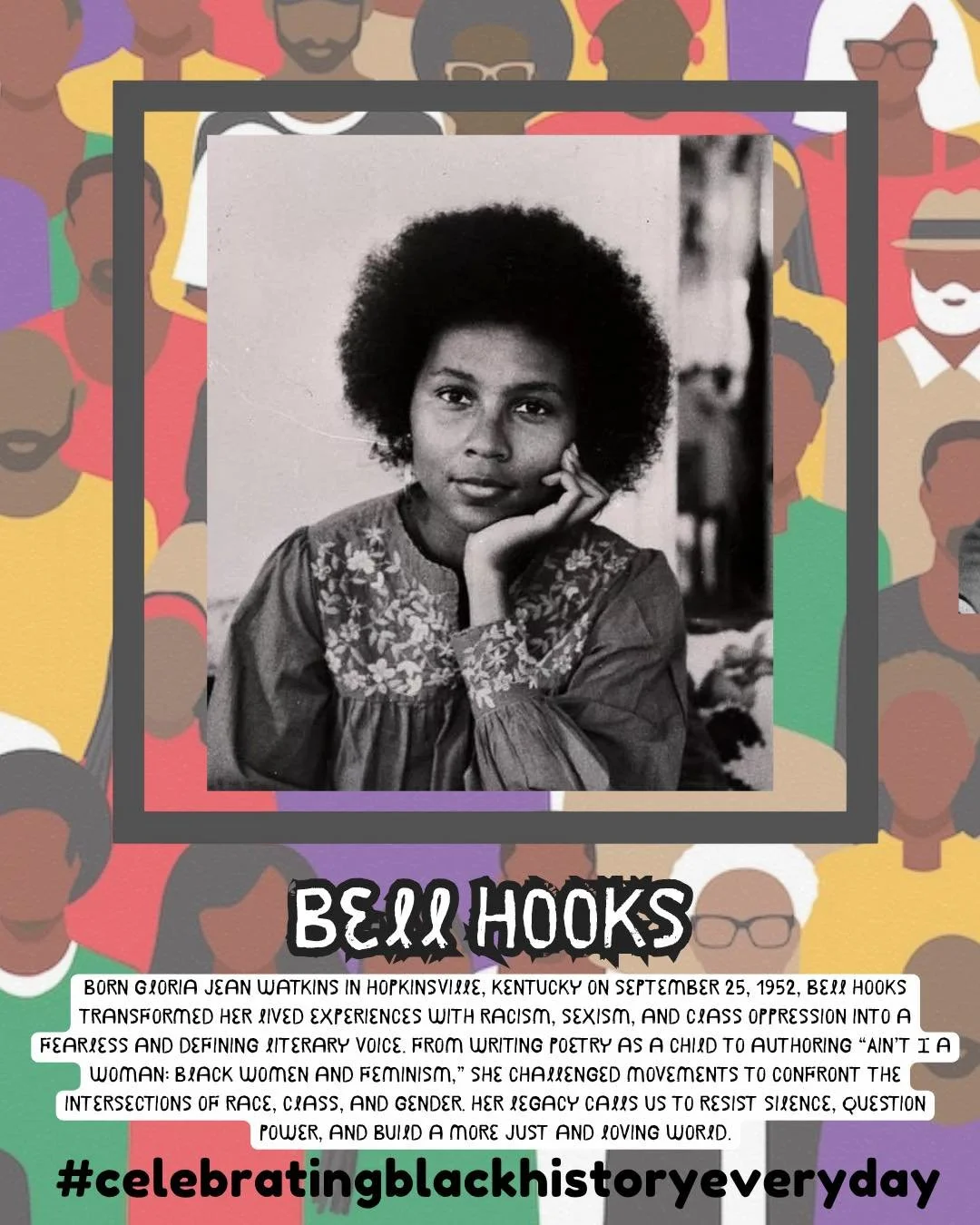
Gloria Jean Watkins, widely known as bell hooks, was born on September 25, 1952, in Hopkinsville Kentucky. Her childhood years, shaped by the forces of segregation, capitalism, and gendered violence, profoundly informed the curation of her literary voice. From being educated mostly by Black women who instilled great confidence in her to being ridiculed for “talking back,” by speaking out against various means of oppression and power structures, bell hooks’ bold defiance and resistance of silence, made her a pioneer in feminist thought.
Choosing the pen name “bell hooks” as a nod to her grandmother, a woman who she remembered as outspoken, sharp-tongued, and never afraid to “talk back,” hooks made sure to exude this “loudness” of her Black ancestors in her prolific career. Her first published book was a collection of poetry titled And there we wept, in 1978. Four years later, her most infamous piece was released– Ain’t I a Woman: Black Women and Feminism. This text critiqued both the Feminist and Civil Rights Movements arguing that neither liberation movement could succeed if they only address one oppressive power structure at a time and rather must look at the intersections of race, class, and gender in both of their fights or else inequality will only continue to be perpetuated. bell’s career then only expanded as she continued to publish a plethora of literature, teach at various institutions that earned her many accolades and distinguished awards, organize a group: the Sisters of the Yam, and even shift the focus of her thought in the 1990s from one that analyzed dominant systems to one that explored personal and social transformation.
Thus, hooks, who was seen as a radical even at youth, changed the landscape of how we begin to approach the action of justice. Her legacy dares us as individuals and as a collective to continue to investigate the harms of oppression in order to create a more comprehensive, equitable, and harmonious society. By making complex ideas accessible, her work continues to serve as a foundation for building a more loving world.
*Please note that bell hooks’ name is not capitalized as hooks chose not to capitalize the name herself as she hoped that this decision would lead to people focusing on her ideas rather than her name.
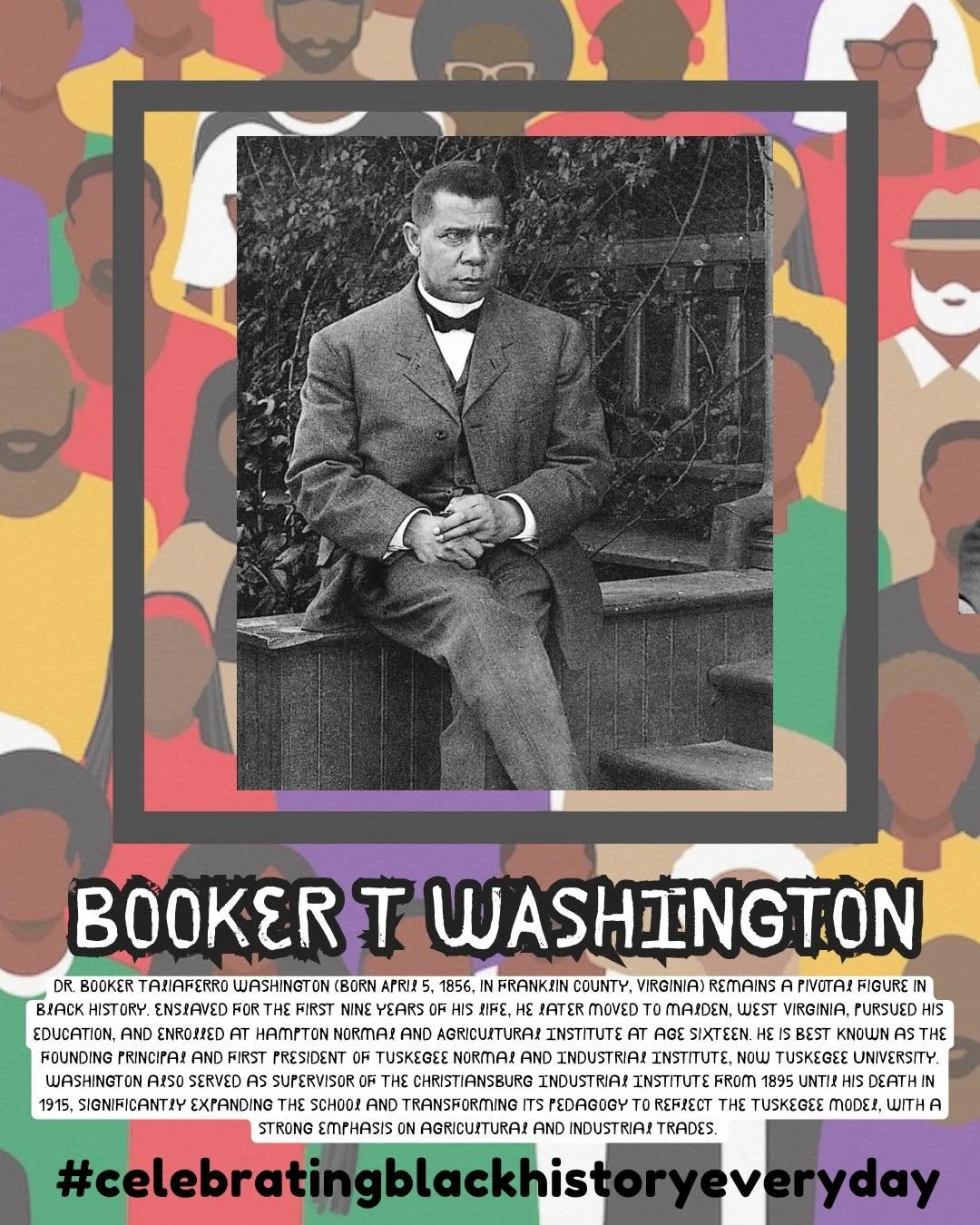
Booker T. Washington, a prominent Black historical figure, dedicated his life to cultivating a strong Black community in the post-Civil War United States.
His focus was primarily on the advancement of Black individuals through industrial education and a philosophy of self-sufficiency. This vision developed while he attended Tuskegee Normal and Industrial Institute. Here he explored a higher education that was not solely academic, he also learned lessons in personal hygiene, good manners, manual labor, public speaking, and more. Once he graduated from Tuskegee, he returned to Malden where he was a student at Wayland Seminary. The strictly academic curriculum at the Seminary further reinforced his belief in the value of an industrial education and self-reliance.
In 1881, Tuskegee Normal and Industrial Institute, was established. Armstrong, who was a pivotal figure to Washington during his attendance at Hampton Normal and Agricultural Institute, recommended Washington as principal of the school. Washington worked relentlessly to build the school, recruit students, and gain support for the institution. Tuskegee Normal and Industrial Institute offered courses of skilled trades, personal hygiene, manners, and character building, in addition many of them worked on the campus which contributed to its growth.
His work in prioritizing industrial education was not exclusive to Tuskegee Normal and Industrial Institute. Washington also had a role at Christiansburg Industrial Institute. He became a supervisor for the school in 1896 and aided in the expansion of the curriculum which implemented practices from the Tuskegee Normal and Industrial Institute. Furthermore, he participated amongst national platforms where he shared his ideas such as the infamous “Atlanta Compromise” speech at the Atlanta Exposition in 1895.
In all, we see his lifetime dedicated to the principles of building the Black community from within. His revolutionary thought centered on education, economic empowerment, and institutional development, did not remain abstract. We can see these ideals materialize through Tuskegee Normal and Industrial Institute and Christiansburg Industrial Institute. These institutions are an embodiment of his focus on resilience, self-determination, and collective uplift.
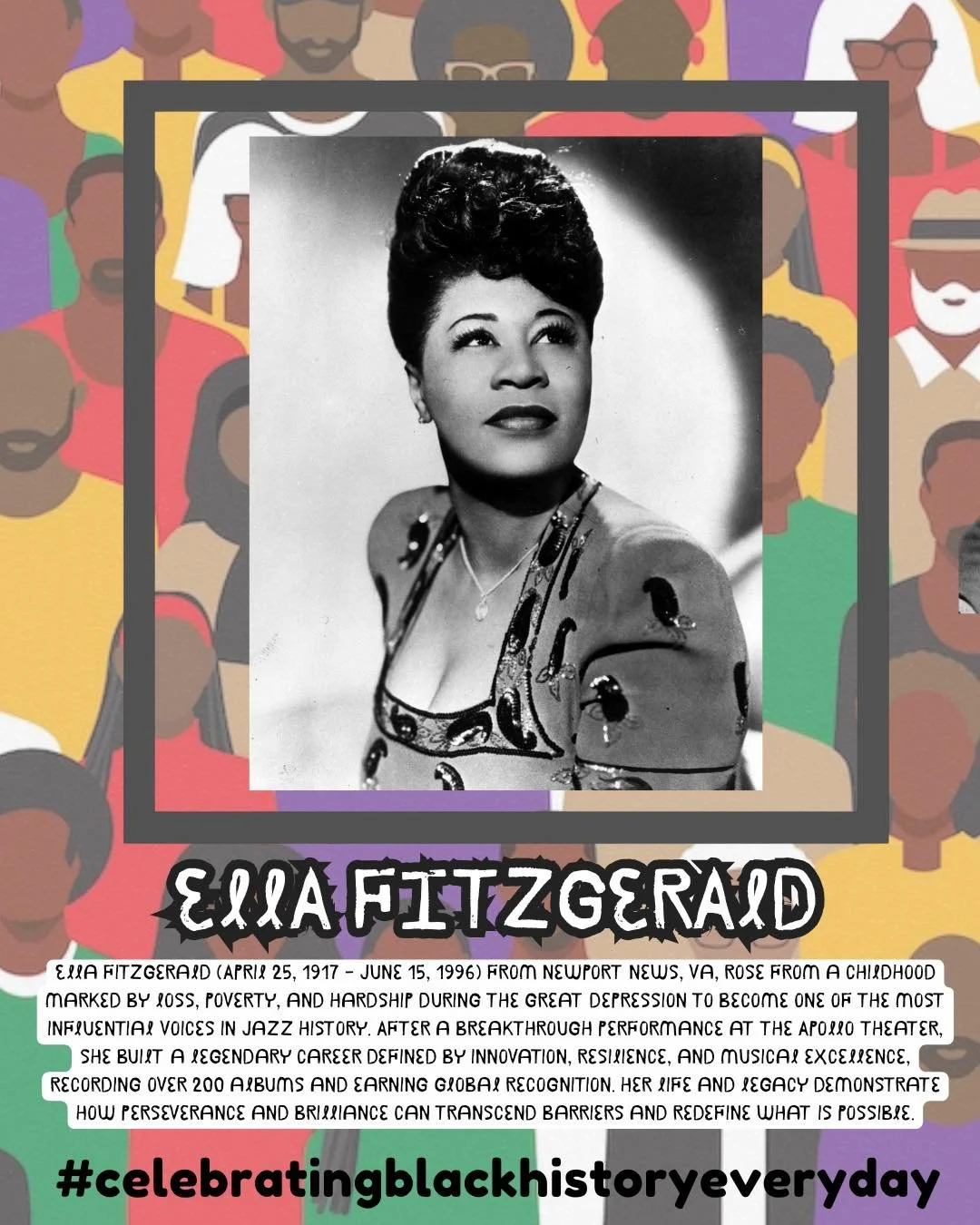
Ella Fitzgerald born April 25, 1917 in Newport News, Virginia, would be recognized as “The First Lady of Song.” Shortly after her birth, Ella’s mother moved them to Yonkers, New York where she immersed herself in dancing, singing, and the theater. However, in her early teenage years Fitzgerald went through a difficult time with the loss of her mother and stepfather. She was sent to a reform school as her grades continued to decline, but due to the abuse she endured there from the caretakers, she escaped. At 15, she was on her own during the Great Depression.
Two years later in 1934, Ella Fitzgerald would get her defining moment. Her name was drawn in the weekly draw at the Apollo Theater to perform in Amateur Night. She originally planned to dance but after watching the Edwards Sisters' dance act before her, she decided to sing Hoagy Carmichael's “Judy.” The audience greeted her with hostility at first but once they heard her voice they demanded an encore. Benny Carter, who was in the band that night and would become a lifelong friend of Fitzgerald, was so deeply impressed that he began to introduce her to individuals who would help launch her career forward.
Ella began entering every contest she could to perform which led to her being hired by Chick Webb in 1935. Her career took off: by mid-1936, she recorded "Love and Kisses,” began to master scat singing—turning it into a form of art—and sold one million copies of the album “A Tisket, A-Tasket” in 1938. Soon after, she became bandleader after the passing of her mentor Chick Webb. Then, Fitzgerald joined the Philharmonic tour and began producing her songbook series recording covers of other musicians’ albums from 1956-1964: Ira Gershwin even remarked, “I never knew how good our songs were until I heard Ella Fitzgerald sing them.”
In 1991, Ella Fitzgerald performed her last concert in Carnegie Hall, but her name had been cemented forever. By this time she had been inducted into the Down Beat magazine Hall of Fame, received Kennedy Center Honors, awarded the National Medal of Arts by Ronald Reagan, granted the Commander of Arts and Letters award from France, and bestowed several honorary doctorates from institutions such as Yale and Dartmouth. She recorded over 200 albums, accumulated 13 Grammy awards, and sold over 40 million albums. Her story reminds us that, legacy is shaped by resilience, transformation, and triumph. From a young girl navigating loss and instability, a teenager navigating the Great Depression, and always existing as a Black woman navigating discrimination, her voice reshaped the possibilities of power. Fitzgerald’s brilliance transcended barriers that sought to confine her and shows us that there are no limits that define us.
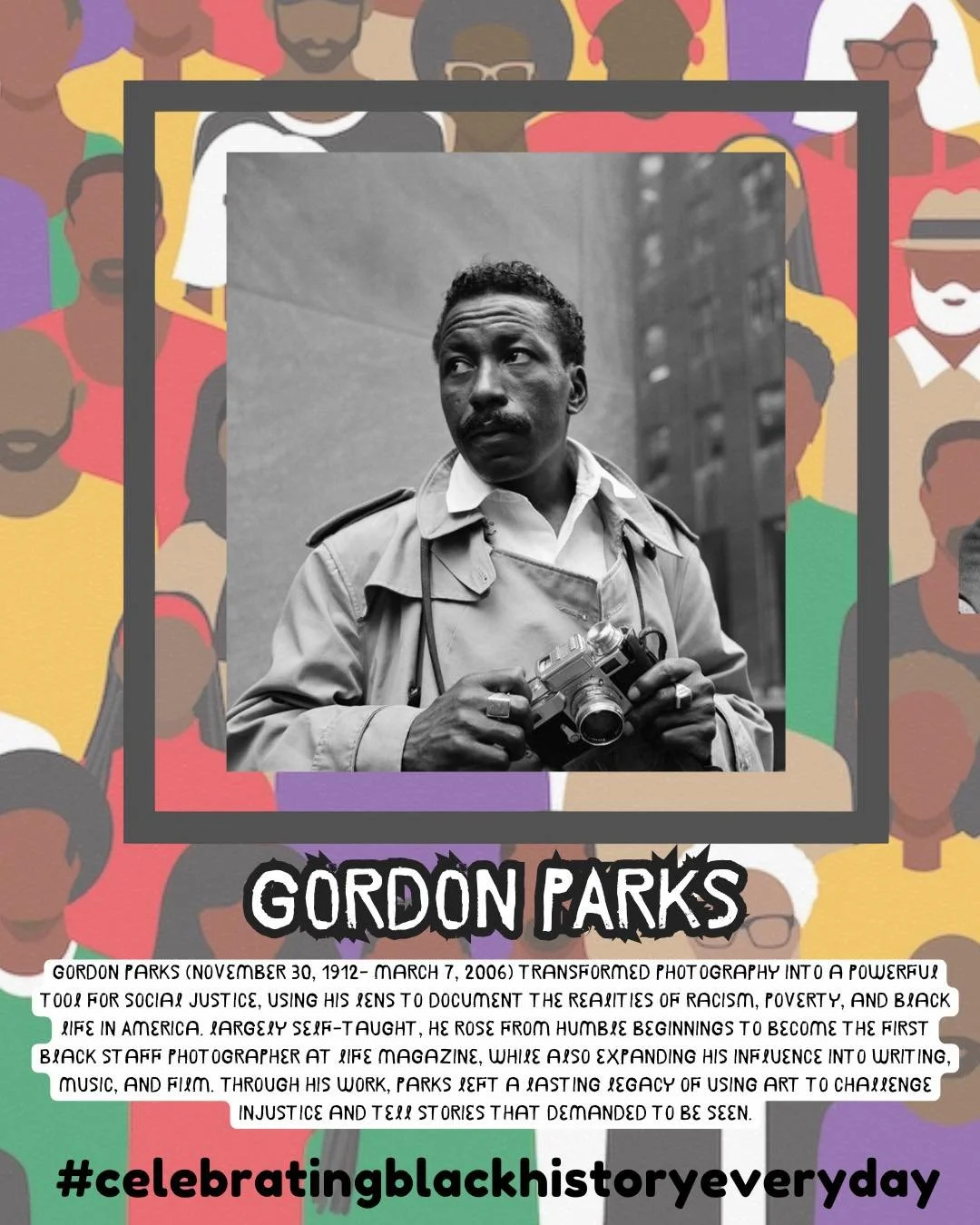
Gordon Parks was more than a pioneer behind the lens: he was a storyteller, activist, and visionary who transformed photography into a tool for justice. Born in Fort Scott, Kansas, in 1912, Parks grew up navigating the harsh realities of segregation and poverty. Yet, those early experiences would later shape the powerful perspective he brought to his work, capturing the dignity, struggle, and resilience of Black life in America.
After buying a camera from a pawnshop, teaching himself how to photograph, and taking inspiration from photographs of migrant workers taken by the Farm Security Administration (FSA), 1937 was the year that Parks became a photographer. By 1942, though without professional training, Gordon earned the Julius Rosenwald Fellowship which led to him gaining a position with the photography section of the FSA and the Office of War Information (OWI). The work that these agencies performed and the environmental exposure set the theme and style of Parks’ photography. He would become a celebrated photographer due to his exploration of social and economic issues through images such as poverty and racism.
Due to his work here, opportunities endlessly emerged for Parks. In 1944, he left the OWI to work on the Standard Oil Company’s photo documentary program while also being a freelance photographer for Glamour and Ebony. Then just four years later after producing a photo essay documenting the life of Harlem gang leader which won him high acclaim, he received a position at Life Magazine, making him the first Black staff photographer for the entity. At Life, he covered an array of subjects from his focus on forms of discrimination to entertainment and fashion. His work could also be seen helping rally support for the Civil Rights Movement in which he was an advocate and documentarian. As Parks moved forward with his career would also expand the modes of his artistry to music composing, filmmaking, novel and poetry-writing, and painting. Gordon Parks directed the renowned Shaft (1971) which was a box office success and aided in launching the Blaxploitation genre of film, bringing audiences one of its first Black action heroes.
Parks famously quoted that “I saw that the camera could be a weapon against poverty, against racism, against all sorts of social wrongs. I knew at that point I had to have a camera.” His career lives on to inspire us to see art not just as expression, but as action to tell the truth boldly, challenge injustice unapologetically, and use the tools we have to shape a more equitable society.
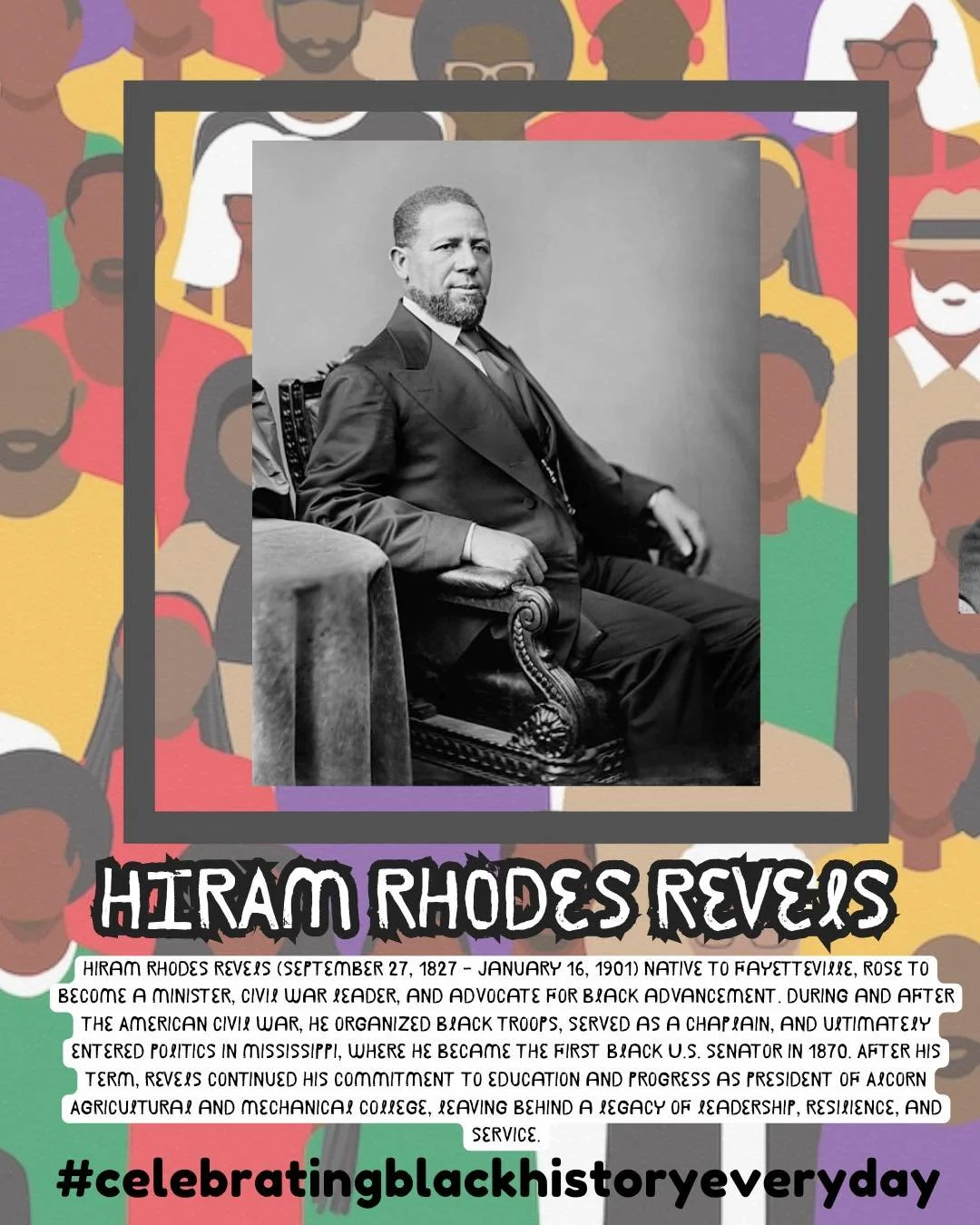
Hiram Rhodes Revels, born September 27, 1827, would become a pioneering and transformative leader in American history. Native to Fayetteville, North Carolina, Revels was a member of a free family. In his youth, he received private school lessons from a Black woman and apprenticed as a barber alongside his brother. Revels eventually inherited and ran the barbershop left behind by his brother before leaving North Carolina to study at seminaries in Indiana and Ohio. He became a minister of the African American Methodist Episcopal Church in 1845 and went on to study theology at Knox College in Illinois.
In the years leading up to the Civil War, Hiram preached to free and enslaved men and women across various states while also aiding fugitive slaves. Soon after the War started, Revels organized regiments of Black soldiers in Maryland. He fought in the Battle of Vicksburg and then served as the Union army chaplain in Mississippi by the end of the War. By the War’s end, he had settled in Natchez, Mississippi with his wife and children where he was deemed the presiding elder of the African Methodist Episcopal Church.
It was his time in Mississippi when his instrumental political career took shape. In 1868, he gained his first elected position as the alderman for the town of Natchez. Within the next year, he also won election to the Mississippi state senate: one of thirty-five Black individuals elected to the Mississippi state legislature that year. But it was in 1870 when a historical opportunity revealed itself. Mississippi was seeking readmission to representation in the U.S. Congress. This, along with the ratification of the Fifteenth Amendment set the stage for America’s first Black Congress members to take fold. The Mississippi U.S. Senate seat was previously held by future Confederate President Jefferson Davis. Black legislators held that the seat should go to a Black member of the Republican Party and after an impressive speech they determined it should go to Revels. There was much conflict regarding whether a Black individual could serve in Congress due to issues of citizenship. Revels (and his supporters), however, persevered and on February 25, 1870 he took the oath of office becoming the first Black U.S. Senator. While in the Senate, he championed education for Black Americans, spoke out against segregation, and fought against efforts to undermine civil rights activism. Civil Rights activist Wendell Phillips acknowledged Revels as “the Fifteenth Amendment in flesh and blood.”
His term ended in 1871 and Revels, instead of going forth with reelection, returned to Mississippi where he would become the President of Alcorn Agricultural and Mechanical College, a Historically Black College and University, and an instructor in philosophy. Here, he still had the ability to directly participate in the enrichment and advancement of future generations of Black Americans. His life is to be remembered not only for the barriers he broke, but for the enduring legacy he built: one rooted in service, resilience, and an unwavering belief in the power of Black progress.
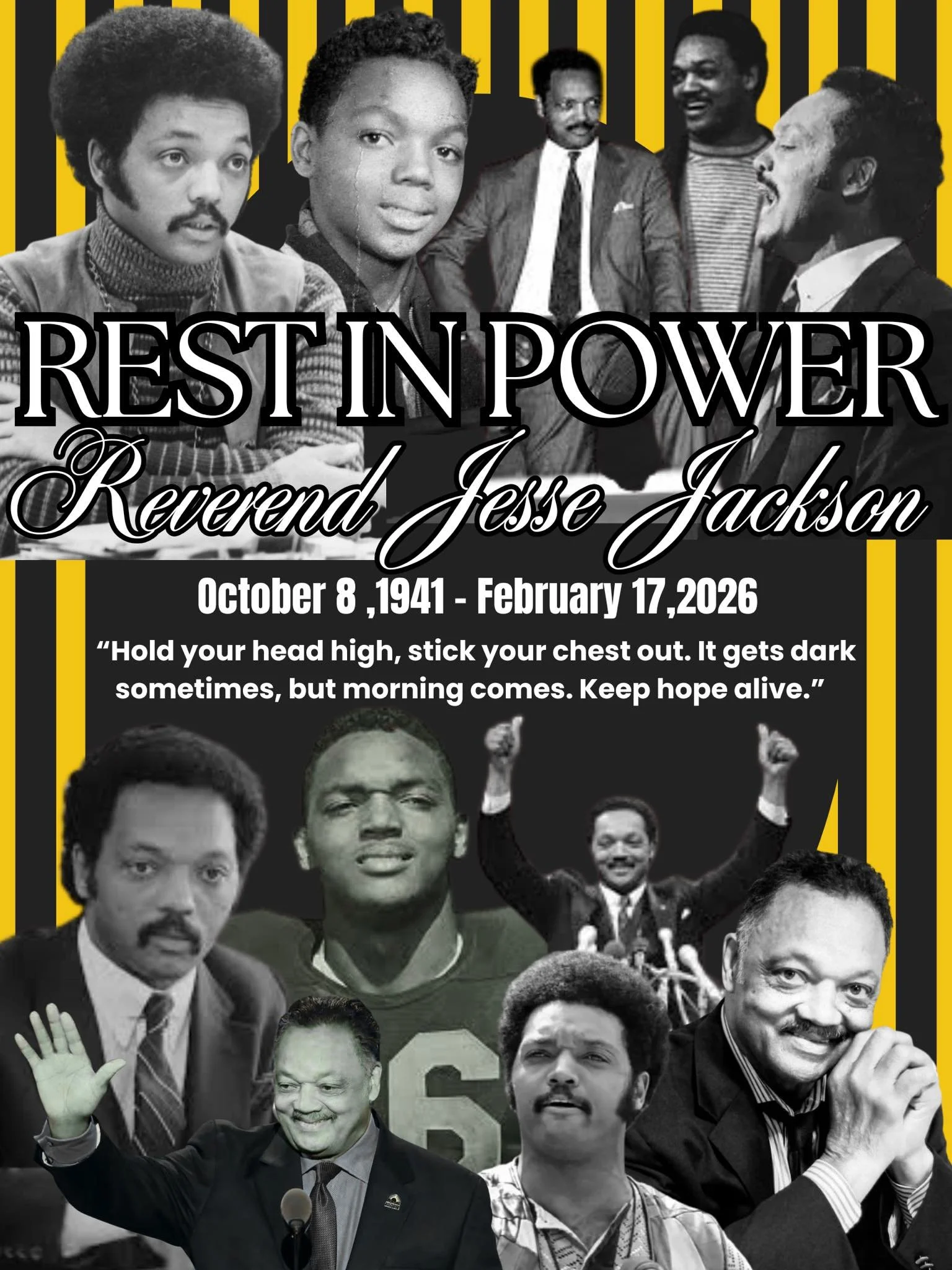
We would like to pause and honor the enduring legacy of Reverend Jesse Jackson, whose life was defined by service, courage, and a steadfast commitment to justice.
Jesse Jackson (October 8, 1941-February 17, 2026), emerged during a defining era of activism. An alumnus of North Carolina Agricultural and Technical State University, he lived as both a student and revolutionary during his time at the institution. In the summer of 1960, he began his public fight for justice as he sought to desegregate the local public library in Greenville, South Carolina. He soon became a leader of the sit-in movement and, after graduating from A&T, became a full-time organizer for the Southern Christian Leadership Conference (SCLC), later a trusted lieutenant for the organization
Jackson carried, centered, and practiced the principles of the Civil Rights Movement forward throughout his life. His historical presidential campaigns in 1984 and 1988 further urged American democracy to continue with a path of change and possibilities. His work here was foundational in expanding the electorate and overall political participation. He registered millions of new voters from various communities who were long excluded from power, drastically reshaping what democracy can, and should, look like.
His work also led him to found the National Rainbow Coalition: an organization devoted to political empowerment, education, and public policy, become Washington D.C. 's “shadow senator” in 1991, be a respected international diplomat, and a mentor for youth. In consequence, Jackson received an extensive amount of honors, awards, and more than 40 honorary doctorate degrees.
Today, we recognize Reverend Jackson as a transformative force in the ongoing fight for civil rights. His leadership has been pivotal to the growth of our nation and the establishment of equity and equality.
May he rest in power.
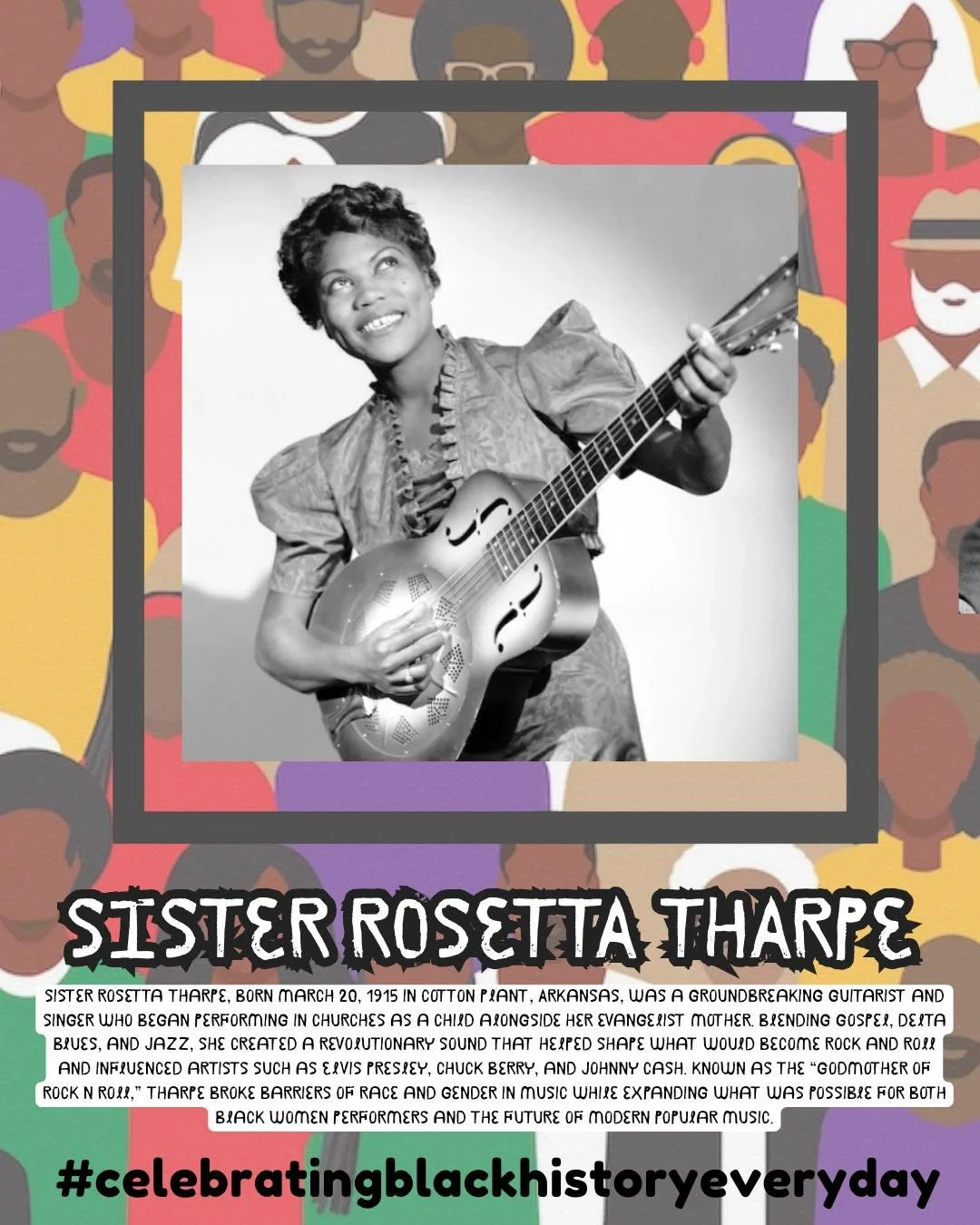
Sister Rosetta Tharpe was born on March 20, 1915 in Cotton Plant, Arkansas. Tharpe had begun playing the guitar at age 4 and is regarded as mastering the instrument by age 6. Hailing from a family of devout Evangelicals, Rosetta began her career in the religious sphere traveling to churches with her mother as a young child playing with an Evangelist troupe.
In the mid-1920’s Tharpe and her mother settled in Chicago. From her travels and time here, Sister Rosetta began merging sounds such as the Delta blues, New Orleans jazz, and gospel music to create her own distinctive sound alongside her unique voice. Then in the late 1930s, she and her mother uprooted themselves and moved to New York City where she quickly joined the Cotton Club Revue in 1938 at age 23. During the depth of her career, Sister Rosetta Tharpe pushed every boundary that she could. She created a new category of music known as pop gospel, sung about both secular and religious themes, was a female guitarist in a male-dominated space noting that “Can’t no man play like me. I play better than a man.,” was also openly queer within the music industry, collaborated with Duke Ellington, Dixie Hummingbirds, and Lucky Millinder Orchestra, and was a legend amongst Black soldiers fighting in World War II as her work with Sammy Price captured the instability the United States was facing.
Her most famous songs include “Rock Me,” “That’s All,” and “Strange Things Happening Everyday.” Her original sound went on to influence and lay the groundwork for artists such as Elvis, Chuck Berry, Johnny Cash, and Little Walter. At the end of her career she spent her time touring Europe building a new fanbase filled with a new generation of listeners.
Tharpe: the “Godmother of Rock n Roll,” the “Original Soul Sister,” and the one who played something that has never been played before, stands as a fearless Black woman who forged a new path. Her presence was a direct challenge to the institutions of racism and sexism, breaking down the barriers in both spaces. Through her sound, style, and unapologetic character, she not only expanded what was possible for Black women but also what was possible for the future of music.
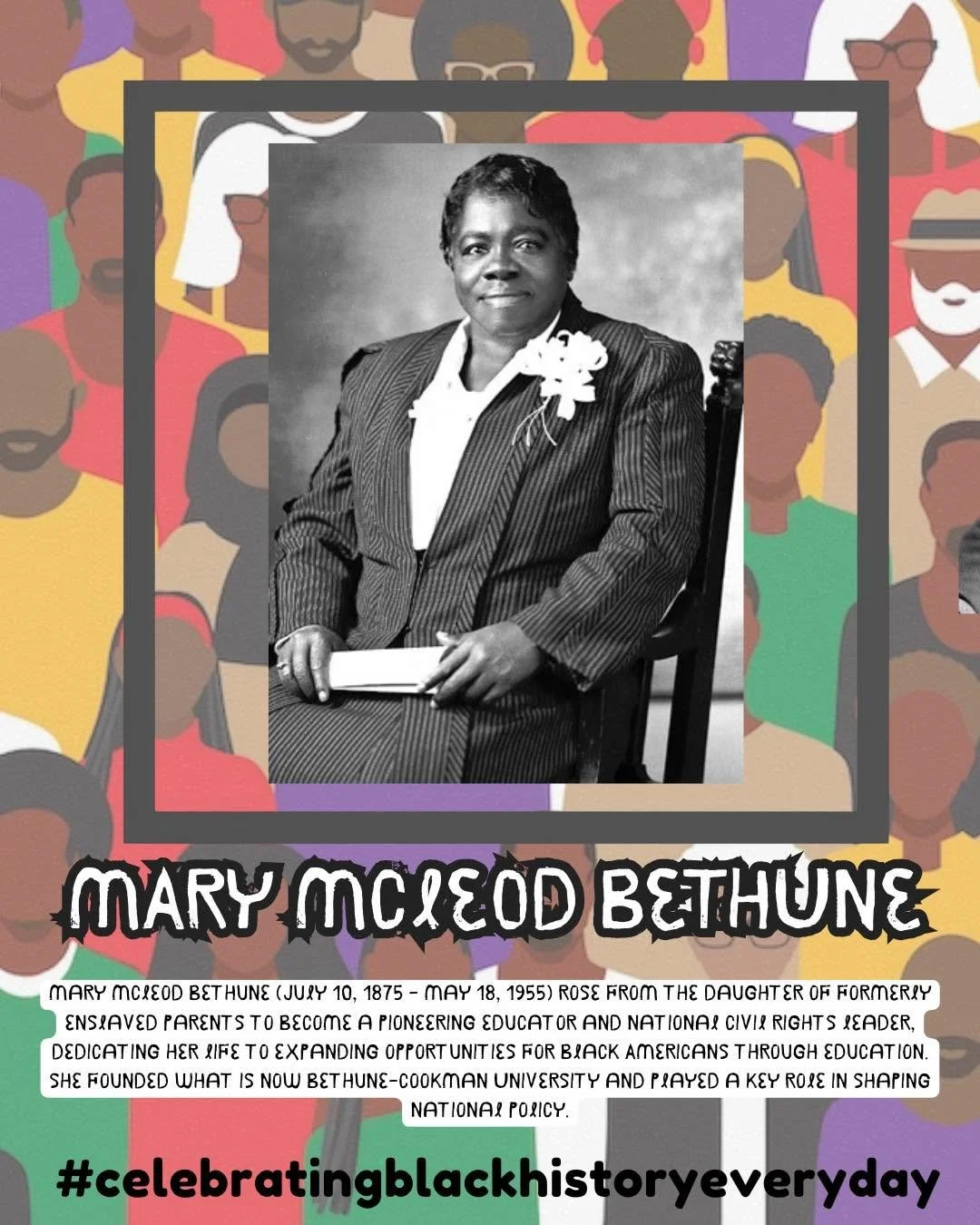
Mary McLeod Bethune was an educator, civil rights leader, and trailblazer. Born on July 10, 1875, in Mayesville, South Carolina, Mary was a part of one of the first generations to be born post-emancipation with her parents and some of her older siblings having been enslaved for a period of their lives. She began working on the land that her family owned (bought from the previous slaveholder of her mother) at age five, however, her eye was set on education. She began learning through the Mission Board of the Presbyterian Church, then with the help of benefactors attended Scotia Seminary in North Carolina, and finally received a scholarship to the Moody Bible Institute in Chicago as the only Black student to attend.
Originally, she had imagined herself as serving as a missionary in Africa but as she witnessed and lived among the conditions of the Black community in the United States, she shifted her focus. Bethune began teaching across Georgia and South Carolina once finishing at the Institute. And within a short time she found herself in Florida, teaching at a Mission School while also visiting prisoners in the county jail, helping them in any way she could whether that was reading or singing to them or working to free those who were not guilty. But, it was in 1904, that Mary McLeod Bethune accomplished her dream of expanding opportunities for African-American girls by opening the Daytona Literary and Industrial School for Training Negro Girls. She acted as President of the school for more than 40 years and during her time she opened a high school, a hospital for Black individuals, and oversaw the school’s merger with the Cookman Institute, making it the Bethune-Cookman College, now known as the HBCU: Bethune-Cookman University.
Beyond education she was engrossed in social work: she worked to integrate Red Cross, became the President of the Florida Federation of Colored Women, the President of the National Association of Colored Women, and formed the National Council of Negro Women in 1935. A year later she found herself as the appointed director of African American affairs in the National Youth Administration and a special adviser on minority affairs by President Franklin D. Roosevelt. She held these positions for eight years, becoming the unofficial leader of FDR’s “Black cabinet.” In addition, Mary organized a conference on the Problems of the Negro and the Negro Youth, became Vice President of the NAACP, was a member of the advisory board that created the Women’s Army Corps, and was the only woman of color at the founding conference of the United Nations in 1945.
Mary McLeod Bethune’s legacy is one of unwavering dedication to education, empowerment, and equality. Through her work, she not only opened doors for generations of Black students but also reshaped the landscape of civil rights and public service in America. Her life stands as a powerful reminder that education, leadership, and community care can be transformative forces for lasting change.
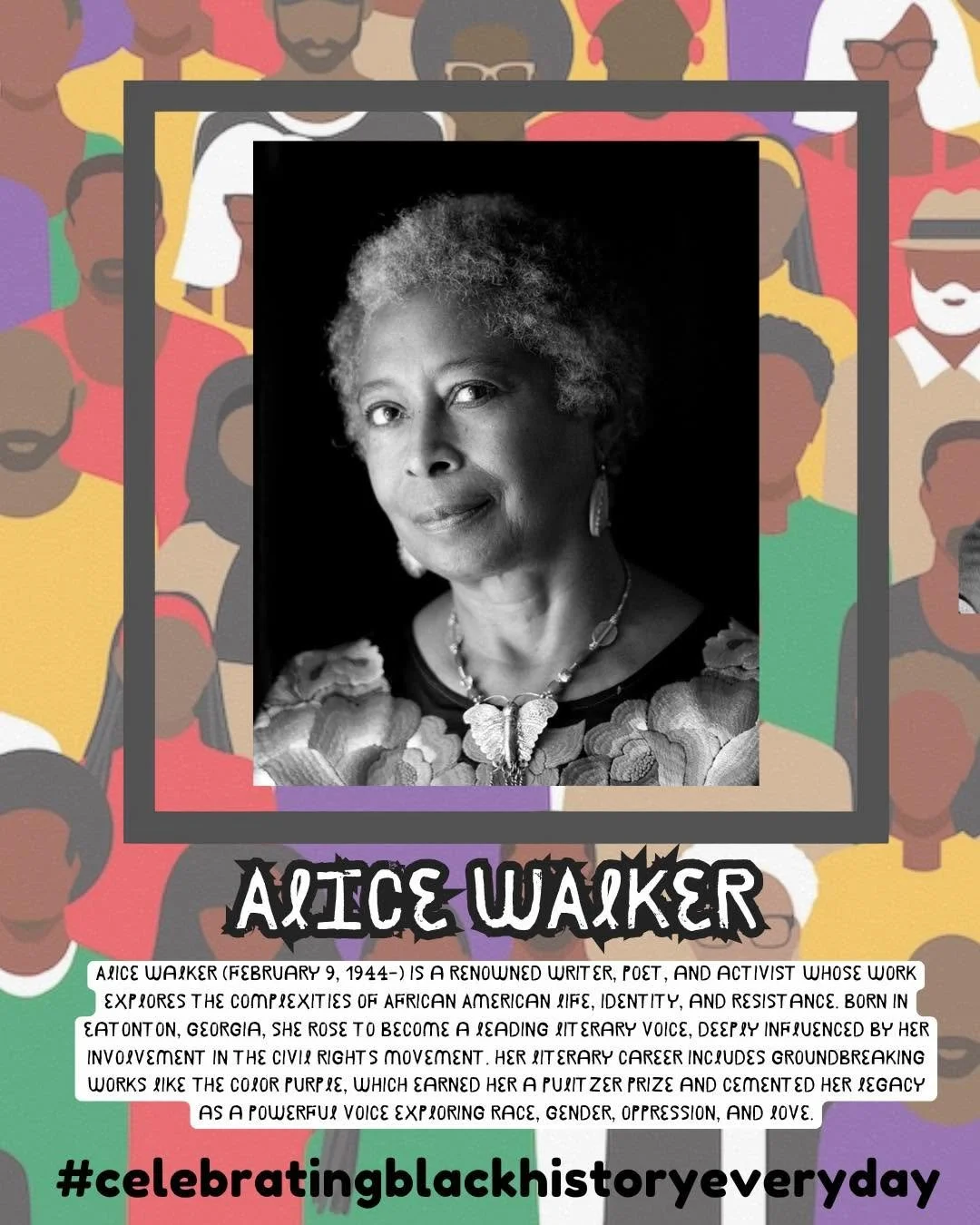
Alice Walker, a celebrated writer, poet, and activist is incredibly influential in the portrayal and understanding of African American life and culture. Born February 9, 1944, in Eatonton, Georgia, she was the daughter of sharecroppers. In her youth she suffered from an injury that left her blind in one eye, thus her mother made the decision that Walker’s efforts should focus on education. Alice had a particular talent for writing, her teachers recognized this and within four years of her schooling, her curriculum completely revolved around books and writing. And, upon graduating high school, she was even valedictorian of her class.
Due to her literary capabilities and academic achievements, she received a scholarship to Spelman College. She studied here for two years before transferring to Sarah Lawrence College, where she graduated in 1965. Immediately after finishing her post-secondary education, Walker joined the Civil Rights Movement in Mississippi. Alice taught and wrote poetry, short stories, and essays, producing her first book of poetry, Once, in 1968. In addition, she was also part of the first interracial marriage in Mississippi in 1967, marrying a civil rights lawyer at the time.
Her writings flourished and received much acclaim. Soon after her first book of poetry, she published her first novel, The Third Life of Grange Copeland, in 1970. Then in 1973, alongside Charlotte D. Hunt, Alice Walker had made a huge discovery, finding Zora Neale Hurston’s unmarked grave– leading her to write “In Search of Zora Neal Hurston,” in 1975 for Ms.Magazine, where she served as editor, which revived the interest for Hurston and her literary works as well. By the late 1980s, Walker wrote the Pulitzer Prize-winning novel, The Color Purple. Other major works of hers include: The Temple of My Familiar, By the Light of My Father’s Smile, Now is the Time to Open Your Heart, You Can’t Keep a Good Woman Down, Revolutionary Petunias, and much more. Throughout her various essays, poems, and novels she has used her literary voice to navigate sexuality, class, feminism, oppression of the Black body, and love and activism.
Alice Walker still contributes to literature and activism, but her legacy has long been cemented. She stands as a literary architect of Black feminist thought, giving voice to those historically silenced and reshaping how stories of Black womanhood are told and understood.
Alice Walker’s life and legacy continue to challenge, inspire, and provoke critical reflection on the nature of resistance, justice, and identity. If you would like to join us in reading her classic novel: The Color Purple, then please come be a part of our book club, The BlackInk Society! You can access more information here and we would be happy to welcome new faces to our dialogue about such a pivotal figure in not only Black history but national history as well.
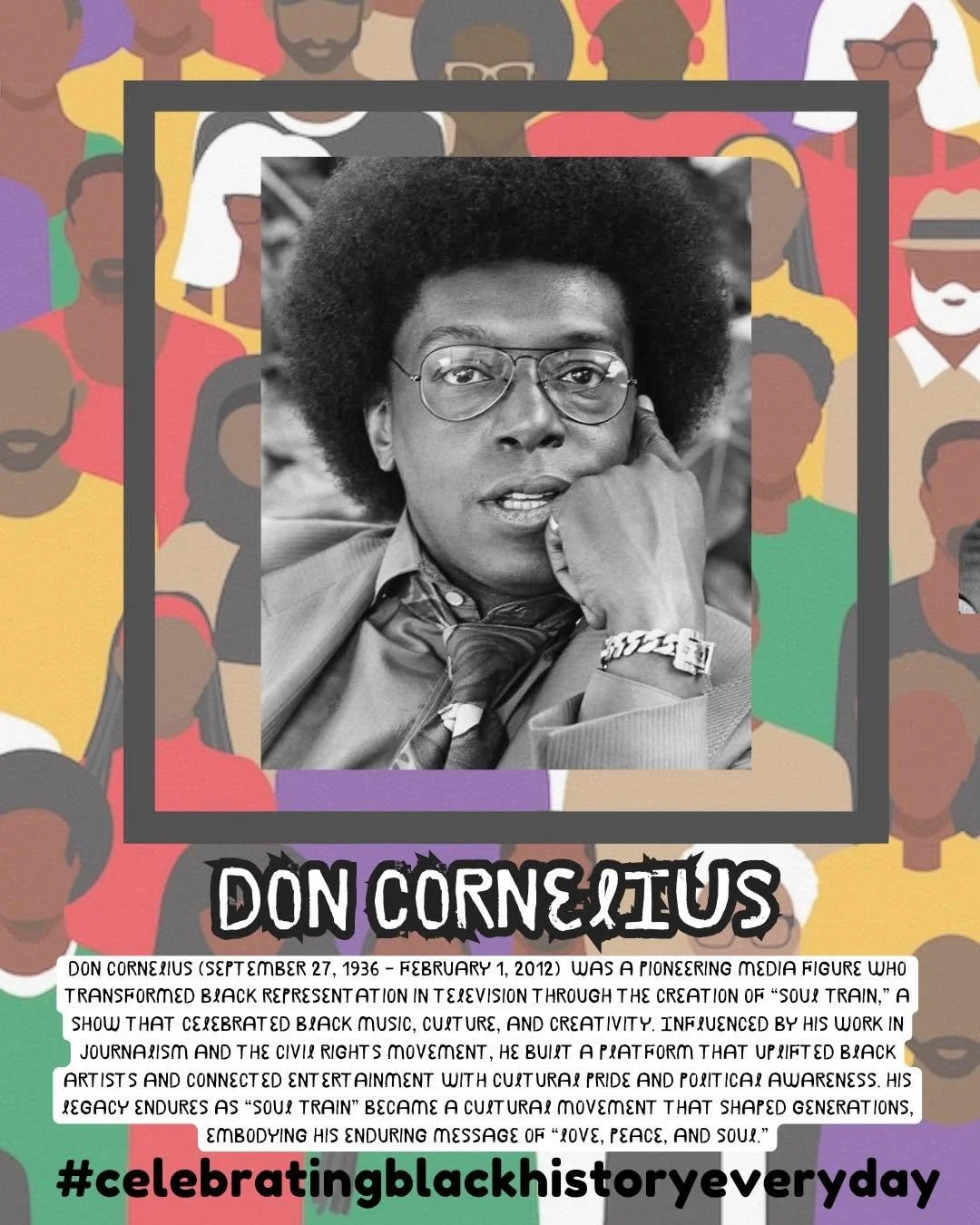
Don Cornelius became an iconic image of Black culture and history. Born in Chicago on September 27, 1936, he was the son of a postal service worker and homemaker. He graduated from DuSable High School in 1954 and joined the U.S. Marine Corps, serving for eighteen months in the Korean War. Upon returning to Chicago in 1956, Cornelius worked many different jobs, but he notably was a journalist and reporter for Chicago’s WCIU-TV, hosting A Black’s View of the News, covering sports and the Civil Rights Movement—once working closely with Dr. Martin Luther King Jr.
His active participation and work within the Civil Rights Movement was deeply influential for his television career. Frustrated with how racism infiltrated all components of society, as seen with the portrayal of Black people in television, Don Cornelius desired to create a show that celebrated and honored the Black community in a positive way. So, while working for WCIU-TV he took charge of a program that brought concerts and dance parties to local high schools, he called these tours of performances: The Soul Train. As this program became increasingly popular, he pitched it as a show to WCIU. WCIU was hesitant and because they thought the show would be a failure, they “gave” the show to Don, making him one of the first Black people to own a TV show.
Don Cornelius used his own funds to create the pilot for his show, Soul Train. Debuting on August 17, 1970, Cornelius hit gold and within one season the show went from being aired locally in Chicago to being aired across the United States. Though there were other shows that featured predominantly Black musicians and dancers, Soul Train saw great success due to Cornelius as its host. He connected entertainment, music, art, and political activism in a way that uplifted the Black community. Once hitting its peak in the 1970s and with the changing tides of what was in and what was out, Soul Train’s musical focus had to shift with the times. Cornelius highlighted Soul, Jazz, R&B, Funk, Disco, Hip Hop, and later on White guests also began to be featured on the show. For artists, it was the goal to be featured on Soul Train, and the show saw guests from all genres from Stevie Wonder and Whitney Houston to the Black Eyed Peas and the Backstreet Boys.
Within his career, Don Cornelius impacted two generations of Black Americans, creating a cultural platform that affirmed Black identity, creativity, and excellence at a time when mainstream media often failed to do so. Soul Train became more than just a television show, it was a movement that shaped music, dance, and culture while providing visibility and opportunity for Black artists across genres. May we continue to honor his legacy by moving forward with the spirit he championed: love, peace, and soul.
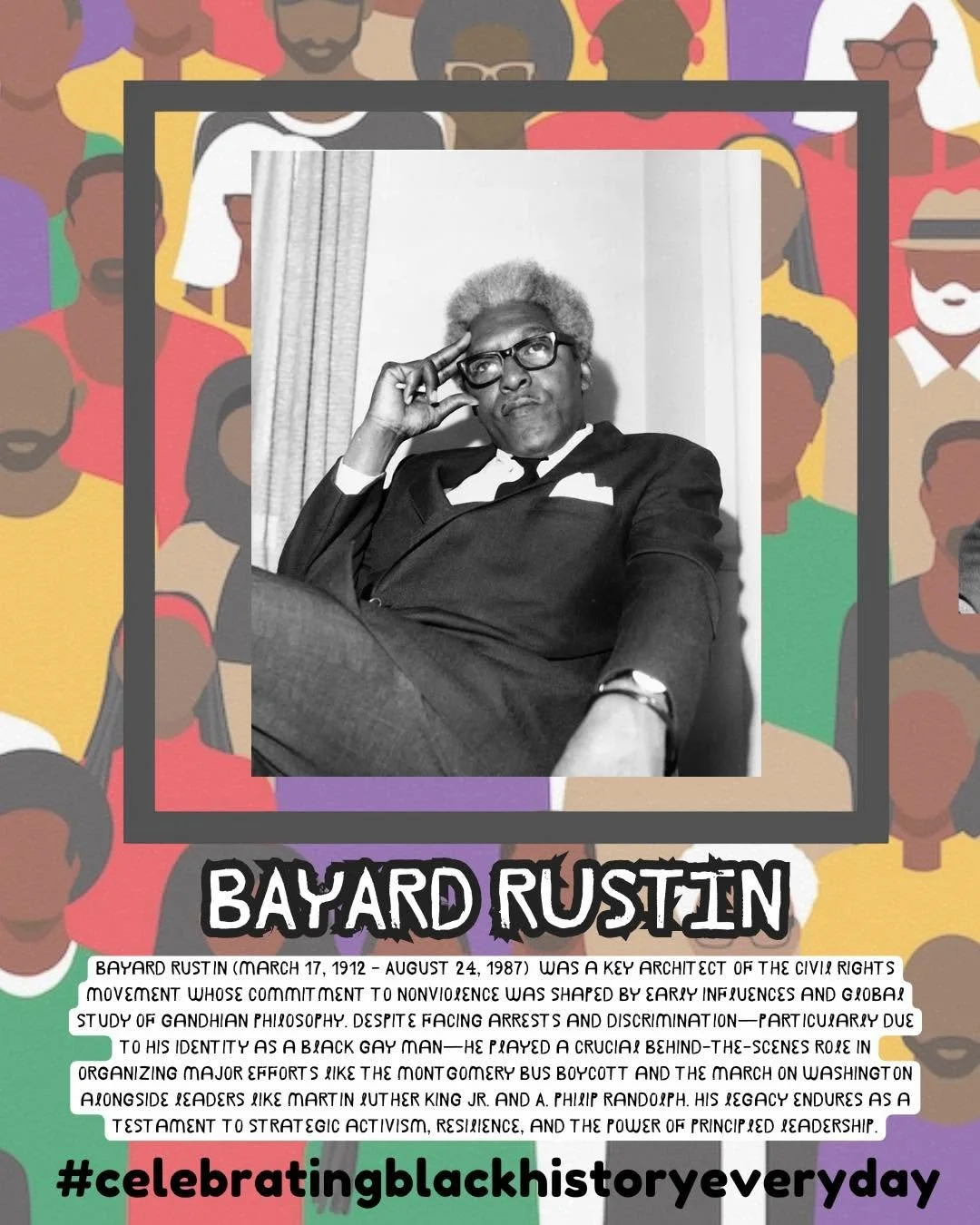
Bayard Rustin was a vital figure in the Civil Rights Movement. Born March 17, 1912, in West Chester, Pennsylvania, one of twelve children and raised by his grandparents. He had a Quaker upbringing and his grandmother was deeply involved in the NAACP which exposed him early on to figures such as W.E.B. Du Bois and Mary McLeod Bethune. These interactions laid the foundation for what would later become his practice of nonviolence in Civil Rights protests and organizing. Upon graduating from West Chester High School, Rustin studied across various universities including Wilberforce, University, Cheyney State Teachers College, and City College of New York.
While at City College of New York in the 1930s, Rustin found himself navigating different ideologies, leading him to joining the Young Communist League (YCL). He left the organization due to what he noted as a lack of focus on racial and civil rights issues heading into the 1940s. After this, Bayard was appointed as the youth organizer for the proposed 1941 March on Washington by A. Philip Randolp. In addition, he also participated in the Fellowship of Reconciliation, later serving as the Race Relations Director, and co-founded the Congress of Racial Equality (CORE). While taking on leadership in these organizations, Rustin emphasized and continued to build out a nonviolent framework through campaigns and workshops. This principle of nonviolence led to his first arrest in 1944 where he would serve two years in federal prison for his refusal to register for the draft as he strongly opposed the institutional war structure and the military’s racial segregation. While in prison, Rustin continued to organize and advocate for racial equality and equity, often breaking the boundaries of segregation within the prison system earning him the title of “Notorious Offender” per the Federal Bureau of Prisons.
Soon after his release, he found himself imprisoned once more alongside fellow CORE members as they carried out their Journey of Reconciliation effort, which would become the model for the Freedom Rides of 1961. Then a year later in 1948, Bayard traveled to India for seven weeks to further advance his nonviolent philosophy by studying Gandhian nonviolence. He also did work in Africa aiding the West African Independence Movements. Returning to the United States, Bayard immediately picked up on his work in the Civil Rights Movement. However, in 1953, he was arrested again, this time for a vagrancy violation– sentenced to sixty days in jail and ordered to register as a sex offender, a common punishment given to gay men for engaging consensually and freely within their sexual identity. This caused some turmoil in his career as a Civil Rights leader as he was forced to cancel speaking engagements, resign from the Fellowship of Reconciliation, other leaders distanced themselves from him, and he eventually had to resign from the Southern Christian Leadership Conference.
Despite his sexuality being labeled as a “liability” for the Movement, Rustin still saw great success. One of his largest accomplishments was becoming a key advisor to Martin Luther King Jr.. Bayard helped develop the Montgomery bus boycott, King’s own understanding of nonviolent ideas and tactics, the overall strategy of the Civil Rights Movement, and the SCLC. He also continued to work with A. Philip Randolph during this time and was appointed as the deputy director of the March on Washington for Jobs and Freedom. Then from 1965 to 1979, Rustin then served as president and then co-chair of the A. Philip Randolph Institute.
Bayard Rustin’s legacy is one of profound impact, strategic brilliance, and unwavering commitment to justice despite persistent marginalization. As a close advisor to Martin Luther King Jr. and collaborator with A. Philip Randolph, he helped shape the philosophy and execution of nonviolent protest that defined the Civil Rights Movement. Though often pushed to the background, Rustin’s contributions remain foundational, and his life stands as a testament to the power of resilience, intersectional identity, and principled activism.
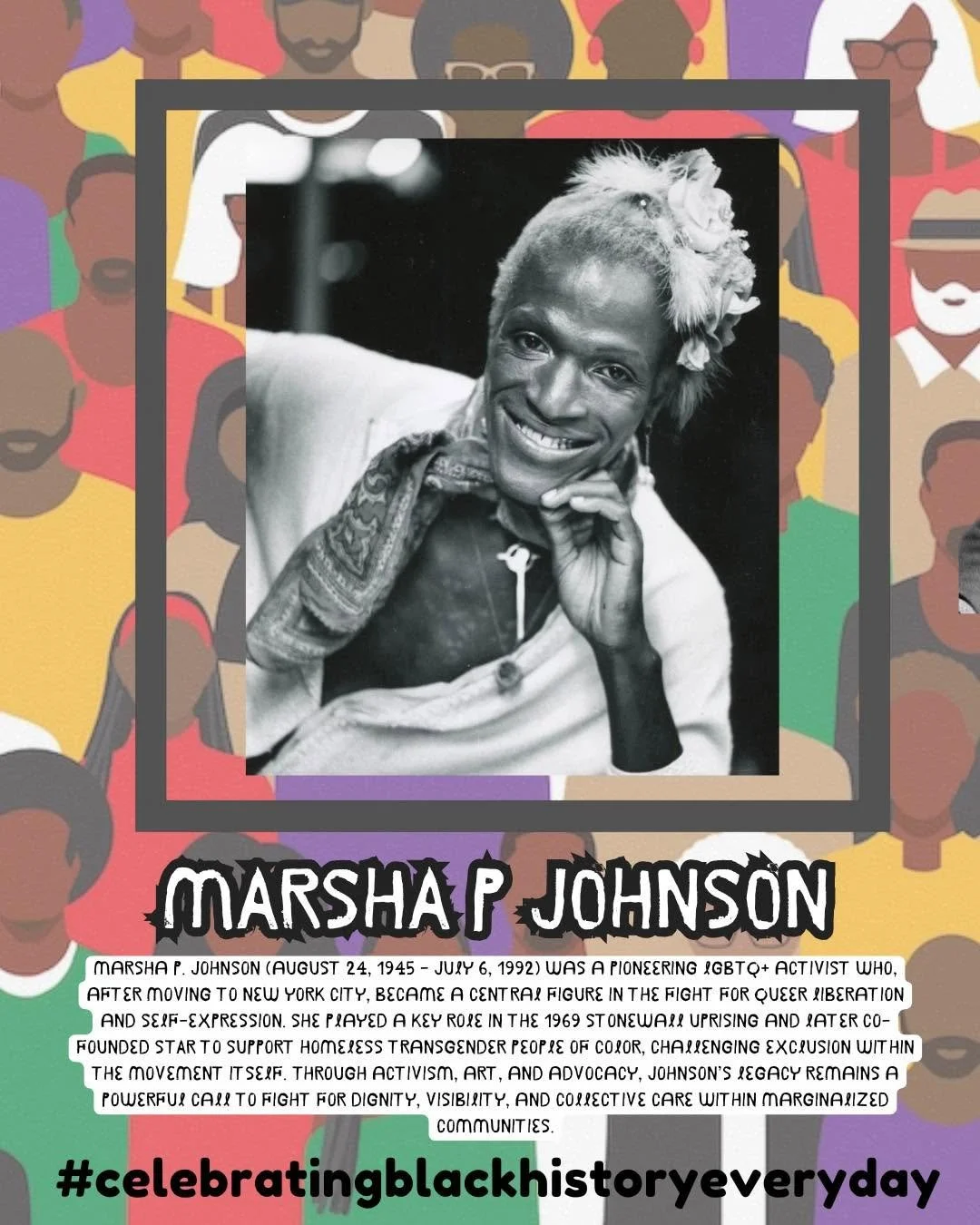
Marsha P Johnson lives on to be one of the most influential activists for LGBTQ+ rights. Born on August 24, 1945, in Elizabeth, New Jersey, she was the fifth of seven children, raised in the Episcopal Church, and began exploring gender expression at a young age, first experimenting with women’s clothing at age 5. After graduating high school, Johnson moved to New York City in Greenwich Village with one bag of clothes and less than twenty-dollars, determined to build a life that more closely aligned with her own vision for herself.
In 1966, Johnson legally changed her name from Malcolm Michaels to Marsha P. Johnson, the “P” standing for “Pay it no mind,” an intentional decision to deter people from asking her middle name when they began to question her about her gender orientation. Living in New York in the 1960s was not easy being an eccentric, queer woman that identified as gay, transgender, and a drag queen. Though regarded as a rather socially liberal state, New York forces still heavily targeted and persecuted the LGBTQ+ community. Johnson not only endured these realities, but would challenge them in a way that caused a shift in the nation.
Greenwich Village had various Gay bars and clubs which served as a place of safety and acceptance for the LGBTQ+ community. However, on June 28, 1969, police in the area raided a bar known as The Stonewall Inn which ensued a violent riot with Marsha P Johnson at its center. Robert Heide remembers her “as in the middle of the whole thing, screaming and yelling, and throwing rocks and almost like Molly Pitcher in the Revolution or something.” This moment, known as the Stonewall Riot, lit a fire under the Gay Rights Movement with the first Gay Pride Parade taking place within the next year in 1970. Following her act of resistance, Johnson was a part of the Gay Liberation Front (GLF) before becoming frustrated with their exclusion of transgender and LGBTQ+ people of color from the Movement. Thus, she would then found her own organization alongside longtime friend Sylvia Rivera: the Street Transvestite Action Revolutionaries (STAR). This organization worked to build a community among homeless or runaway transgender individuals.
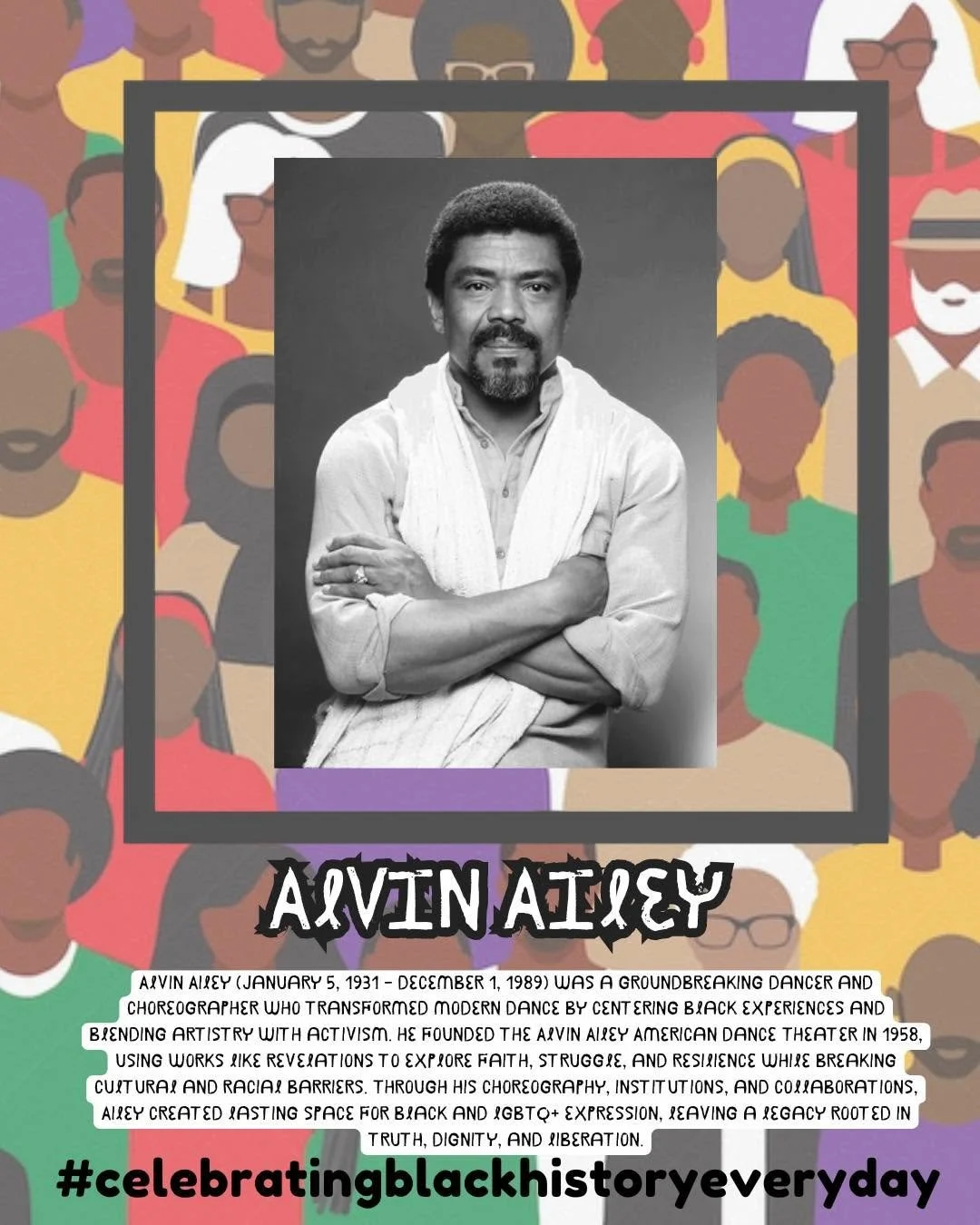
Alvin Ailey combined the movement of the body with activism to revolutionize modern dance. Born January 5, 1931, in Rogers, Texas, he grew up working in cotton fields and participating within the Baptist Church. As a teenager, after moving to Los Angeles, Ailey experienced his first concert dance. With encouragement from his friend and dancer Carmen de Lavallade, he then began to formally train for dance under renowned Lester Horton who was the founder of one of the first racially integrated dance companies in the country. After several years of performing with the Lester Horton Dancers, Ailey would evolve to become a choreographer and when Horton unexpectedly passed in 1953, Ailey assumed leadership as director of the company.
In 1958, Alvin Ailey established his own dance company known as the Alvin Ailey American Dance Theater (AAADT). His mission within the company was to further expand modern dance while also honoring, centering, and uplifting the stories and experiences of Black individuals in America. He used much of his background to inform his choreographed ballets such as the river baptisms performed by his local church during his childhood that heavily influenced his infamous production “Revelations” that explores tradition, grief, and the soul. This piece specifically transcended racial barriers, faith differences, and national borders. Furthermore, though not openly out to the public about his sexuality, especially in his early career, he also used dance to navigate heterosexuality by combining it with the expression of religious and hypermasculine archetypes.
Within his lifetime he would creatively collaborate with icons like Duke Ellington and Langston Hughes. He also opened other institutions and programs such as the Alvin Ailey American Dance Center, now the Alvin Ailey School, in 1969, the Alvin Ailey Repertory Ensemble, now Ailey II, in 1974, and the AileyCamp in 1989. His dance, choreography, philosophy, and community work was extremely transformative in the storytelling of the Black experience. Ailey is widely regarded as a Civil Rights trailblazer due to his use of dance to investigate the oppression of both the Black community and the LGBTQ+ community, separately and intersectionally. Overall, his work earned him Kennedy Honors in 1988 for his contributions to American culture and he posthumously received the Presidential Medal of Freedom in 2014 for his commitment to civil rights and dance.
Ailey’s story lives on in every performance and dancer who moves with intention and uses their body and voice as instruments of truth. Alvin did more than choreograph and perform dances, he carved out and secured space for truth, dignity, and liberation within the world of art and expression. His work ensures that Black stories are not only seen but deeply moving and felt.
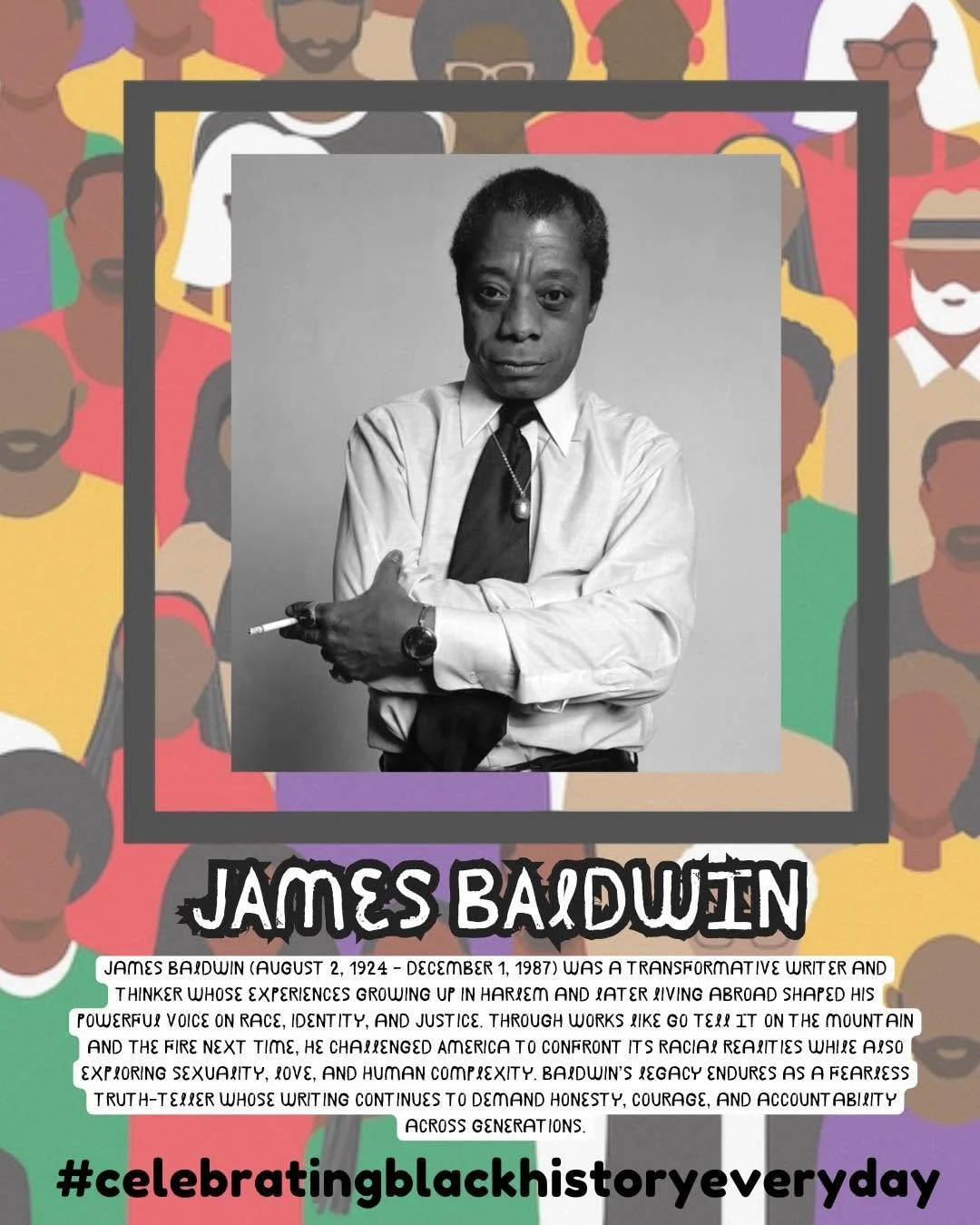
James Baldwin, a revolutionary, a speaker for the world. Born in Harlem, New York, on August 2, 1924, he was the oldest of nine. As the oldest, he took on the role of being his mother’s and siblings defender whilst being in a household that followed rigid and strict rules implemented by his father. Beginning at age fourteen, Baldwin, became a preacher at the Fireside Pentecostal Assembly, it was here that laid the ground of his rhetorical style as his preaching style was widely celebrated. During this time as well, Baldwin was navigating high school attending both Frederick Douglass Junior High School and Dewitt Clinton High School where he met one of his first mentors Countee Cullen and edited the school literary magazine “Magpie,” respectively at the schools.
By the time of his graduation in 1942, James Baldwin would soon witness the Harlem Race Riot a year later and lose his father. In these challenging times, he made the decision to not pursue a college degree and rather found a way to provide for his family. He worked various jobs while still freelance writing, hoping to become a writer. His works had caught the attention of well-known novelist Richard Wright, who would serve as a mentor and friend for Baldwin, even helping him obtain a fellowship to write his first novel. In 1948, Baldwin left for Paris due to the racism of his country and the homophobia he experienced, in an interview in 1984, he reflected: “My luck was running out. I was going to go to jail, I was going to kill somebody or be killed.” Paris gave him the freedom to pursue his craft and to unequivocally live in his identity. And after writing a few pieces for magazines, Baldwin published Go Tell It on the Mountain in 1953, a work that would be hailed as an American classic that described his life growing up in Harlem while also depicting the struggles of Black Americans in an unprecedented way at the time.
Over the next couple of years in the 1950s, he traveled across Europe and wrote Notes of a Native Son in 1955 and Giovanni’s Room in 1956. By the early 1960s he wrote Nobody Knows My Name (1961), Another Country (1962). All of these writings discussed racial tensions while also exploring “taboo themes,” such as homosexuality and interracial relationships. However, with the turmoil in the United States centering racial relations, he felt the need to return to the country and continue his work in the South. Baldwin produced The Fire Next Time in 1963, a bestseller and explosive discussion about Black identity and racial struggle. The Fire Next Time, Nobody Knows My Name, and the essays in the Notes of a Native Son were a primary and essential voice in the early Civil Rights Movement. After the assassinations of his friends Medgar Evers, Reverend Martin Luther King, Jr., and Malcolm X, James returned to the south of France where he worked on If Beale Street Could Talk (1974).
James Baldwin continued to build out his catalog throughout his life writing fiction, nonfiction, and poetry pieces– always teaching and creating. His legacy endures as one of the most profound literary and intellectual voices of the twentieth century. Baldwin’s work continues to resonate because it refuses simplicity: demanding honesty, courage, and accountability. Baldwin was not just a writer of his time; he was, and remains, a voice for the world, illuminating truths that society often seeks to ignore while calling each generation to do better.
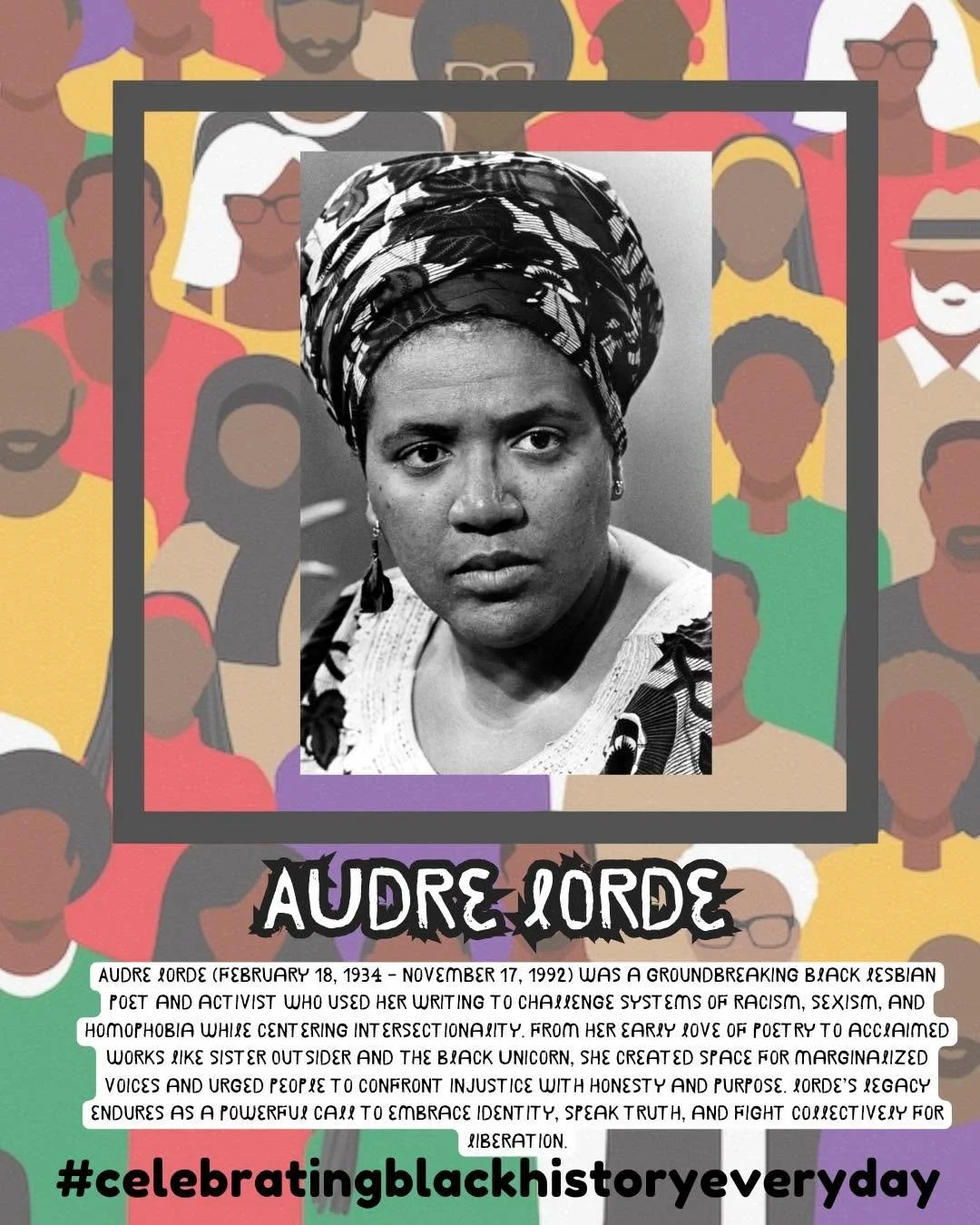
Audre Lorde is a self-described “Black, lesbian, mother, warrior, poet,” who used her writings to make vast strides in rights activism, literature, and academia. Born on February 18, 1934, to immigrant parents from Grenada, she grew up in Manhattan. In her youth, she was very connected to poetry, finding herself speaking in poems to express her feelings and discuss her experiences. Once she began writing them, one of her high school teachers rejected her poems for the school's literary magazine. This led her to submitting it to Seventeen Magazine, who then published the piece making it her first professional publication even as a teenager.
Lorde continued her education at the National University of Mexico in Cuernavaca for a year where she continued to more confidently build her voice as a poet and grow into her identity as a lesbian. She then finished her bachelor’s degree at Hunter College and her master’s degree in library science from Columbia University to which she served as a librarian in New York City public schools from 1961-1968. During this time, she was also incredibly active in the Civil Rights, Antiwar, and Women’s Liberation movements (she would continue this by being a speaker at the National March on Washington for Lesbian and Gay Rights in 1979 and found the Kitchen Table: Women of Color Press that promoted feminists of color and their writings).
In 1968, Audre published her first volume of poems, The First Cities, and earned a grant from the National Endowment for the Arts and became a writer-in-residence at Tougaloo College. From here she wrote prolifically through the 70s and 80s, producing Cables to Rage which more overtly discussed racism, sexism, violence, and her lesbianism, From a Land Where Other People Live, The Black Unicorn, Zami: A New Spelling of My Name, and Sister Outsider: Essays and Speeches which included “The Master’s Tools Will Never Dismantle the Master’s House.” Her literary works took on the responsibility of advocacy for various groups of people, empowering generations to investigate issues intersectionally and comprehensively.
Audre Lorde collected many awards in her career including the Bill White Head Memorial Award, the Walt Whitman Citation of Merit, the Before Columbus Foundation National Book Award, and various honorary doctorates. Her legacy endures as her words continue to challenge, affirm, and inspire those committed to justice, self-definition, and collective liberation.
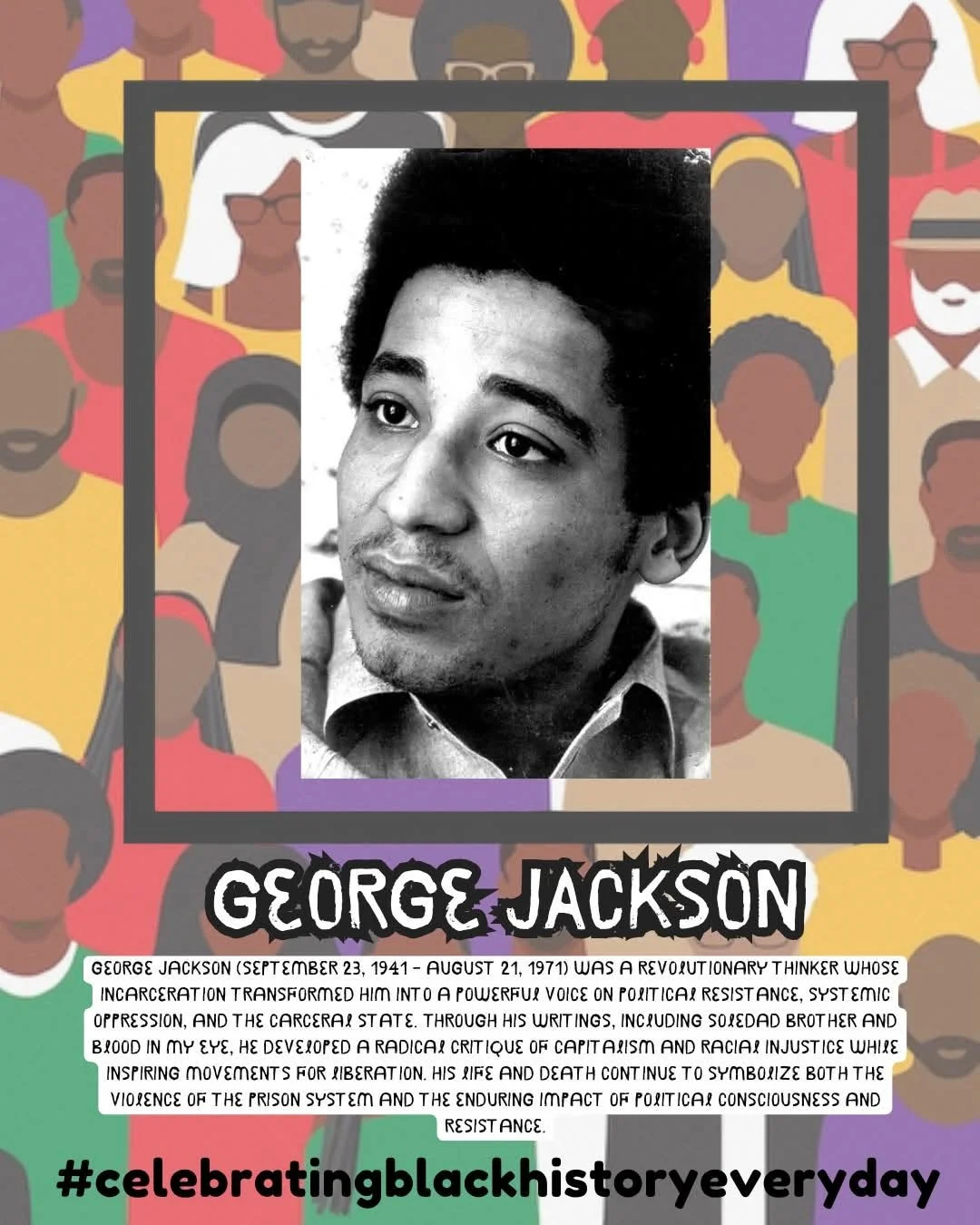
George Jackson was a revolutionary whose life and legacy continue to shape conversations about incarceration, resistance, and political consciousness. Born September 23, 1941, in Chicago, Illinois, he was the second of five children. After experiencing some violence in the public school system, his parents moved him to St. Malachy School, a Black Catholic school that he attended for several years. During the summers, Jackson found himself learning a variety of skills as he spent time in the rural areas of southern Illinois with his grandmother and aunt. Here, he began to learn how to use firearms and hunt animals and rely on self-sufficiency and independent work.
By 1956, Jackson’s family moved to Los Angeles, where he became a member of the street gang called the Capones. At fifteen, he was arrested for stealing a motorcycle, and after a series of other arrests, Jackson was placed in the California Youth Authority Facility. After this, at the age of eighteen, he was accused of stealing $71 from a gas station. Though evidence proved his innocence, Jackson was encouraged to take a plea deal, ending in him receiving an indeterminate sentence of one year-to-life in prison. So, at nineteen George Jackson entered Soledad Prison, which sparked his transformation.
In Soledad Prison, George became immersed in Marxist Literature, nationalist movements in Vietnam, and South American revolutionaries. He used the perspectives and concepts that he learned to frame his own ideology regarding politics, economics, history, philosophy, and more. K. Kim Holder of the Harlem Black Panther Party regarded Jackson as “the embodiment of what the Third World liberationists sought.” Jackson cited capitalism, White aggression, and neoliberalism as the means of oppression on both Black Americans and third-world peoples. He eventually called for an overthrow of the government led by Black militants. And despite being in solitary confinement for the majority of his time in prison, he made great friends and allies, such as W.L. Nolen that continued to teach him radical political theory and also cofounded the Black Guerilla Family with Jackson that existed as a political entity that focused on anti-racist class analysis and struggle. Jackson also wrote many, now infamous, pieces of literature such as Soledad Brother: The Prison Letters of George Jackson and Blood in My Eye.
On January 16, 1969, George Jackson was accused of murdering a White prison guard alongside two others: Fleeta Drumgo and John Cluchette. The three became known as the Soledad Brothers and though two secret hearings had proceeded to convict them, Cluchette was able to get a message to his mother stating he was in trouble. Once his mother got involved, the case received national attention as a state senator and the chosen lawyer revealed that the murder was only connected to the men due to them being identified as Black militants. This caused many to rally behind them including Jackson’s brother, Jonathan, who was killed in his effort to demand freedom for the Soledad Brothers.
Then, on August 21, 1971, two days before his trial and a little over a year since his brother’s passing, George Jackson was killed by a tower prison guard. There is much speculation of whether he was murdered due to his rising influence rather than him being murdered due to trying to escape– James Baldwin wrote “No Black person will ever believe that George Jackson died the way they tell us he did.” George Jackson’s life and legacy lives to reflect both the violence of the carceral system and the transformative power of political education. Through his writings and influence, he continues to inspire movements that challenge injustice, urging future generations to confront oppression and imagine new possibilities for liberation.
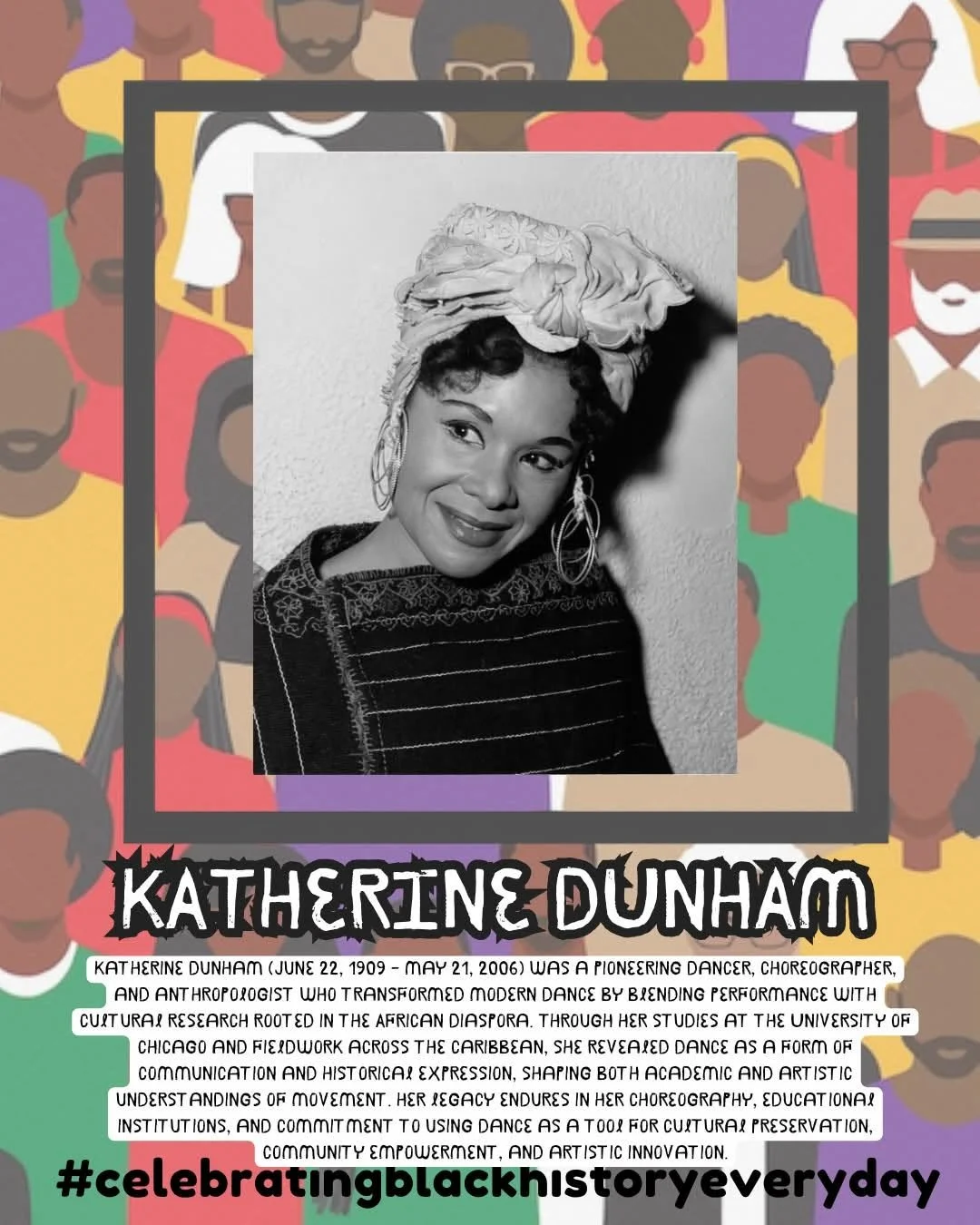
Katherine Dunham was a pioneer in dance and anthropology. Born on June 22,1909, in Glen Ellyn, Illinois, she was the daughter of a French-Canadian woman and African American man. Her mother passed when she was only four years old which led her to living a childhood that involved much movement. She grew up alongside her brother spending time and living with their father and various aunts and uncles. During this time, Dunham became inspired and interested in dance, she was particularly supported by her step-mother Annette who would sew her costumes, invested in ballet classes, and had her learn the piano. Through time and with her participation in the Terpsichorean Club, Katherine performed her skills and even organized a performance night where she organized singers, selected music, choreographed and performed dance
By the time of the Great Depression, Katherine was stepping into her own. She found employment at a library, opened a dance studio, and began attending the University of Chicago after completing some of her post-secondary education at Joliet Junior College. While at the University of Chicago she studied modern dance and ballet, which provided her a space to innovate dance. Alongside the ballet instructor, Mark Turbyfill, the two formed a Black dance group that debuted at the Beaux Arts Ball in 1931. Shortly after, Dunham and Ludmila Speranzeva, the modern dance teacher at the university, formed a company of seven women to perform at the Chicago World’s Fair.
With the physical demands of dance worsening for her, Katherine looked to anthropology and continued her studies at the University of Chicago, going on to finish her bachelor’s, master’s and doctoral degrees at the institution. Through anthropology she was able to connect her love for dance and culture more deeply. Dunham investigated the traditions and ways of dance in countries around the world including Trinidad, Martinique, Jamaica, and Haiti. She found that dance in African and African American diasporic cultures was a form of communication and that the experiences of these groups could be understood through movement. This was seen as a great contribution to the theories of modern dance and her first book Journey to Accompong is regarded as a “beautiful anthropological account.”
Katherine Dunham continued to perform and choreograph throughout her career such as creating L’Ag’Ya, aiding in Broadway’s Cabin in the Sky, and producing dances for films such as Mambo, Pardon My Sarong, and Green Mansions. She then brought her talents to Southern Illinois University in the 1960s. At SIU, she established the Performing Arts Training Center and directed the Katherine Dunham Center for Performing Arts. Dunham also touched the community by creating a program that attempted to channel the community’s youth away from violence into dance. For her work, she received many awards including the Professional Achievement Award, inducted into the Black Filmmakers Hall of Fame, the Albert Schweitzer Music Award, the Presidential Medal of the Arts, and the NAACP Lifetime Achievement Award.
We remember her today as a visionary who transformed dance into a language of culture, resistance, and storytelling, bridging art and anthropology to honor the depth and beauty of the African diaspora.
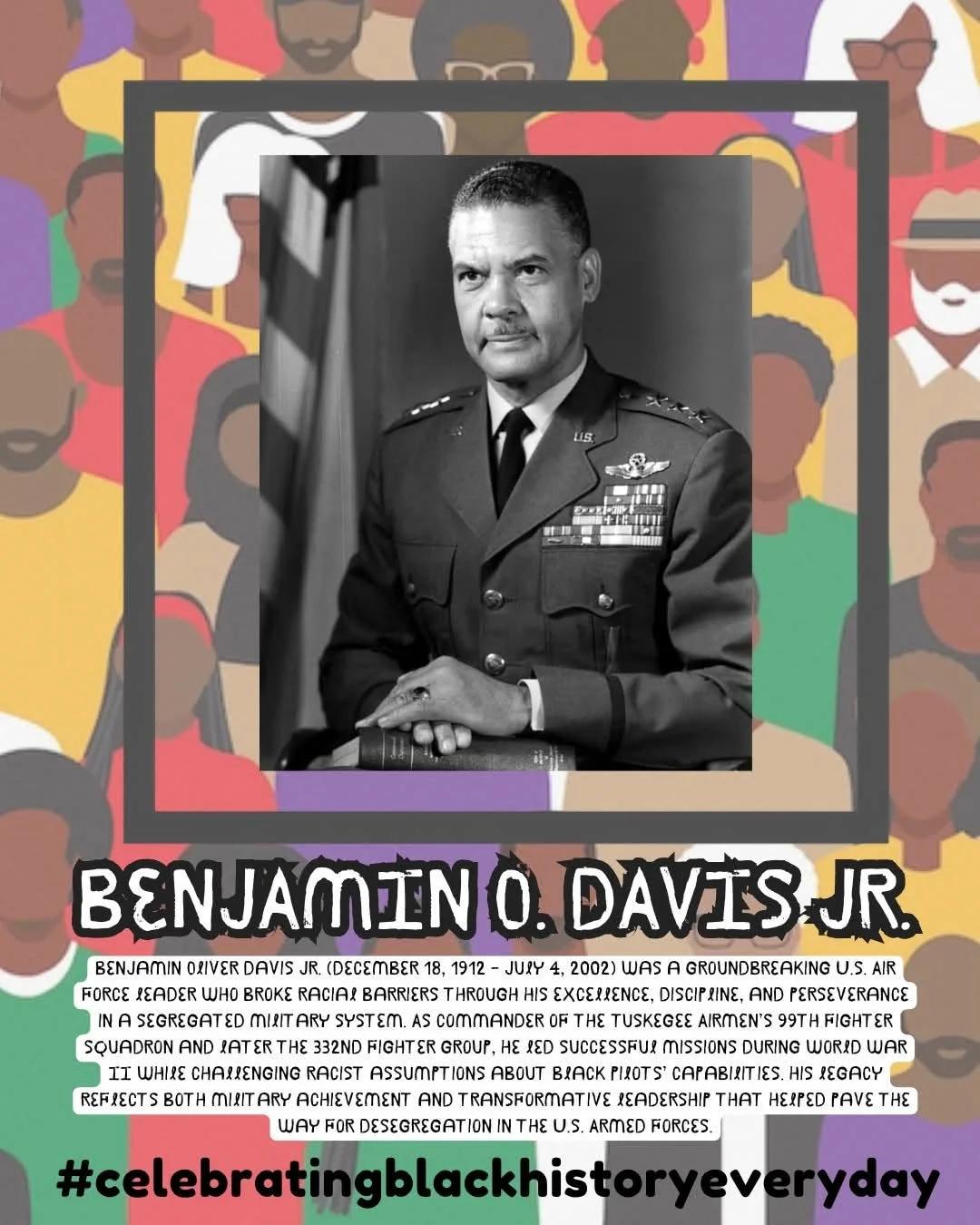
Benjamin Oliver Davis Jr. broke new ground, redefining what leadership and excellence looked like in the face of segregation. Born December 18, 1912, in Washington, D.C., Davis Jr. grew up in a military family. At the time his father was one of only two Black officers in the Army and was stationed at various places around the world such as the Philippines, the Tuskegee Institute in Alabama, and Ohio. Experiencing this movement, Benjamin was exposed to harsh realities of racism both in the military and in society. Thus, once he graduated high school he was determined to play a part in fighting segregation.
With the hopes of becoming a pilot, Davis Jr. attended college at Western Reserve University and the University of Chicago before receiving a recommendation to attend West Point from Representative Oscar S. De Priest, the only Black congressman at the time. He entered West Point in 1932 and was met with the active racist attitude at the academy– being isolated from his White classmates during meals, activities, and even plain conversation. Despite this, he persevered and graduated in 1936 within the top twenty percent of his class, becoming the fourth Black graduate from the academy.
After graduation, his dreams of becoming a pilot were delayed as there were no all-Black aviation units. Thus, he was sent to Georgia to serve and lead a company of the Buffalo Soldiers which were the four all-Black regiments in the Army. In June 1938, Davis Jr., was sent to Tuskegee Institute as a professor of military science and tactics, a position his father once held. Then in three years he was transferred to Fort Riley as his father’s aide in the 4th Cavalry Brigade. It was here that his father received a letter from the Chief of the Air Corps requesting that his son report to the Tuskegee Army Airfield to begin pilot training. Davis Sr., quickly approved this request, and Davis. Jr. alongside twelve other aviation cadets, made the first class of Black pilots that would be known as the Tuskegee Airmen.
By August 1942, Davis Jr. was made the commander of the 99th Fighter Squadron at Tuskegee Army Airfield. He and his men were then deployed in April 1943, to operate out of Tunisia where they successfully performed Operation Corkscrew that targeted enemy positions on the island of Pantelleria. The Squadron would be questioned in Washington within the walls of the Pentagon to which Davis Jr. fiercely defended them against accusations of incompetence and calls for its dissolution– he won his defense and protected the Squadron. From here Davis Jr. commanded the 332nd Fighter Group, the 477th Composite Group, and by the end was promoted to four-star general by President Bill Clinton.
Benjamin O. Davis Jr. is remembered as a trailblazer who not only soared through the skies but also broke barriers on the ground. His courage, discipline, and unwavering commitment to equality helped transform the U.S. Armed Forces and opened doors for generations to come, proving that excellence can challenge even the most deeply rooted systems of discrimination.
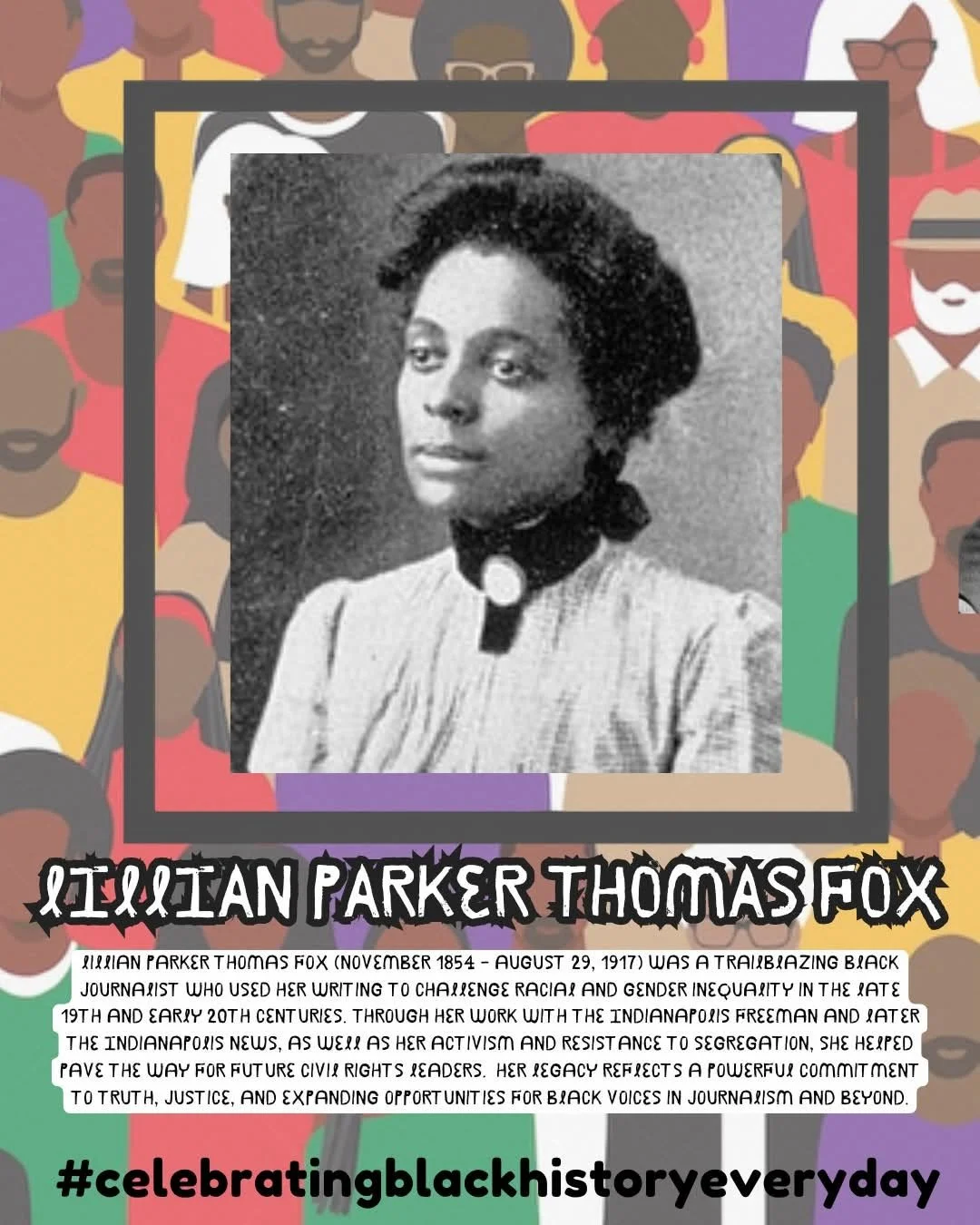
Lillian Parker Thomas Fox was a pioneer in the field of journalism. Born in November 1854 in Chicago, she grew up in OshKosh, Wisconsin. As a child, she was known to be dedicated to her pursuit of knowledge– being an avid reader and writer. It was in her third year of high school that her studies were disrupted due to her being engaged and then married. Despite this, Fox continued to intellectually challenge herself, those around her, and the country. She went on to write for Wisconsin’s Black press where she wrote about America’s hypocrisy stating that “You pity England with her Lords and Commons; Russia with its Czar and subjects, and yet practically acknowledge that you have a people among you of American birth whom you consider by God created for your servants, your inferiors by nature rather than by condition.”
In the early 1880s, Fox moved to Indianapolis. Here, she began working for the Indianapolis Freeman, a nationally known Black newspaper, as a reporter and correspondence editor. She served as the only woman journalist at the paper and her writings often highlighted and advocated for both racial and gender equality. Her activism also reached beyond printed word as she founded several women’s groups in Indiana and was a part of various speaking tours as she shared her ideas amongst women and religious organizations across the South and Midwest. Lilian, in 1895, even found herself suing a railroad company as she refused to move to the “colored” section of the train while traveling to one of her speaking events. The results of the case continue to remain unknown, but she aided in setting the stage for others like Claudette Colve and Rosa Parks.
After a brief pause from writing, retiring from the Freeman, Lillian returned to journalism and in 1900 she was hired by Indianapolis News. This opportunity made her the first Black journalist to work for the White newspaper. And though her works were rarely published, she saw great support from the Black journalist community, many citing her in their own works as they began to write about similar topics. In addition, she also used this platform and her contacts within the White community to continue to fuel and advance the movement, the power of the community, and the social, political, and economic plans created by Black organizations.
Lillian Parker Thomas Fox’s legacy is one of courage, conviction, and unwavering commitment to truth. She carved out space in a field that sought to exclude her, using journalism as both a tool of resistance and a platform for advocacy. Through her words and actions, she challenged systems of oppression and inspired generations of Black journalists, activists, and women to demand more from a nation that often denied them equity.
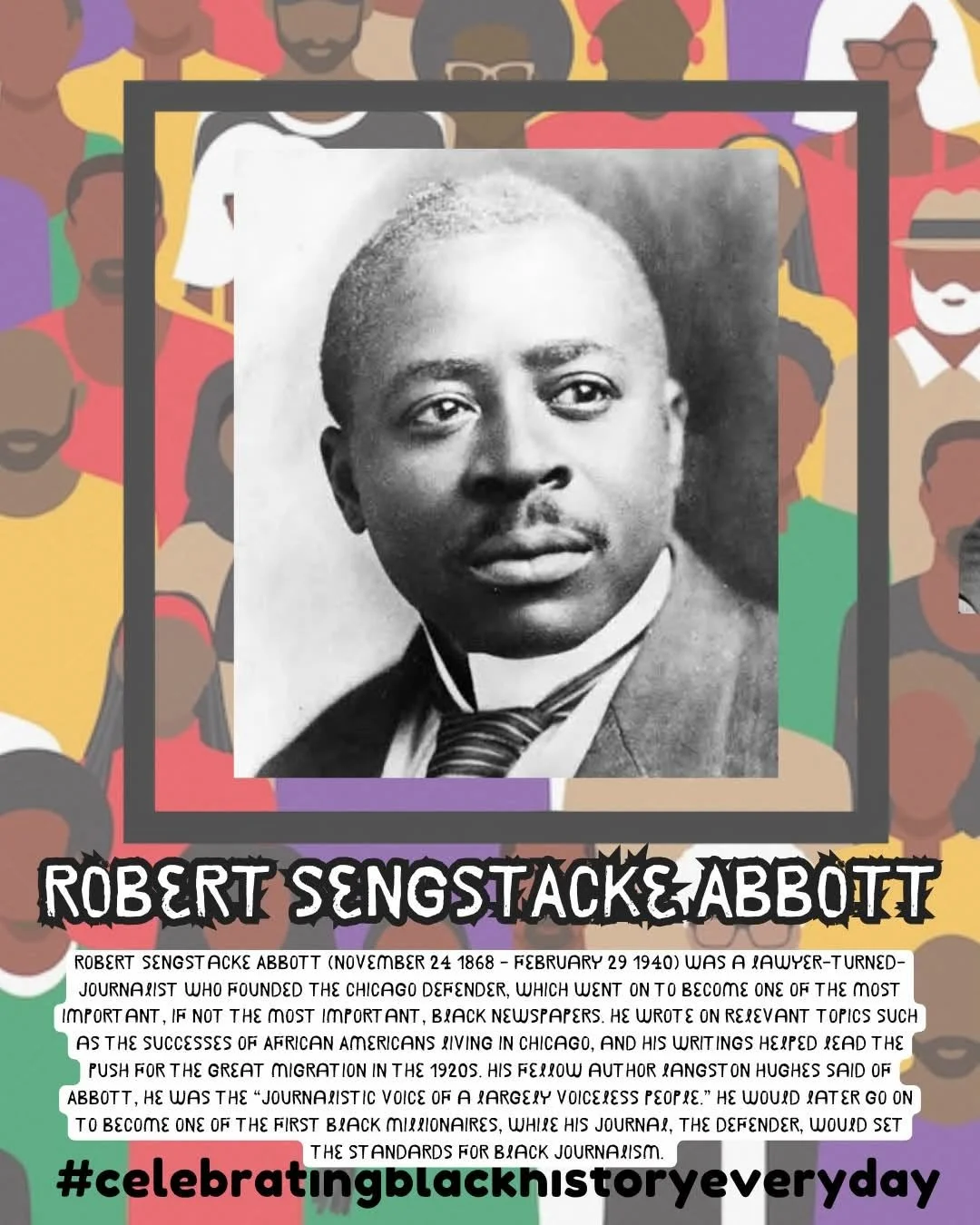
Robert Sengstacke Abbott, through creating a great resource of accessibility, became a major influence in Black history. Born on November 24, 1868, on St.Simons Island off the Georgia coast, he was the son of formerly enslaved individuals. His father passed away when he was an infant which led to a legal battle between his mother and his father’s planter’s household over the custody of him. With help from John H. Sengstacke, Flora was successfully represented in court, the two then married in 1874. It was the work of Sengstacke as a Congregationalist minister-teacher that had a passion for learning and equality that aided in shaping Robert.
Abbott went on to attend Savannah’s Beach Institute and Claflin University before attending Hampton Institute to study printing. Once he completed his studies in Hampton in 1896, he left for Chicago to earn his law degree from Kent College of Law. Becoming a Black lawyer in the early 1900s, was not an easy task, though he completed his degree and was qualified to perform the work, Robert had difficulty finding employment due to his race. This difficulty led Abbott to turn to journalism and in 1905 he founded the Chicago Defender. The Chicago Defender, a weekly newspaper, became one of the nation’s most important Black newspapers reaching more than 200,000 people by the early 1920s, readership tripled, and two-thirds of the sales went beyond Chicago.
Robert as founder, editor, and publisher for his newspaper used this platform to accomplish all he could within his advocacy work. The paper included items such as celebratory reporting on the achievements of Bronzeville (the nickname for Black Chicago), racial news from the South, militant editorials for racial equality, Abbott coined his antilynching slogan in the print stating that “If you must die, take at least one with you,” and he refused to use “negro” and “colored” and instead used the phrase “the Race.” Furthermore, his publications in the Chicago Defender were deeply influential in the Great Migration following World War I as the paper connected southern Blacks with one another and northern Black communities– there were even efforts to keep the newspaper out of the South and inaccessible to Black southerners due to this push for migration. The success of the newspaper led to Abbott being named on the Chicago Commission on Race Relations which authored an instrumental report on Black living conditions in urban areas, he became one of the earliest Black millionaires, and the Defender continued to advance the development of Black culture as those such as Langston Hughes became loyal contributors to the newspaper.
Robert Sengstacke Abbott’s legacy was best captured by Langston Hughes as he cited the paper as “the journalistic voice of a largely voiceless people.” Through his vision and determination, Abbott transformed journalism into a force for social change, using the press not just to inform, but to mobilize, uplift, and protect Black communities across the nation. His work redefined the role of media in advocacy, demonstrating that storytelling could be both a mirror of injustice and a catalyst for change. Beyond his lifetime, the Defender set the standard for Black journalism, inspiring future generations to use their voices boldly and unapologetically. Abbott’s legacy endures as one rooted in empowerment, resistance, and an unyielding commitment to truth and progress.