
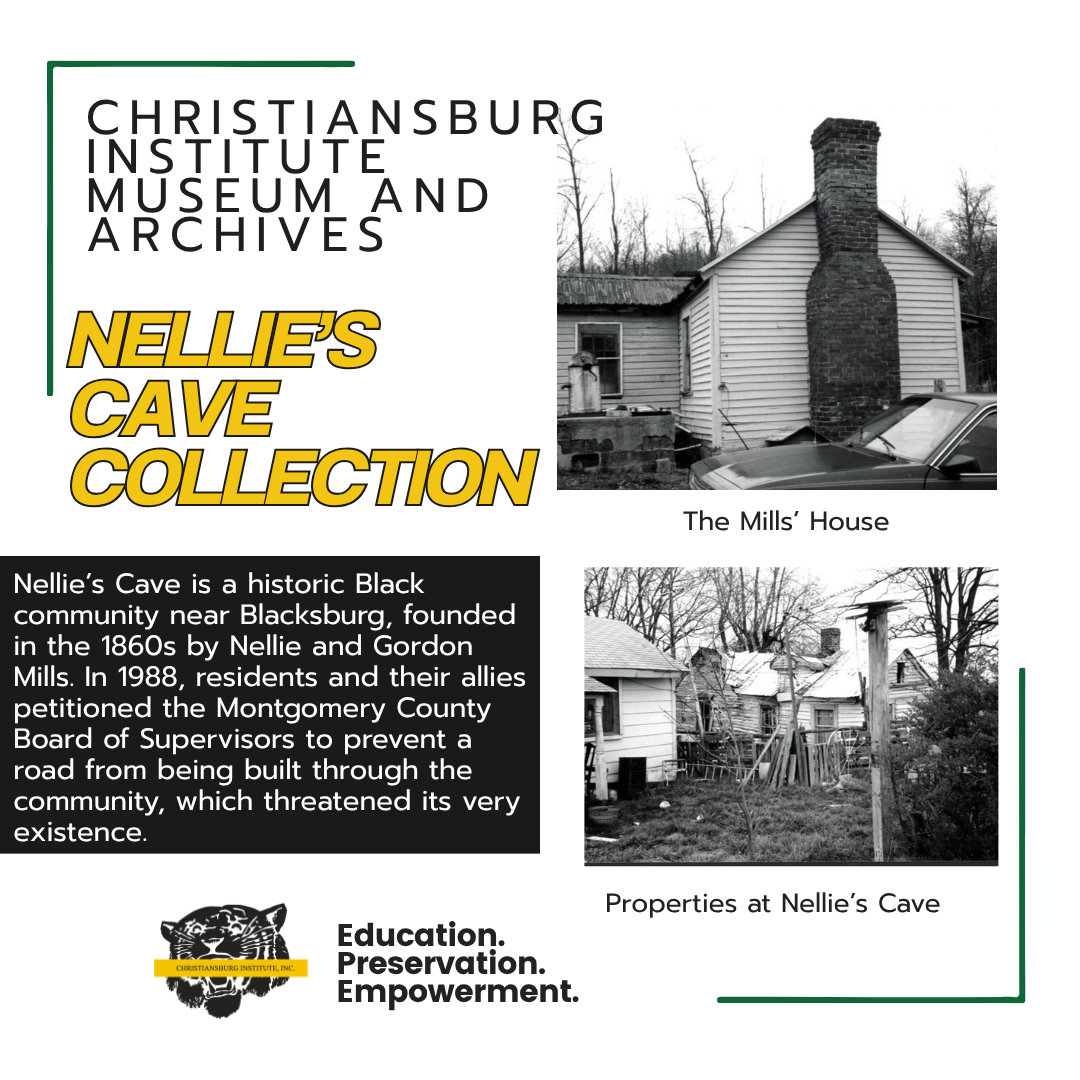
Nellie’s Cave, which lies just outside of Blacksburg’s corporate limits toward Ellett Valley, was settled by Nellie and Gordon Mills directly after Emancipation. Nellie Mills had been enslaved on the Hoge plantation and was given the land from the Hoge estate upon her emancipation. The Nellie’s Cave area had grown to be a sizable African American community by the early 1900s, and at one point it had its own schoolhouse and dance hall. Descendants of Nellie and Gordon Mills continue to inhabit the area today.
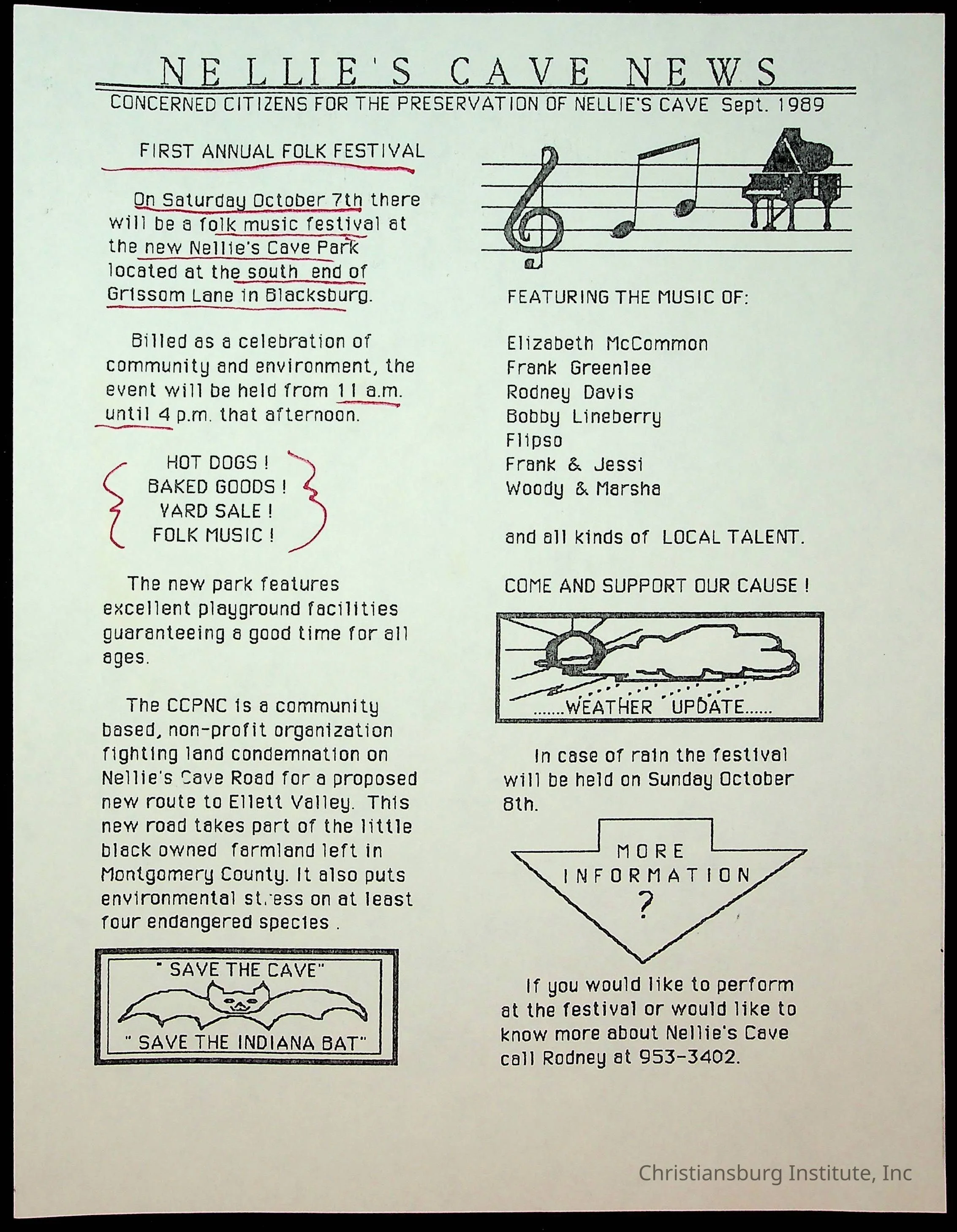
In more recent times, the Nellie’s Cave community was the site of a serious political controversy. In 1988, the Montgomery County Board of Supervisors approved a plan brought forward by a property development company to build a large road through the residents’ properties. The local Black community fought back. They created “The Concerned Citizens for the Preservation of Nellie’s Cave Community” (CCNCC), which raised money to file a lawsuit against the members of the Board of Supervisors, accusing them of racial discrimination and improper process in approving the development.
To raise money, they held a Folk Festival at Nellie’s Cave Park with food, music, and art by local African Americans. On other occasions, poet and Virginia Tech professor emeritus Nikki Giovanni held a poetry benefit night, and Michael Cook, a Virginia Tech professor of history, held public lectures about the value of preserving local Black history and the injustices committed by the Board of Supervisors. Members of the Mills family of Nellie’s Cave, some of whom were graduates of the Christiansburg Industrial Institute, were instrumental in organizing the group.
The activists involved in the fight intertwined their understandings of racial injustice with environmental degradation. They argued that the construction would threaten endangered species and that the porous rocks underlying the properties would lead any development to contaminate the groundwater, on which the African American residents in the community depended. The activists were skilled in media relations and managed to get the story published by newspapers around the state.
Unfortunately, the group was unsuccessful in their attempts to curtail the development of the road, as well as in their lawsuit. However, they succeeded not only in illuminating the deep-rooted history of the Nellie’s Cave community but also in documenting and exposing the racial injustice at the core of local institutions.
For more information about the history of Nellie’s Cave and The Concerned Citizens for the Preservation of Nellie’s Cave Community, check out the Nellie’s Cave Collection in the Christiansburg Institute Digital Archives (CIDA)