Learning Resources: Digging in the Archives
History as seen through materials in the Christiansburg Institute Museum and Archives (CIMA) and the Christiansburg Institute Digital Archives (CIDA). #DiggingintheArchives
Curated by Sasha Halfon-DeLay
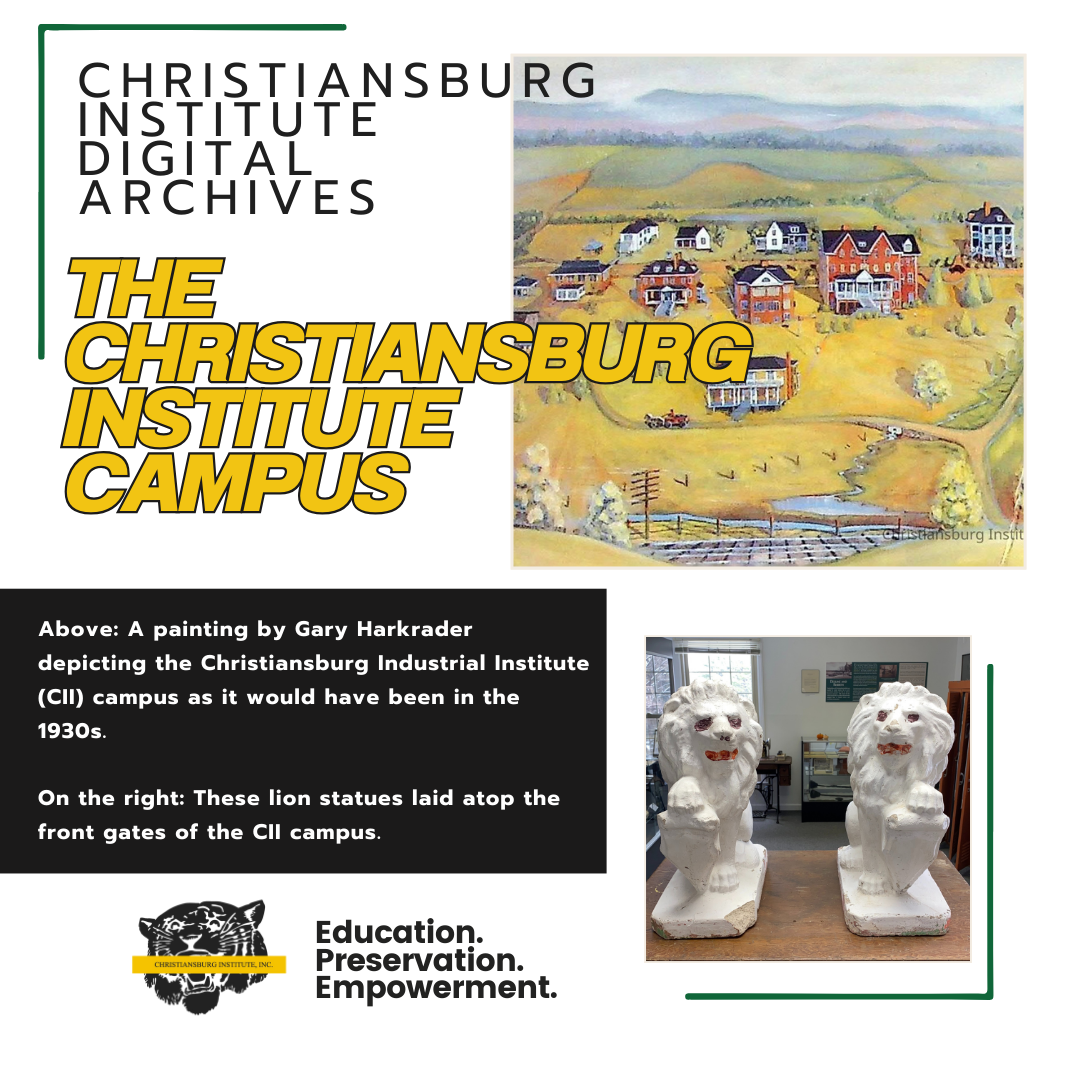
What could be a better way to introduce the story of the Christiansburg Industrial Institute (CII) than with the stone lions that once stood at the entrance gate to the school, welcoming students as they arrived on campus?
CI operated for 100 years, from 1866-1966. It was founded through collaboration between locals and an agent of the Freedmen’s Bureau, who had been tasked with reconstructing the south after the Civil War. The school’s main goal was to educate formerly enslaved African Americans, of whom many were denied access to the ability to read or write.
By the turn of the century, and after persevering through many hardships, the school had grown to be the largest secondary school for Black children in the region. Its campus occupied nearly 200 acres of land and consisted of dormitory buildings, classroom buildings, workshops, barns, and even at one point a state-of-the-art hospital. It was much larger than any high school in the area today. The Christiansburg Industrial Institute stood as a bastion for African American education, solidarity, and empowerment in the region. These steadfast lions symbolize that legacy. For a student to cross the border into the CII campus was for them to become a part of a fierce struggle towards creating a better future for themselves and their community.
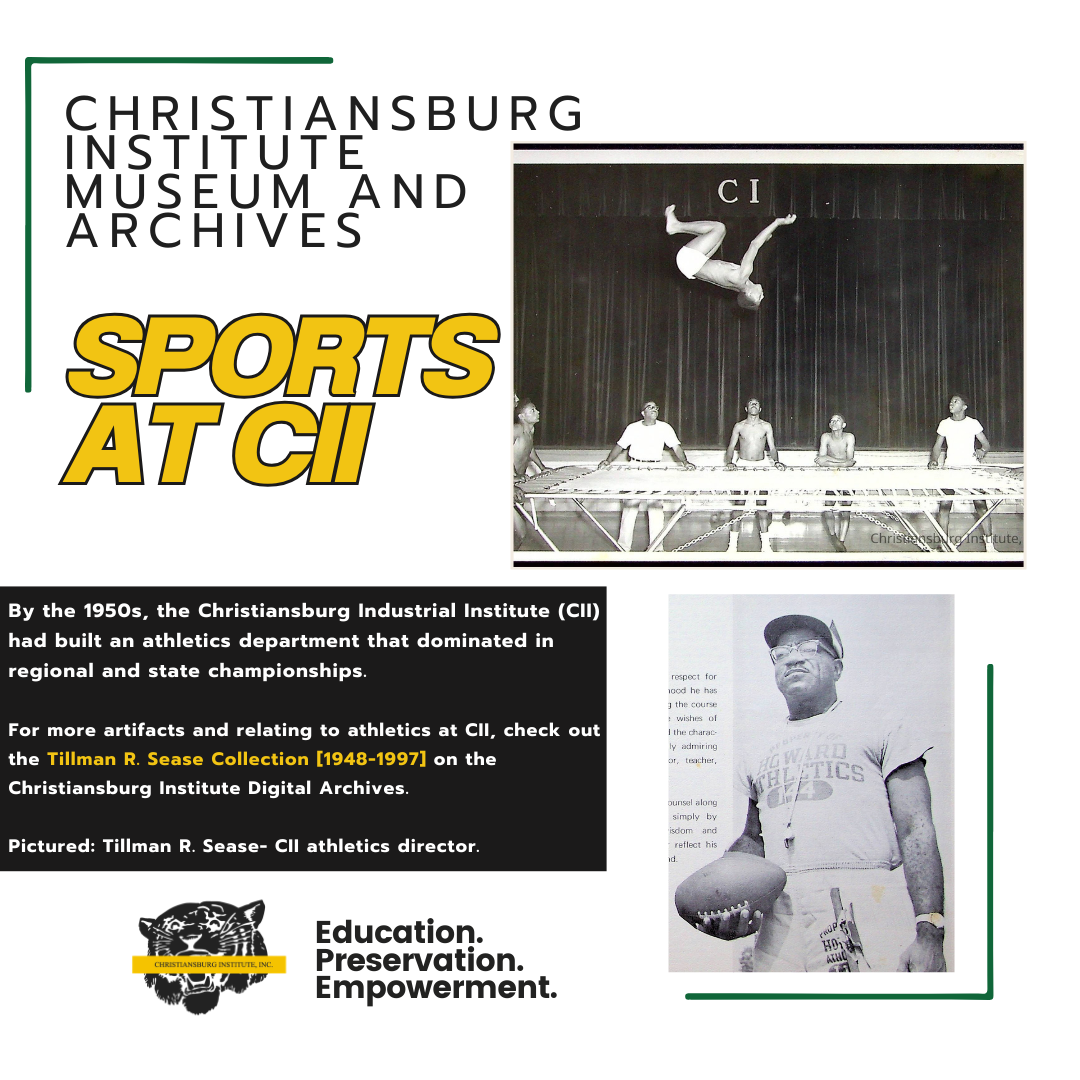
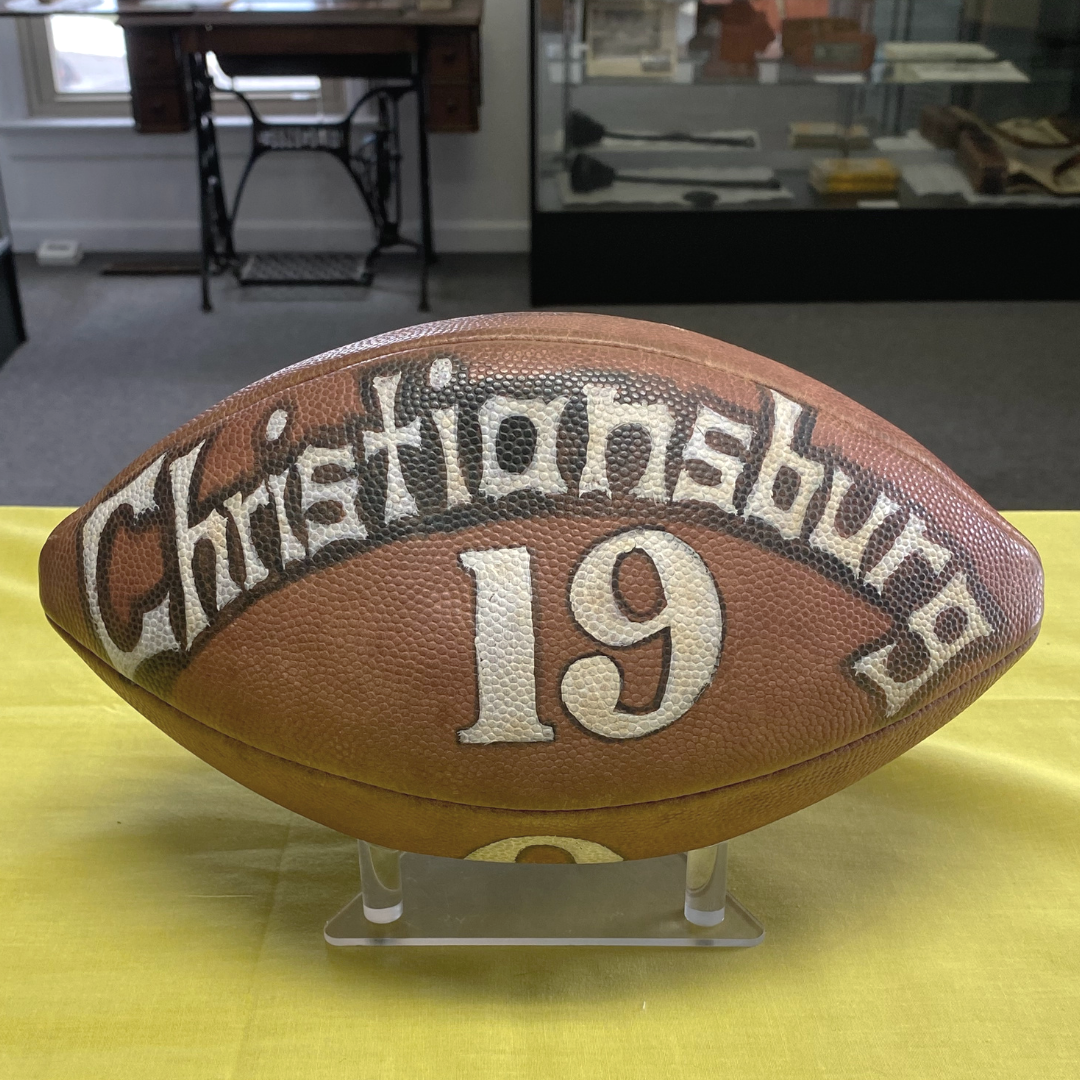
By the 1950s, The Christiansburg Industrial Institute (CII) had built a competitive athletics program. Male students who maintained good academic standing could choose to compete in football, baseball, or basketball. Female students could join the majorettes team.
CII athletics truly took off in 1948, when recent Bluefield State College graduate Tillman R. Sease was appointed its Athletic Director. Under his leadership, CII joined the Virginia Interscholastic Athletic League (VIAL), enabling the school to compete against other African American secondary schools across the state. And compete they did- In 1954, the CII Tigers won the Western District Interscholastic Athletic Baseball Championship . With Sease’s training and leadership, three CII students went on to play baseball professionally. That same year, the football team dominated their season, winning nine games with zero losses . In 1956, the basketball team also claimed its championship title .
CII’s athletics program not only brought home trophies but also fostered discipline, teamwork, and opportunity for its students, leaving behind a legacy of excellence that is still remembered today.
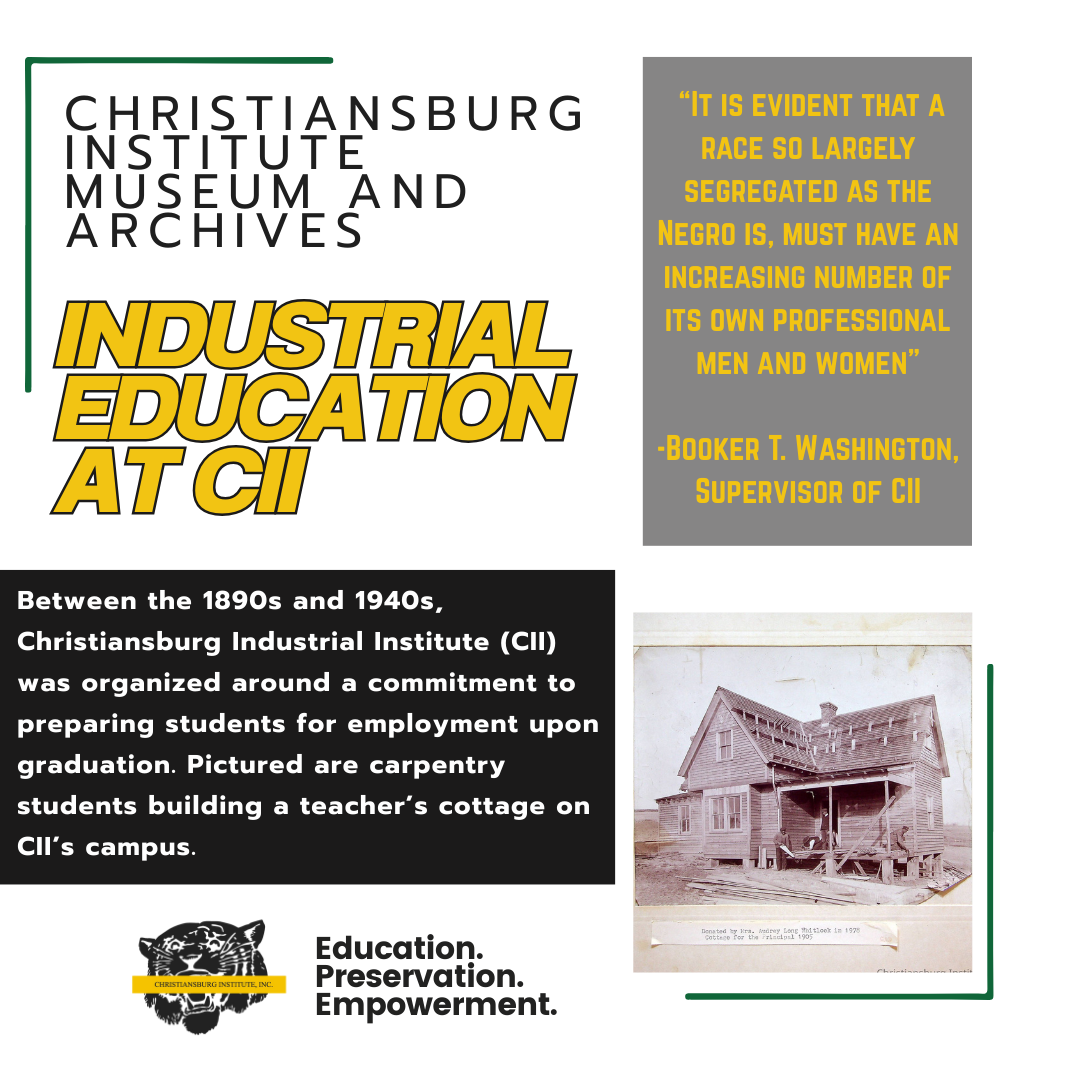
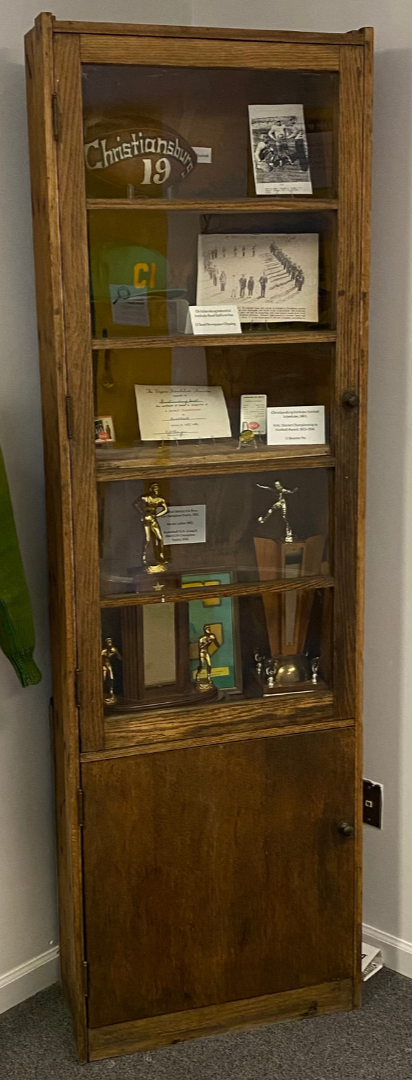
The Christiansburg Industrial Institute’s (CII) curriculum was based around vocational education.One physical example of the curriculum is this display case in our museum which was built by carpentry students at CII. It stood within the halls of the school, likely displaying sports trophies and awards.
One of the many great successes of the carpentry department at CII came in 1908, when carpentry students worked to install a state-of-the-art plumbing system on campus entirely by themselves. This project consisted of building and installing a 10,000 gallon tank, a steam pump, a boiler, the housing required to store them, and all of the necessary piping. Notably, this pumped and piped water system was more advanced than the system in the town of Christiansburg, which still relied on manually operated well pumps for water.
The Christiansburg Institute was founded primarily as a literary and religious school, but by the 1880s, with Booker T. Washington of the Tuskegee Institute appointed as supervisor of the school, emphasis shifted toward vocational education that trained students in skills to be self-sufficient and employable upon graduation. To reflect this change, the name was changed to the Christiansburg Industrial Institute. Carpentry remained one of the cornerstones of industrial education at CII until the school’s closing.
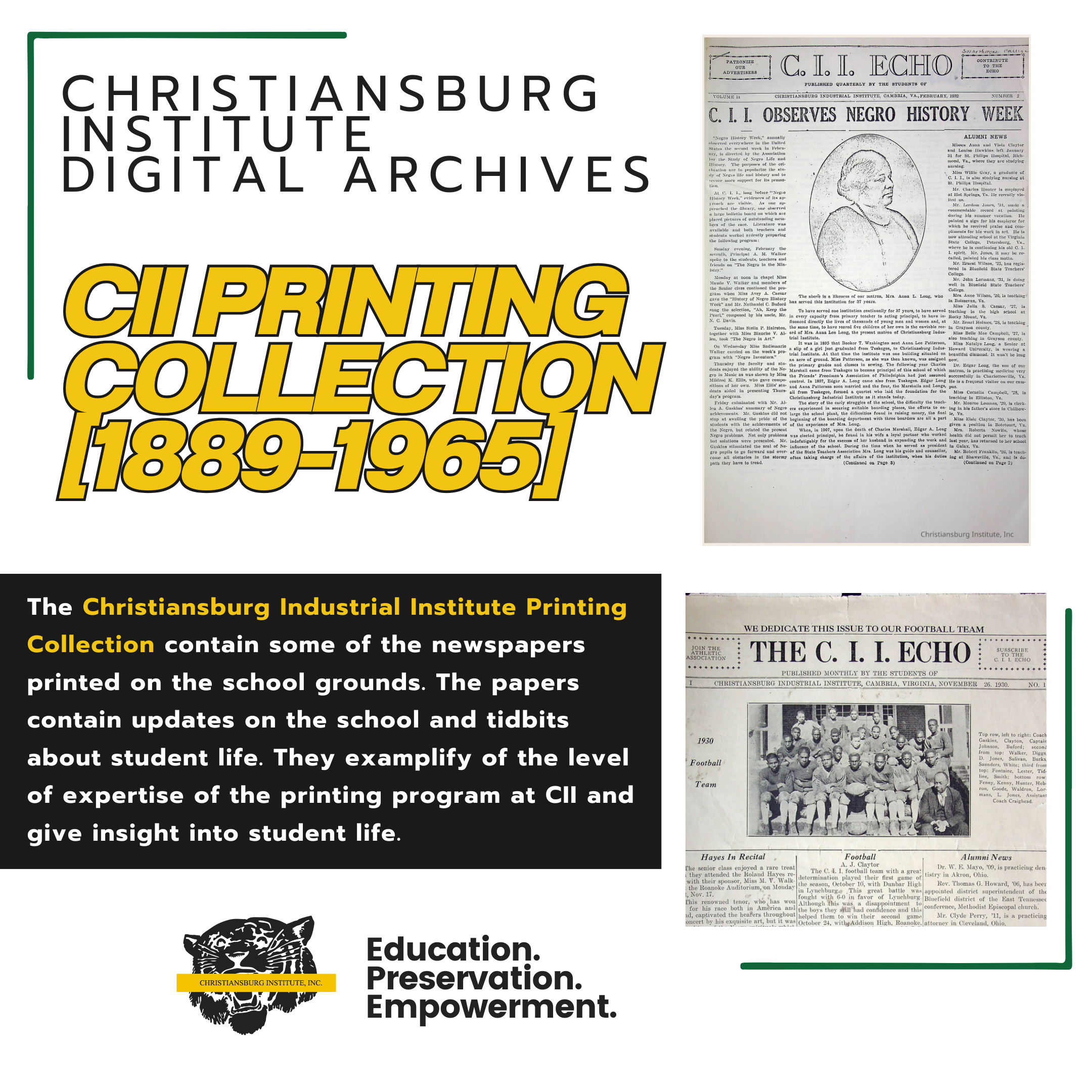
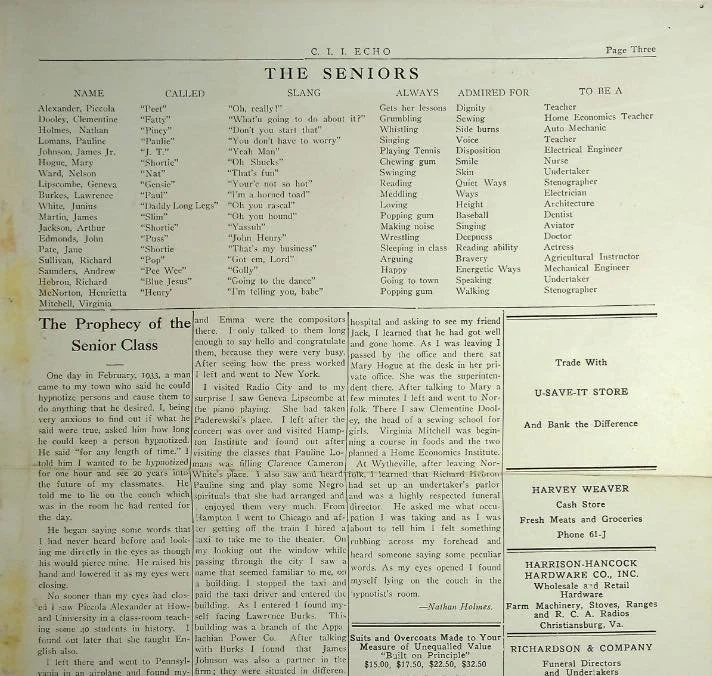
Pictured here is a snippet of the Christiansburg Industrial Institute (CII) student newspaper, The C.I.I. Echo, from 1933.
The newspaper’s breadth, depth, and professional formatting are highly impressive for students in their mid-teens and stand as a testament to the rigor of classes and extracurricular life at CII.
Publications printed at the Christiansburg Industrial Institute are a vital source of information for Christiansburg Institute, Inc. today as we conduct historical research about the school.
Within these pages are snapshots of student life, information about individuals, technical details about school operations, and articles covering the events of the time.
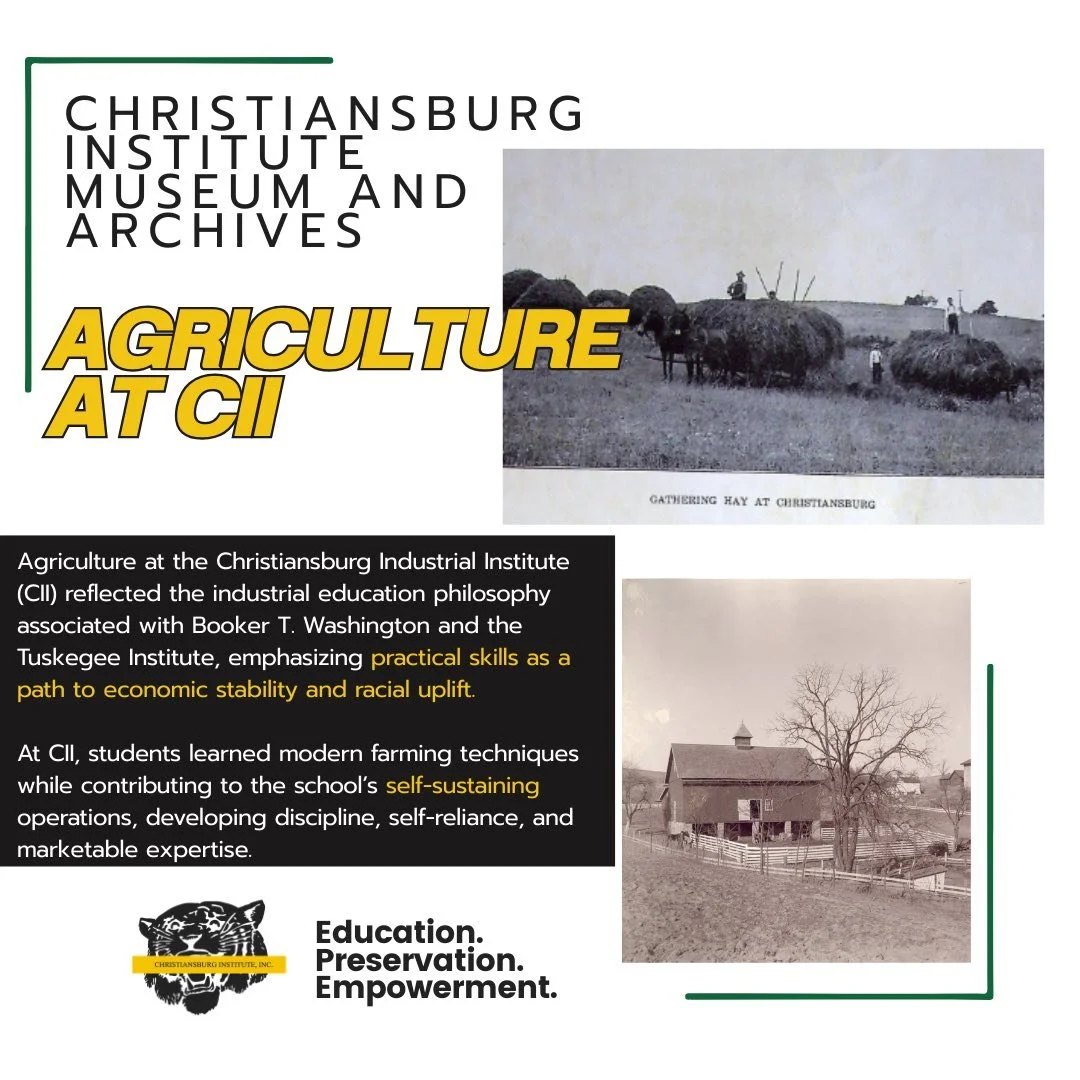
Agriculture played a central role in both life and education at CII. While it was initially controversial due to skepticism of agricultural labor among some African Americans at the time, every student was required to take classes in agriculture to cultivate skills in self-reliance and economic independence.
CII stayed up to date with modern farming techniques, at times bringing in outside agricultural experts to tutor students. In the summer of 1915, one especially savvy student produced such a large yield of vegetables on a 30 x 48 foot plot of land that it was calculated the harvest could have generated $354 per acre if sold at market rate, roughly the equivalent of $11,000 per acre today.
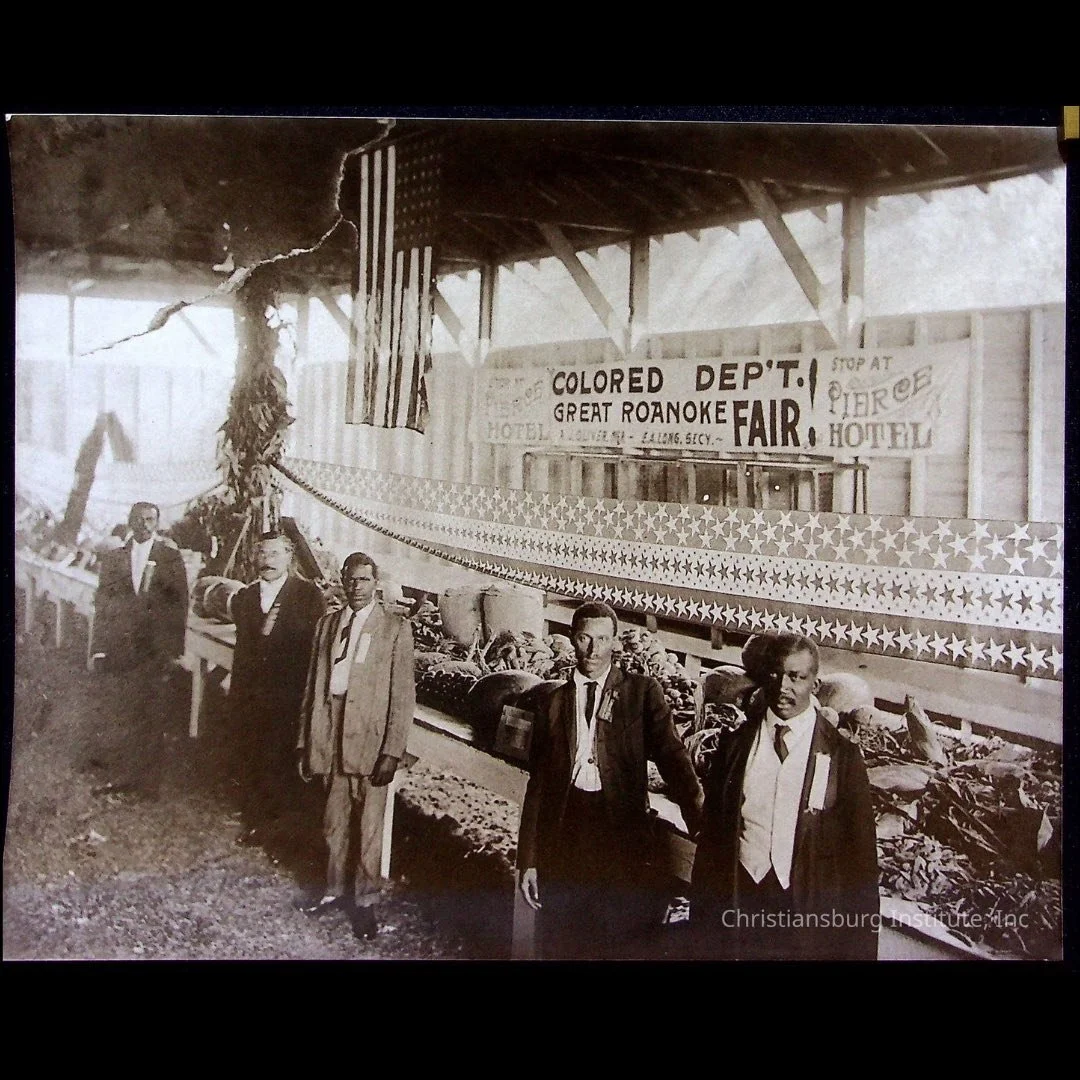
Pictured is the Christiansburg Industrial Institute’s (CII) agriculture display at the annual Great Roanoke Fair. In 1910, CII won first prize in five categories: beets, cabbages, parsnips, Irish potatoes, and wheat .
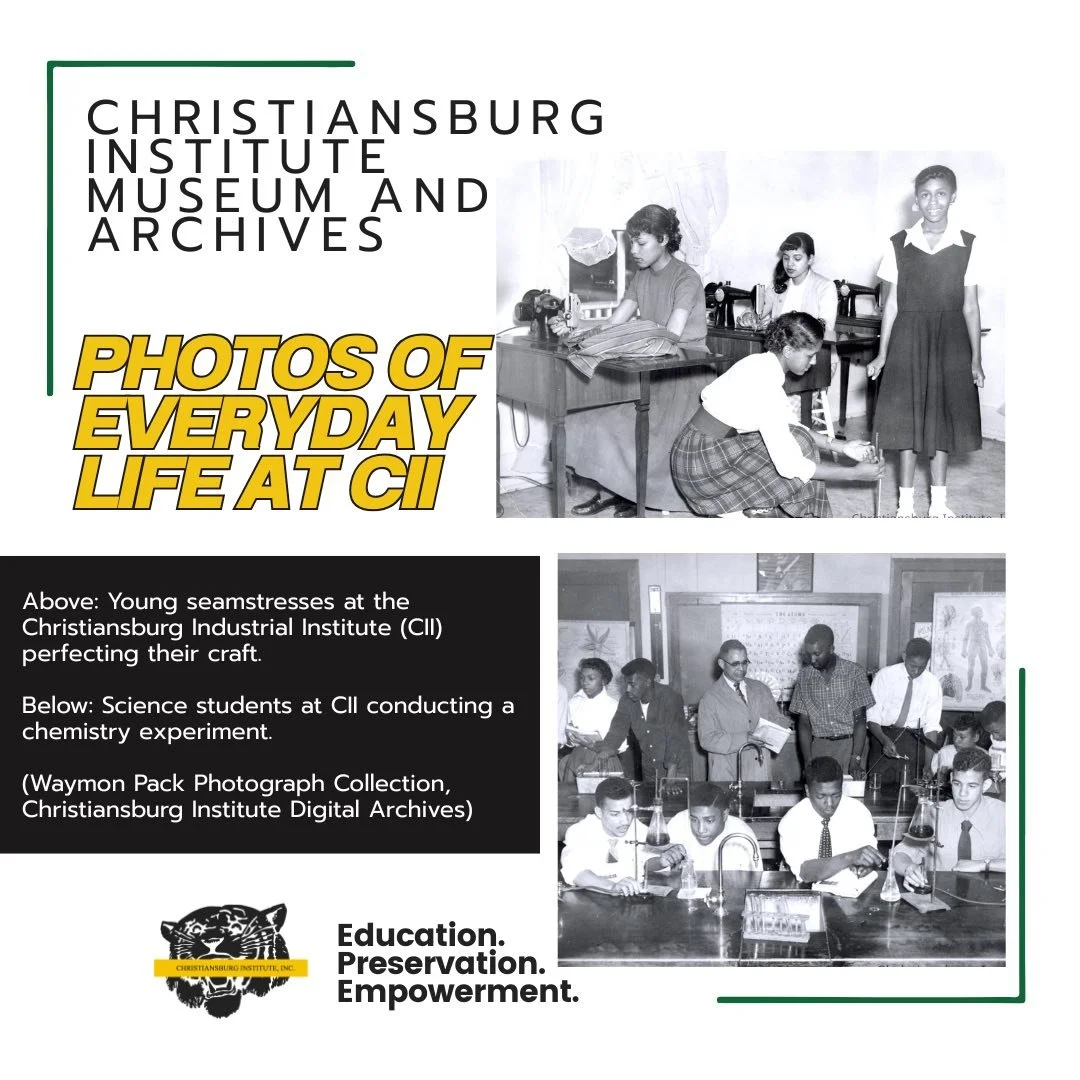
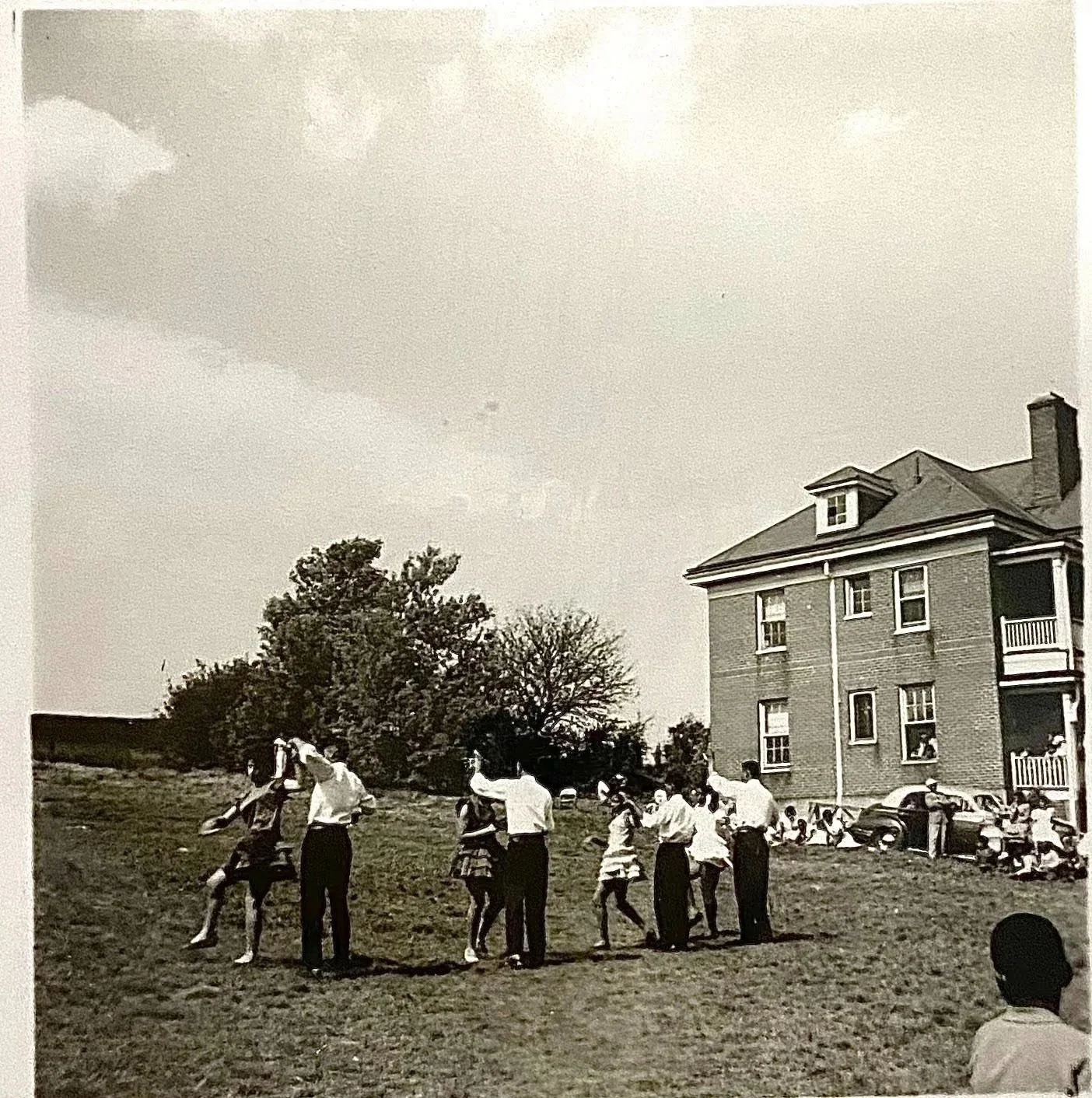
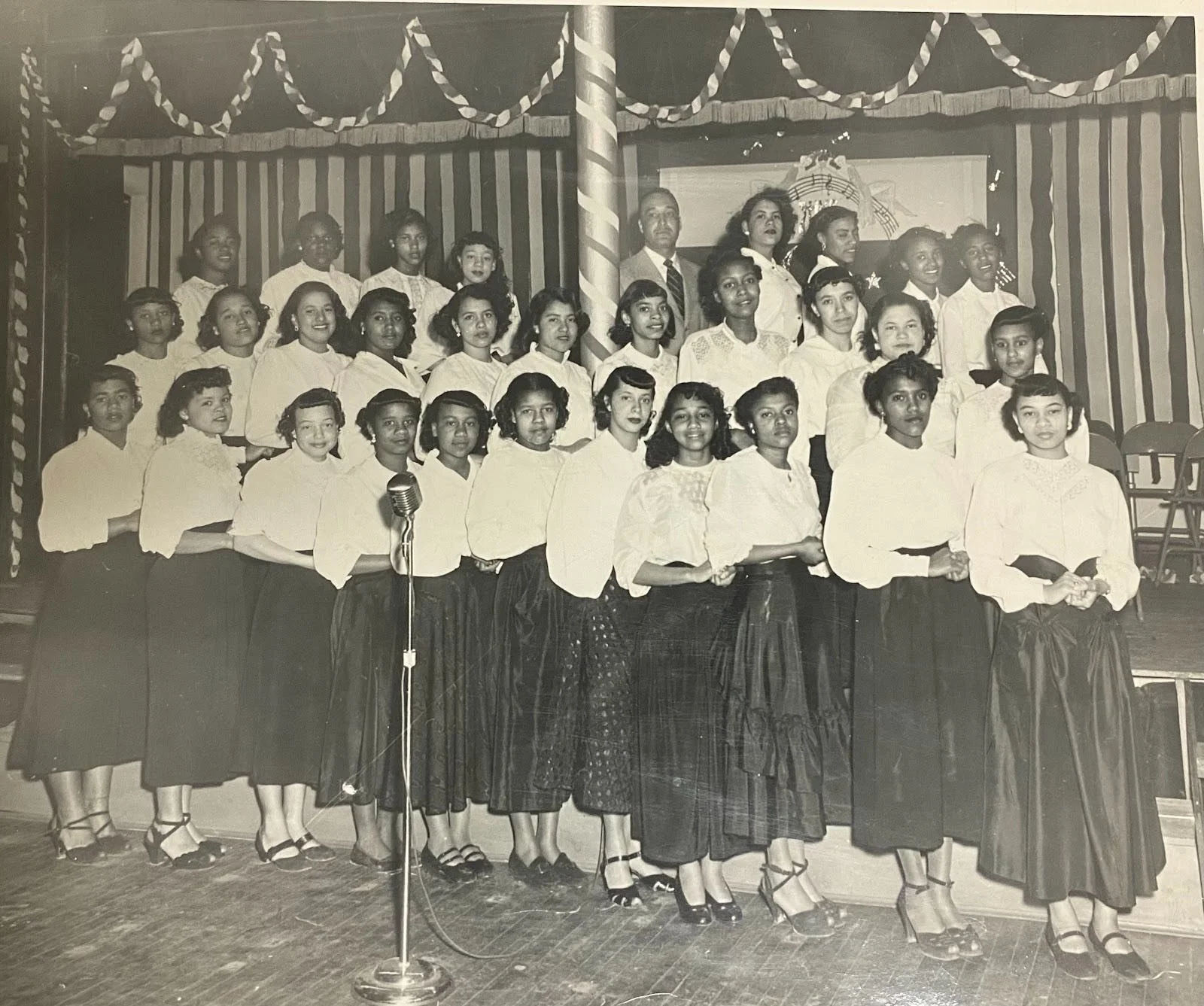
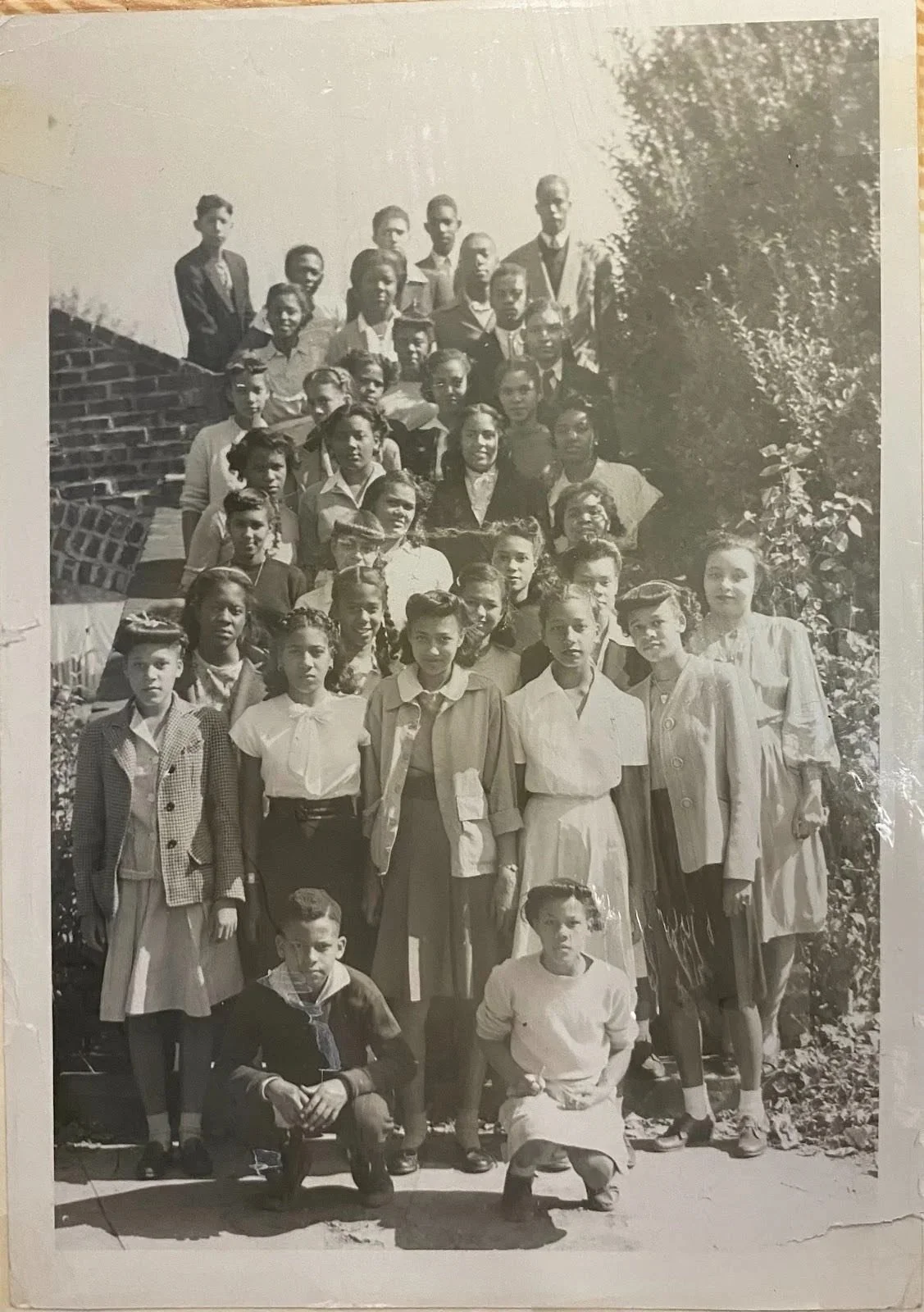
Here are some curated historic images of everyday life at the Christiansburg Industrial Institute (CII), from homecoming celebrations to English class.
The following are quotes from CII alumni about their experiences of the school:
“[CII is] the story of resilience, the story of excellence, and the story of fair treatment among human beings. I think being able to preserve what went on and how people were impacted, how their souls were enriched is far more important than preserving a building and the land.”- Bob Lease, class of 1948
“It was a dream of mine [to have gone to CII]. It was the one thing that I truly wanted to do. Because I wanted that education, I wanted that training, I wanted that connection that my sisters had and my father and them had at that school. Because it's not like you’re just going to attend and nobody knows who you are… there they knew your name, they knew your family, they knew your history… I would like for [future generations] to know about the pageantry, the pomp and circumstance, the pride, the degree of education, strength that we received from the teachers there at that school. They were all just awesome teachers and before they know your family they make sure that you were going to be an awesome person and graduate coming out of that school.” Shirley Johnson Akers, would-be class of 1973
These quotes are drawn from the Buzz for Good documentary on CII.Watch to hear firsthand from Bob Lease, Shirley Johnson Akers, and other alumni as they share their stories and experiences.
For more pictures of students and life at CII, check out the Waymon Pack Photograph Collection on the Christiansburg Institute Digital Archives (CIDA).
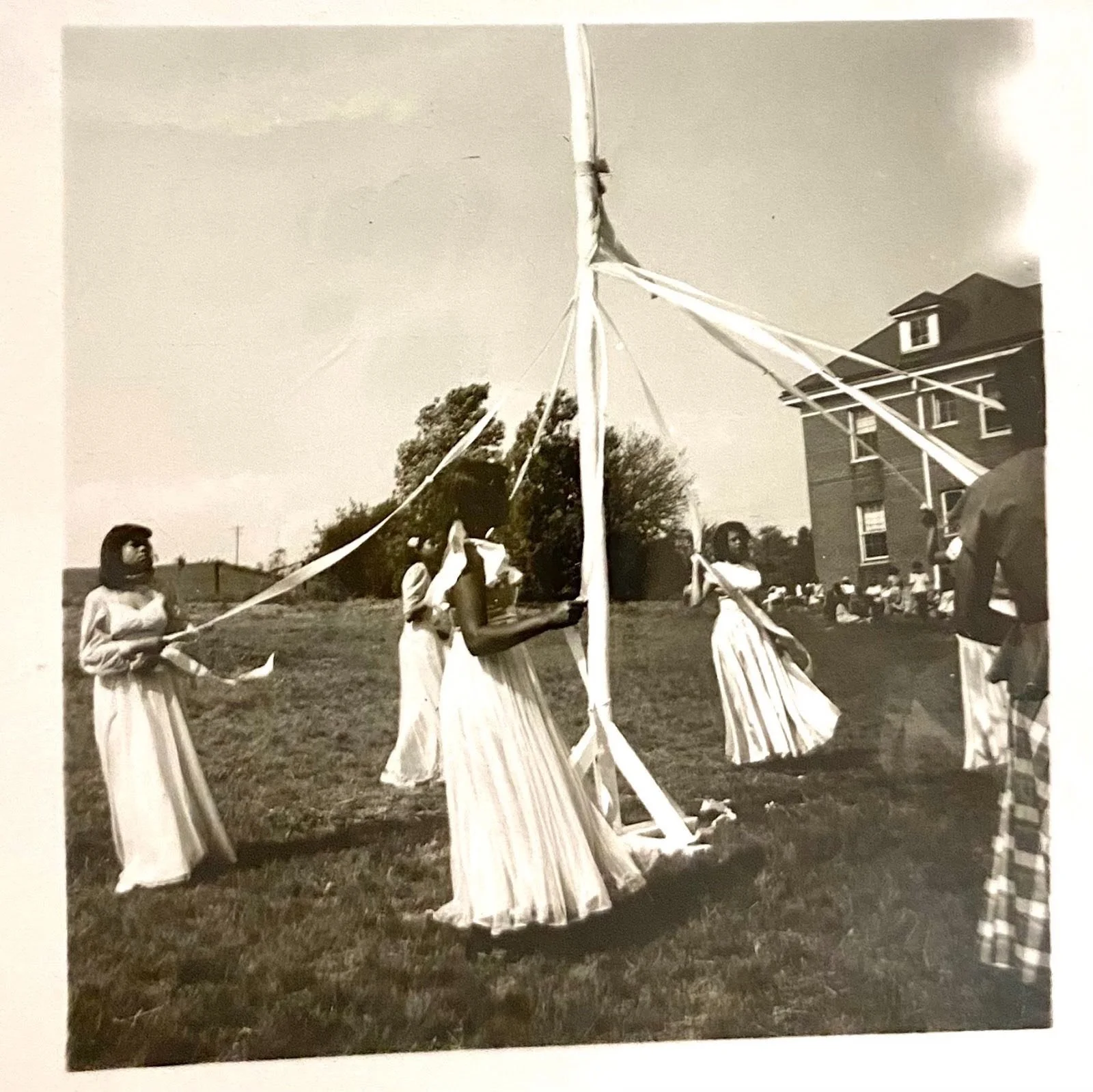
Here are some curated historic images of everyday life at the Christiansburg Industrial Institute (CII), from homecoming celebrations to English class.
The following are quotes from CII alumni about their experiences of the school:
“[CII is] the story of resilience, the story of excellence, and the story of fair treatment among human beings. I think being able to preserve what went on and how people were impacted, how their souls were enriched is far more important than preserving a building and the land.”- Bob Lease, class of 1948
“It was a dream of mine [to have gone to CII]. It was the one thing that I truly wanted to do. Because I wanted that education, I wanted that training, I wanted that connection that my sisters had and my father and them had at that school. Because it's not like you’re just going to attend and nobody knows who you are… there they knew your name, they knew your family, they knew your history… I would like for [future generations] to know about the pageantry, the pomp and circumstance, the pride, the degree of education, strength that we received from the teachers there at that school. They were all just awesome teachers and before they know your family they make sure that you were going to be an awesome person and graduate coming out of that school.” Shirley Johnson Akers, would-be class of 1973
These quotes are drawn from the Buzz for Good documentary on CII. Watch to hear firsthand from Bob Lease, Shirley Johnson Akers, and other alumni as they share their stories and experiences.
For more pictures of students and life at CII, check out the Waymon Pack Photograph Collection on the Christiansburg Institute Digital Archives (CIDA).
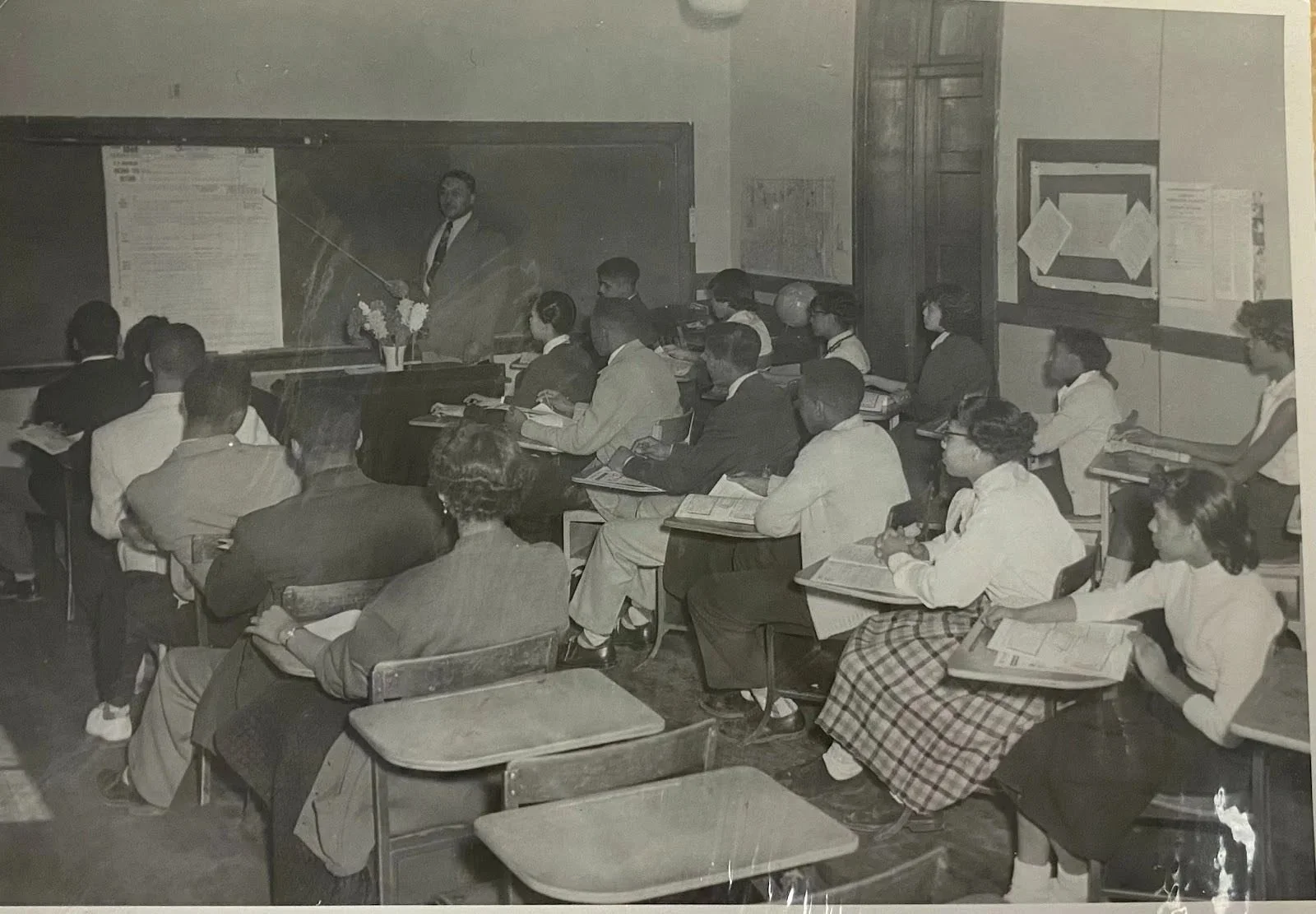
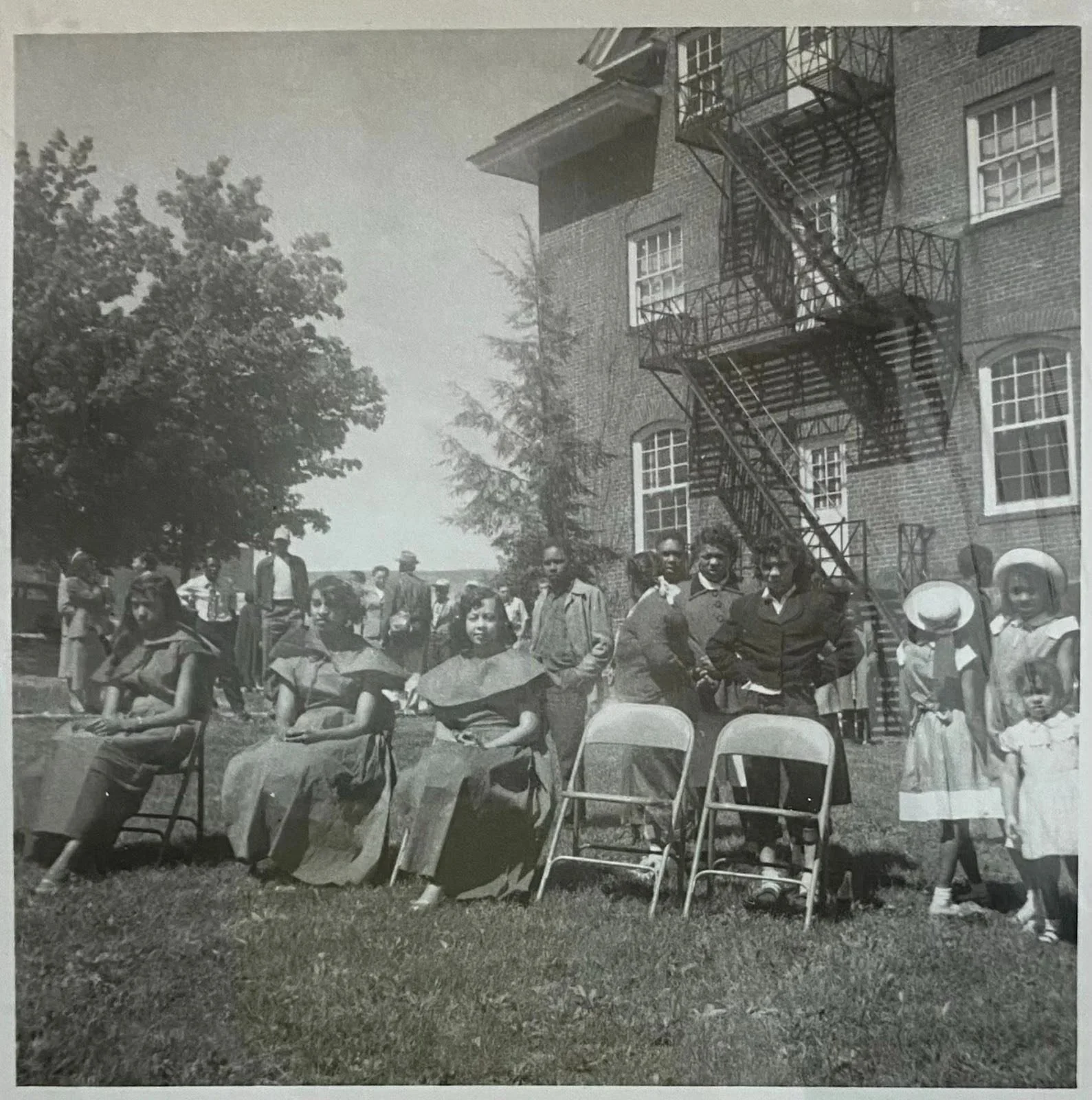
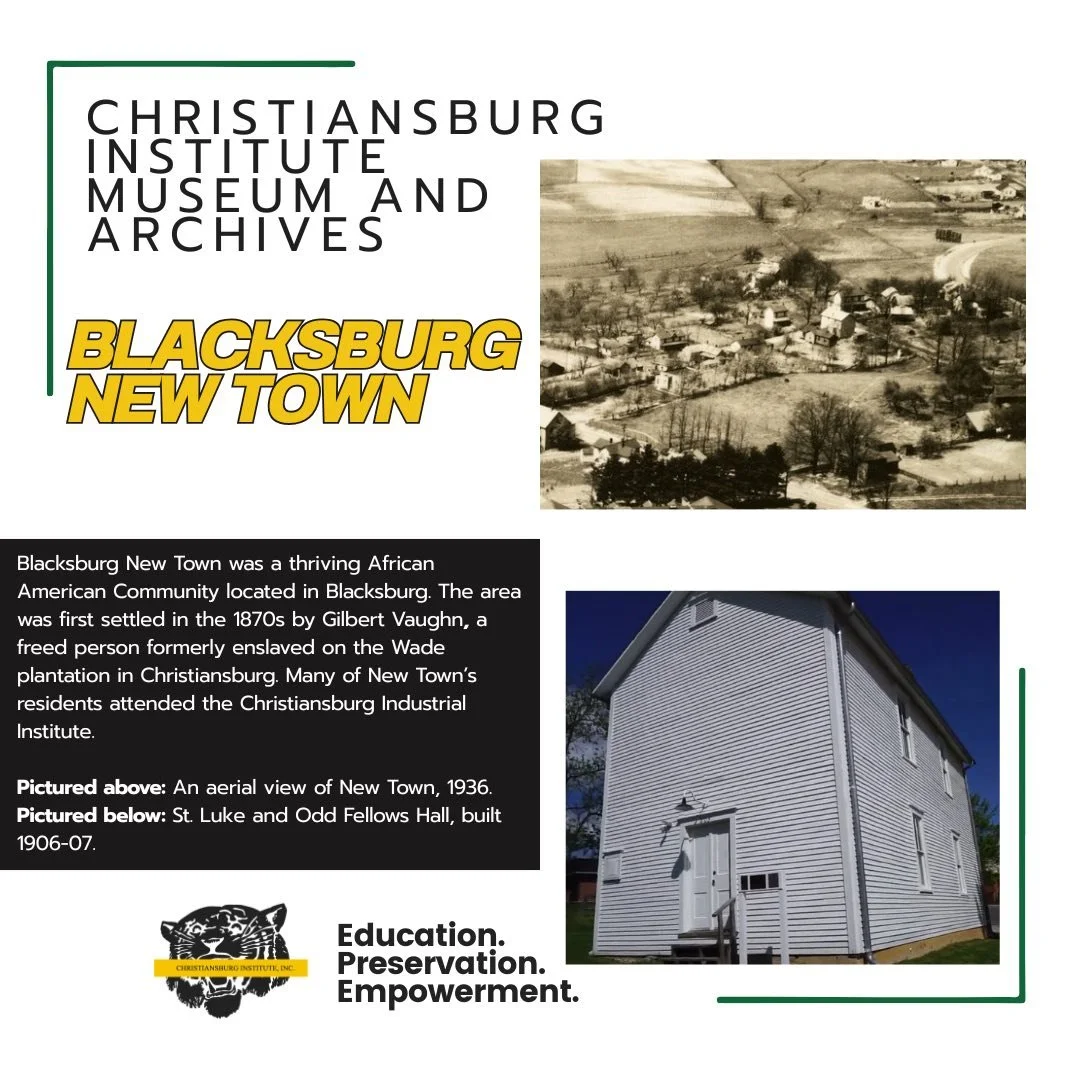
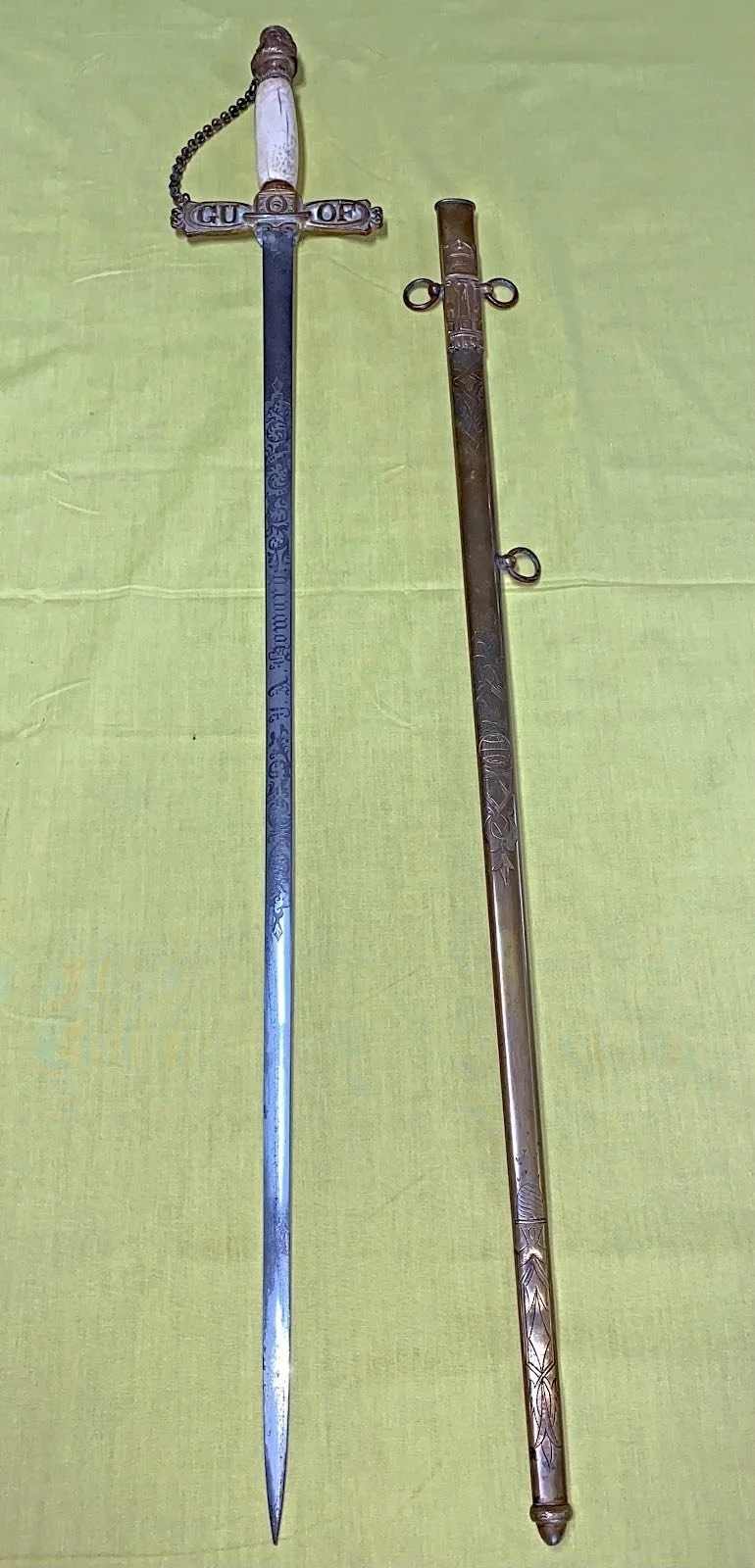
Blacksburg New Town and St. Luke and Odd Fellows Hall in Blacksburg: The ceremonial sword pictured below, held in the Christiansburg Institute Museum and Archives (CIMA), was used by the Grand United Order of Odd Fellows and was similar to the one used at St. Luke and Odd Fellows Hall in the New Town neighborhood of Blacksburg. The formation of fraternal lodges amongst African Americans was not merely social - it was a necessary response to exclusion, as white fraternal orders systematically denied Black people membership on the basis of race. As a fraternal organization, the Odd Fellows emphasized mutual aid, charity, and community cohesion, and ceremonial objects like this sword played a role in formal lodge rituals and initiations. One important role of the fraternal organization was that it provided its members with opportunities to purchase insurance and borrow loans - important transactions which were otherwise difficult for African Americans to pursue in Blacksburg during Jim Crow segregation.
The first African American landowner in the New Town area was Gilbert Vaughn, a formerly enslaved man from Christiansburg who helped lay the foundation for what would become a thriving Black community. By the turn of the 20th century, New Town had grown into a fully developed, self-sufficient neighborhood, home to many families, businesses, and organizations like the Grand United Order of Odd Fellows. The St. Luke and Odd Fellows hall itself served as the religious, social, and civic heart of New Town, hosting everything from community meetings and worship services to celebrations and sporting events. Many New Town residents attended school at the Christiansburg Industrial Institute.
Today, St. Luke and Odd Fellows Hall stands as the last remaining structure from historic New Town, representing African American life, business, resilience, and cultural expression in Blacksburg. Though the fraternal order no longer meets there, the building stands as a reminder of the vital networks of support and leadership within local African American communities during the early- and mid-20th century and as a testament to the African American Blacksburgers that helped make the town what it is today.
For more information, check out Christiansburg Institute Inc.’s curated virtual African American Legacy Tour
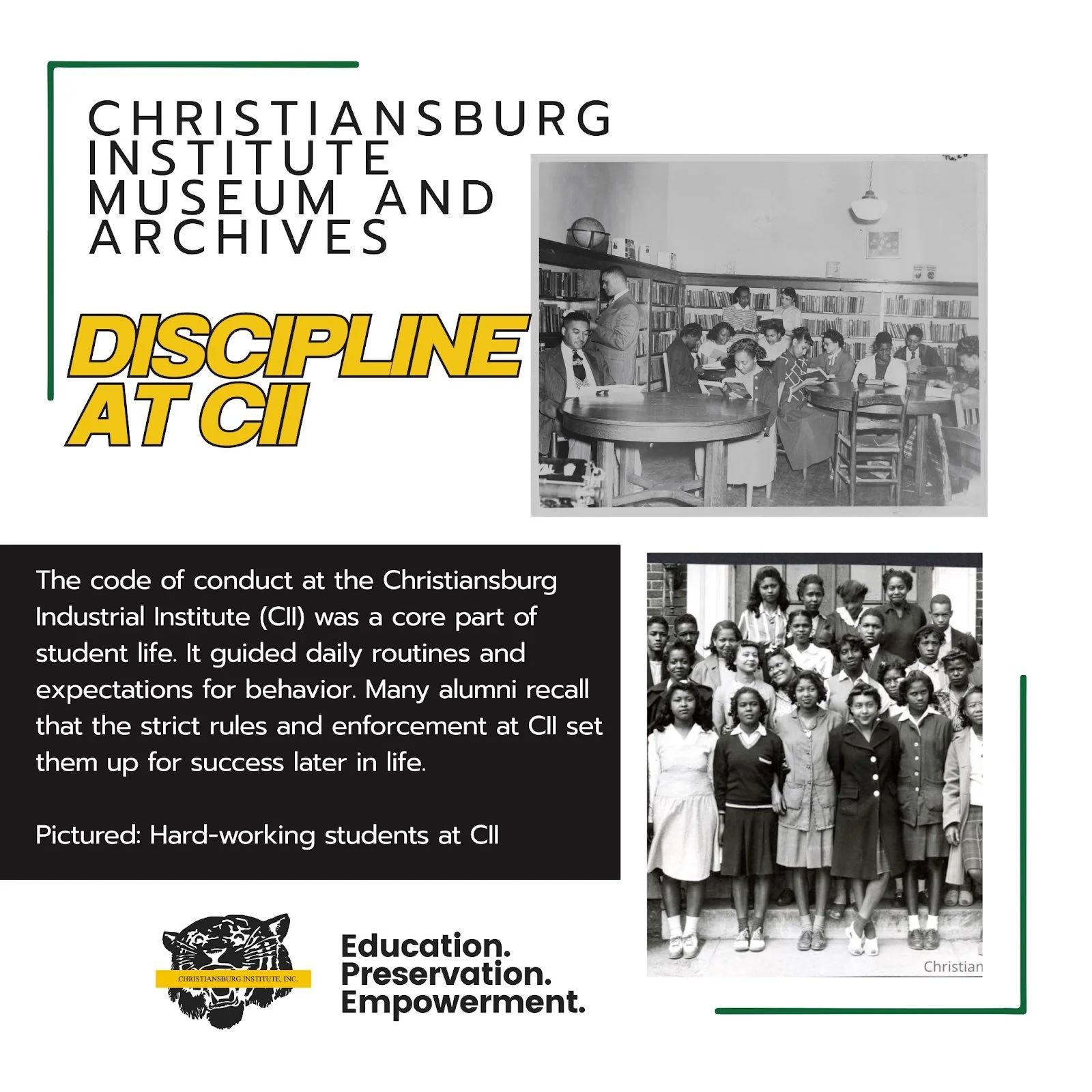
Life at CII was characterized by a strict code of conduct rooted in the principles of discipline, morality, civic engagement, and hard work, which were believed to mold students into upstanding and resilient citizens. Principal Edgar A. Long believed this to be especially important for Black students, who would have “to do better work than other people in order to hold our jobs” and who, more so than white people, would “have to restrain ourselves when we feel we are imposed upon.” This code of conduct was serious business; in 1910, two graduating students had their diplomas withheld because they were caught playing cards a week before graduation.
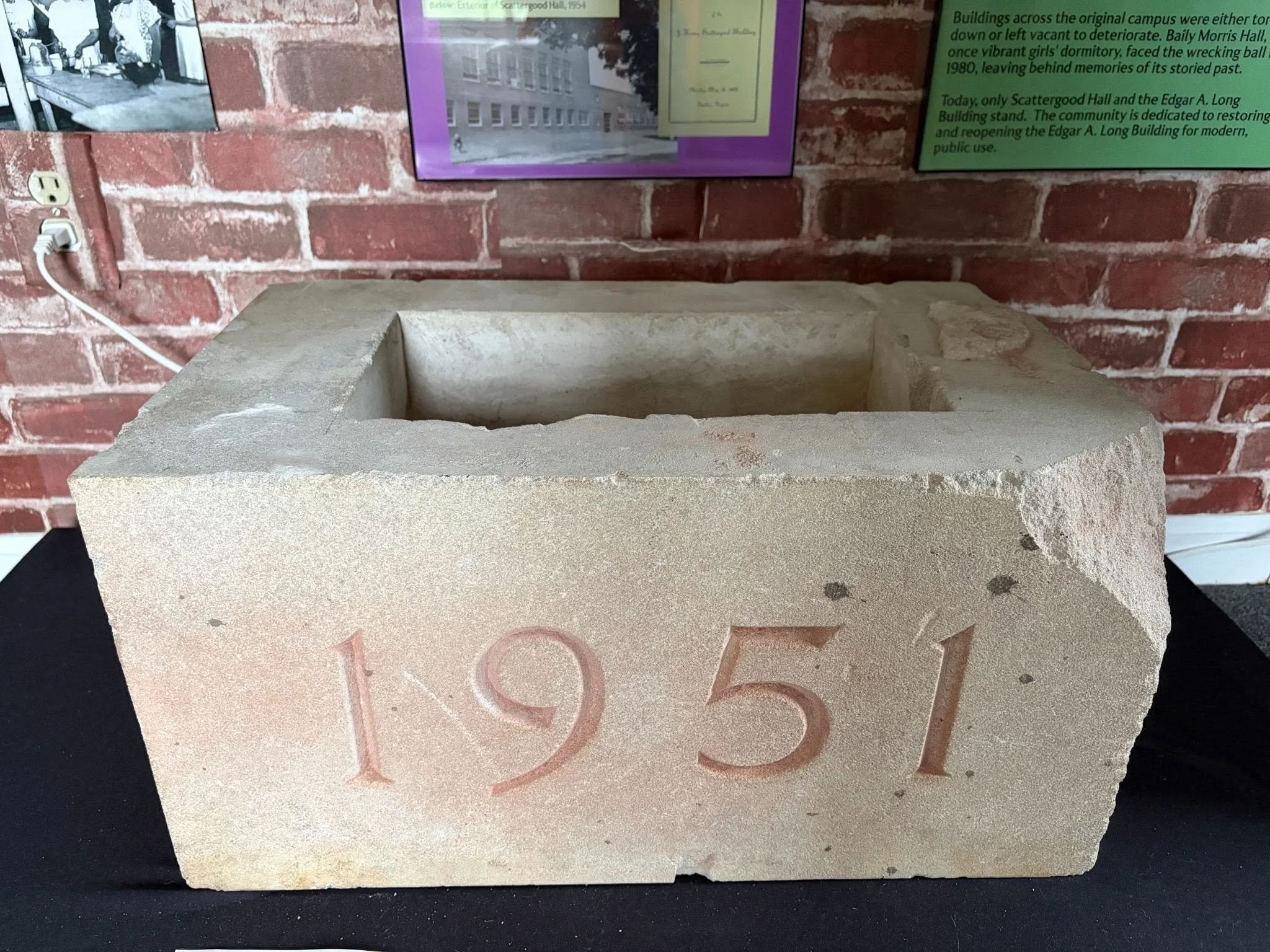
The fountain pictured has a story behind it that exemplifies life under the CII code of conduct. It was recovered from the Edgar A. Long building, the central academic building and one of the few buildings remaining on what was the former Christiansburg Industrial Institute’s (CII) campus and is now on display in our museum. CII alumni and CI, Inc. Board Chair, Debbie Sherman-Lee, recalls that in the 1960s, this very fountain was a central socializing location where male and female students mingled outside of class. CII dormitories were gender segregated; the female students resided at Baily-Morris Hall on the east side of the Edgar A. Long building. Male students resided at Morris Hall on the west side of the building. The Edgar A. Long building even had two doors, one for each gender. There would be strict punishment if a girl and boy were caught with each other unsupervised, and the fountain was one place where supervised mingling would take place in-between classes.

Life at CII was characterized by a strict code of conduct rooted in the principles of discipline, morality, civic engagement, and hard work, which were believed to mold students into upstanding and resilient citizens. Principal Edgar A. Long believed this to be especially important for Black students, who would have “to do better work than other people in order to hold our jobs” and who, more so than white people, would “have to restrain ourselves when we feel we are imposed upon.” This code of conduct was serious business; in 1910, two graduating students had their diplomas withheld because they were caught playing cards a week before graduation.
The fountain pictured has a story behind it that exemplifies life under the CII code of conduct. It was recovered from the Edgar A. Long building, the central academic building and one of the few buildings remaining on what was the former Christiansburg Industrial Institute’s (CII) campus and is now on display in our museum. CII alumni and CI, Inc. Board Chair, Debbie Sherman-Lee, recalls that in the 1960s, this very fountain was a central socializing location where male and female students mingled outside of class. CII dormitories were gender segregated; the female students resided at Baily-Morris Hall on the east side of the Edgar A. Long building. Male students resided at Morris Hall on the west side of the building. The Edgar A. Long building even had two doors, one for each gender. There would be strict punishment if a girl and boy were caught with each other unsupervised, and the fountain was one place where supervised mingling would take place in-between classes.
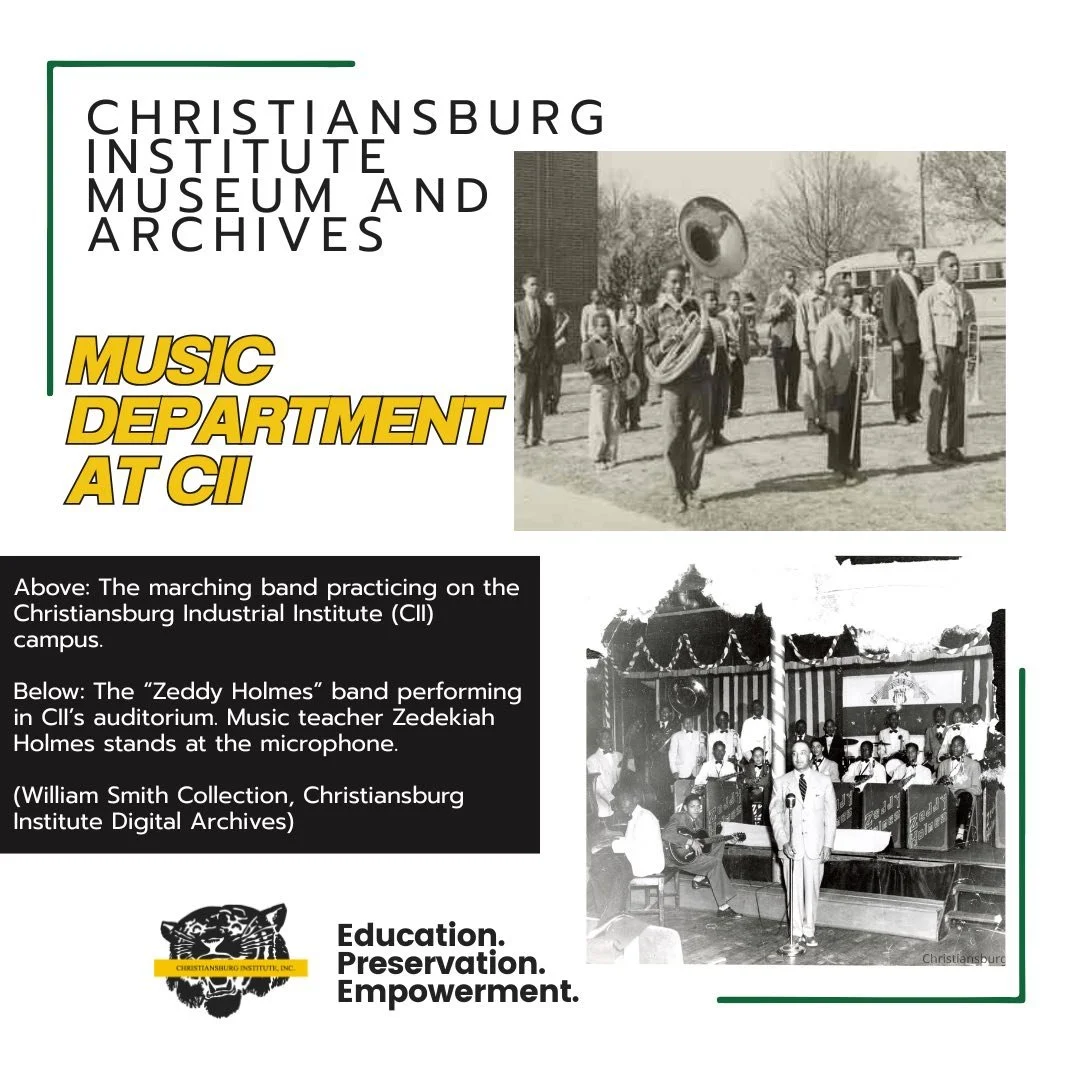
The music department at the Christiansburg Industrial Institute (CII) was well regarded around Montgomery County for training highly skilled student musicians. The success of the music department at CII was made possible by music teacher Zedekiah (Zeddy) Eli Holmes, who started teaching at CII after graduating from Howard University and the University of Michigan, where he studied under the famous Black concert pianist, Hazel Harrison. Upon arriving at CII, he found the music department was so underfunded that there weren’t enough instruments for everyone. To remedy this, he brought his own instruments to the school for students to play. He developed the music department to the point where the Boys’ Band and the Girls’ Glee Club were touring and competing around the state, as well as being well-regarded ensembles in Christiansburg.
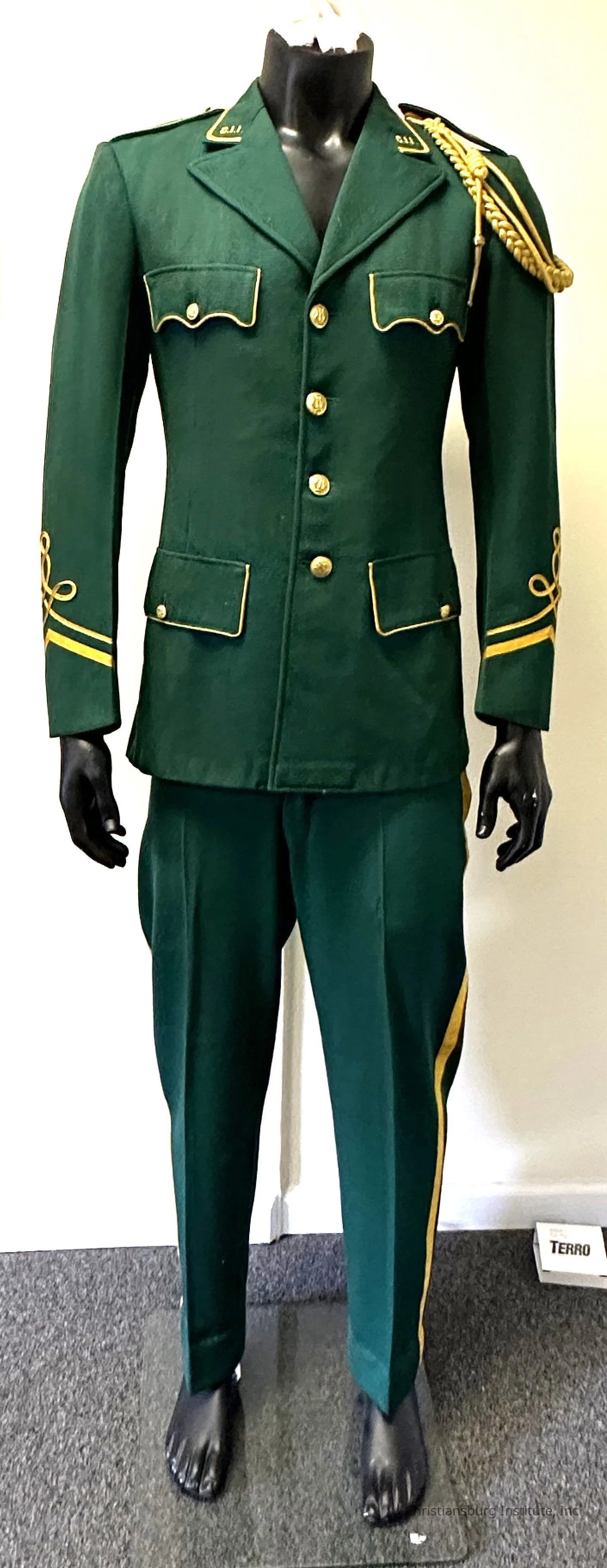
Pictured is the uniform that students would have worn in the Christiansburg Industrial Institute’s marching band. For CII’s homecoming parade, the band would march through downtown Christiansburg and was met with great local fanfare.
To see more CII uniforms in our collection, explore theC.I. Uniform Collection on the Christiansburg Institute Digital Archives (CIDA).
The music department at the Christiansburg Industrial Institute (CII) was well regarded around Montgomery County for training highly skilled student musicians. The success of the music department at CII was made possible by music teacher Zedekiah (Zeddy) Eli Holmes, who started teaching at CII after graduating from Howard University and the University of Michigan, where he studied under the famous Black concert pianist, Hazel Harrison. Upon arriving at CII, he found the music department was so underfunded that there weren’t enough instruments for everyone. To remedy this, he brought his own instruments to the school for students to play. He developed the music department to the point where the Boys’ Band and the Girls’ Glee Club were touring and competing around the state, as well as being well-regarded ensembles in Christiansburg.
Pictured is the uniform that students would have worn in the Christiansburg Industrial Institute’s marching band. For CII’s homecoming parade, the band would march through downtown Christiansburg and was met with great local fanfare.
To see more CII uniforms in our collection, explore the C.I. Uniform Collection on the Christiansburg Institute Digital Archives (CIDA).
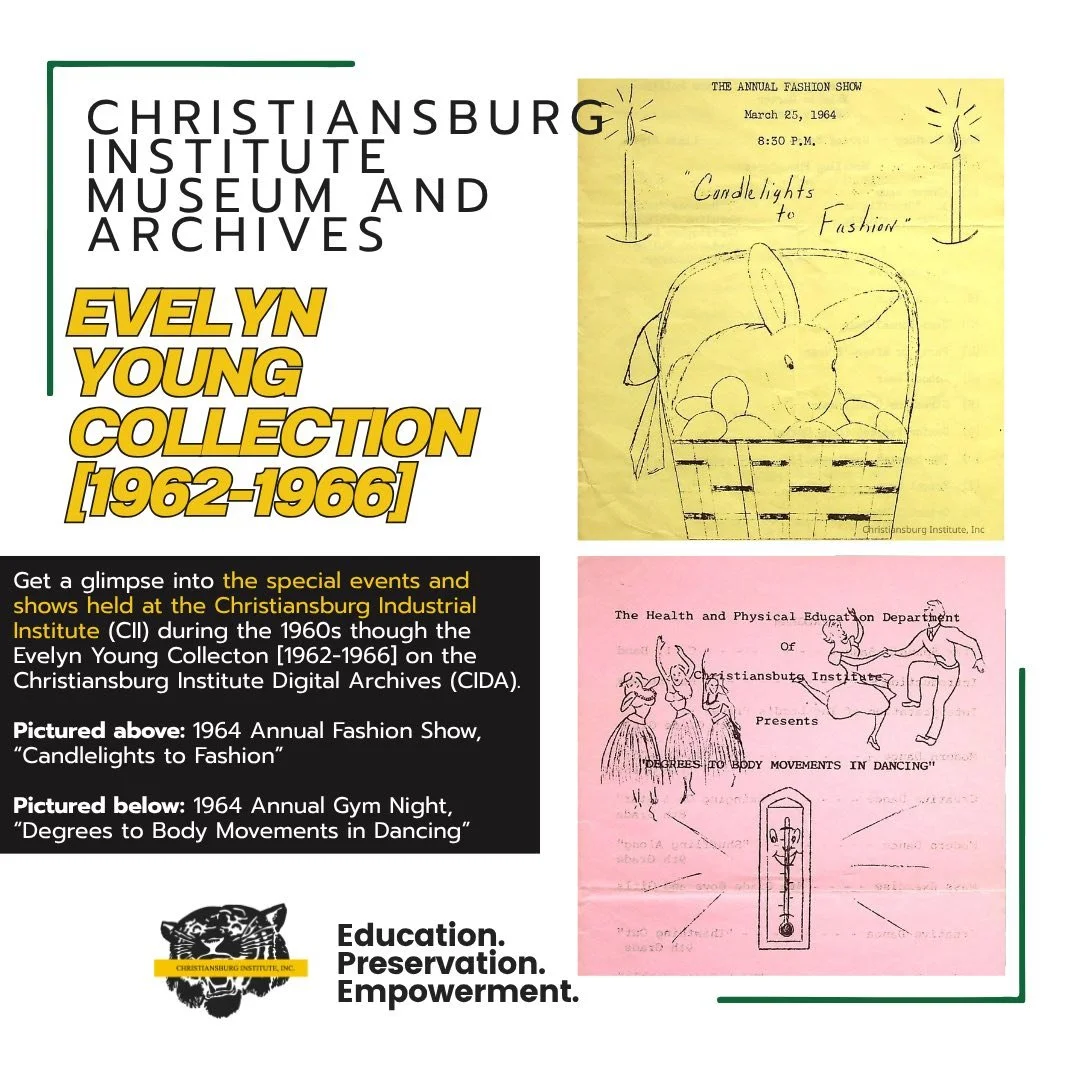
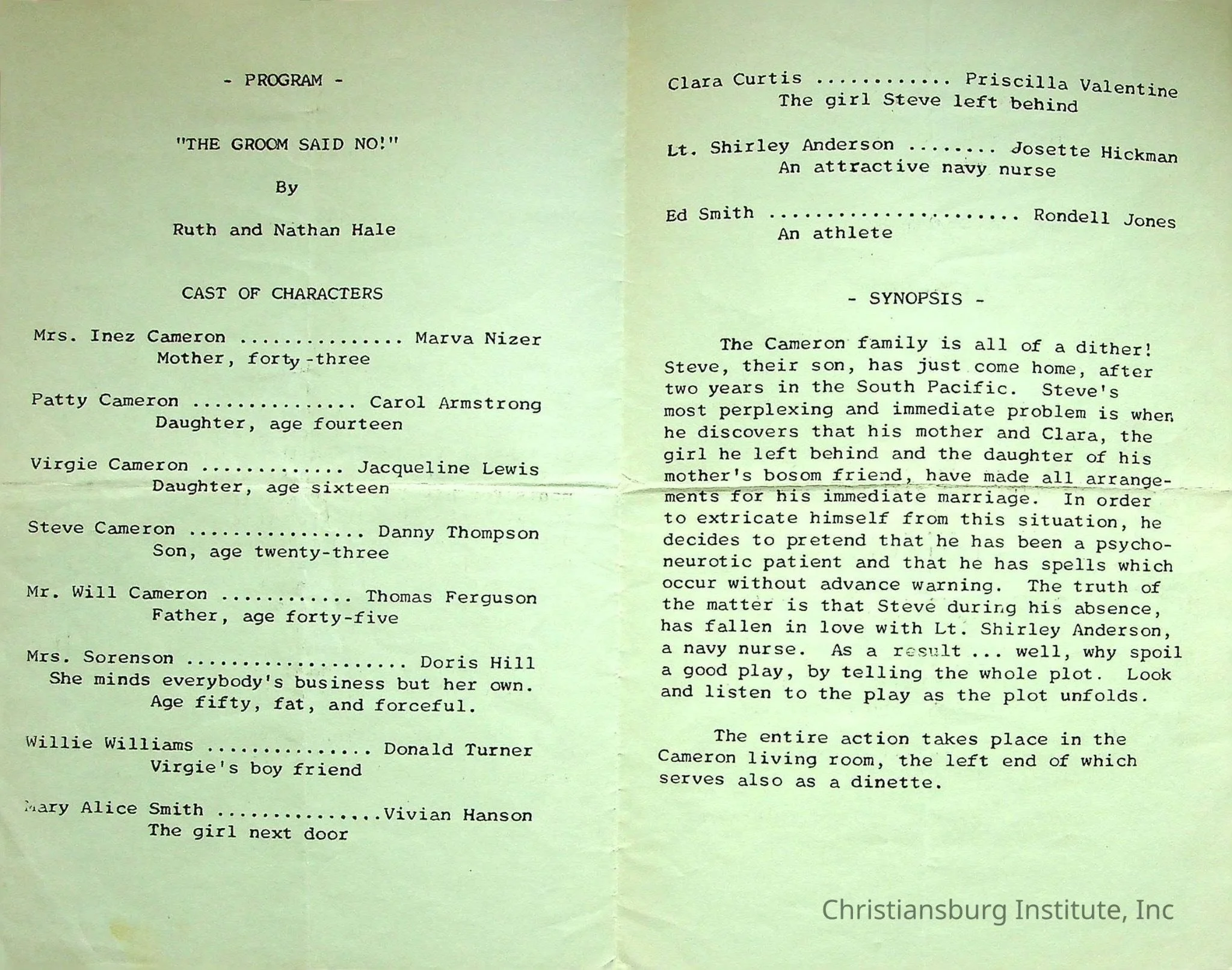
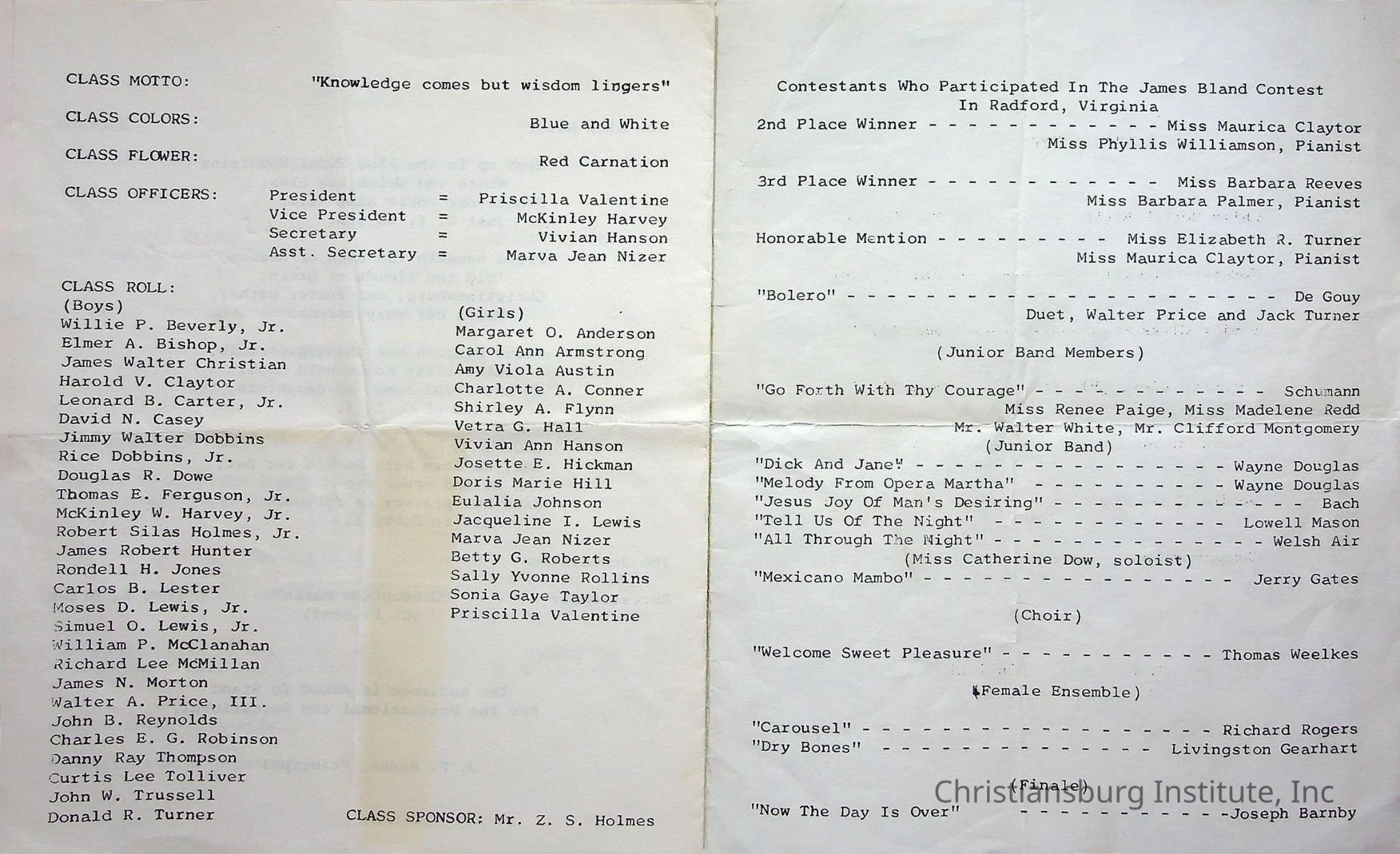
The Evelyn Young Collection [1962-1966] in the Christiansburg Institute Digital Archives (CIDA) holds programs from many of the coveted performances, concerts, and shows held at the Christiansburg Industrial Institute in the 1960s. Revealed within this collection are the proud showcases of classes and extra-curriculars like theater, band, choir, home economics, forensics, and cosmetology, and the names of students and faculty involved.
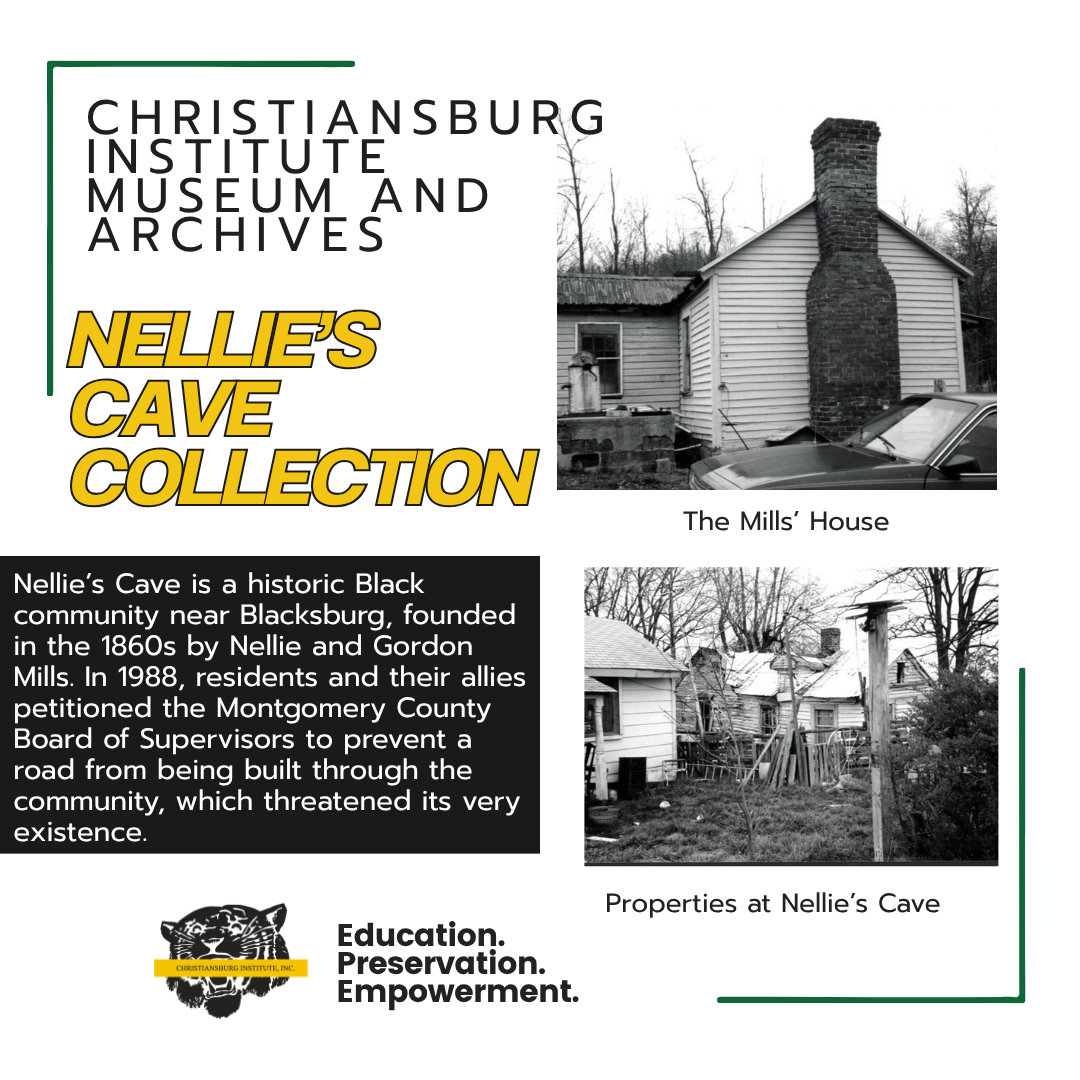
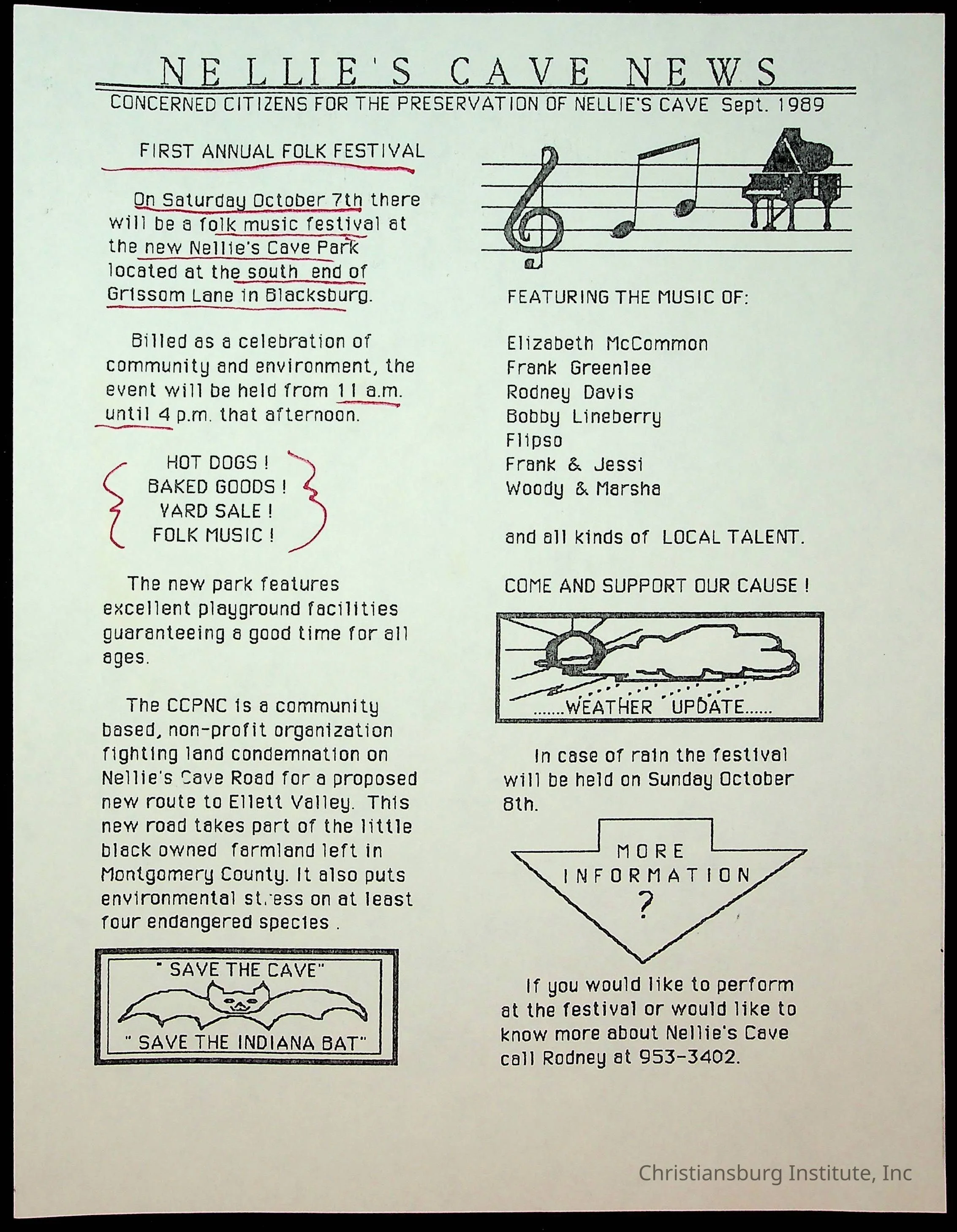
Nellie’s Cave, which lies just outside of Blacksburg’s corporate limits toward Ellett Valley, was settled by Nellie and Gordon Mills directly after Emancipation. Nellie Mills had been enslaved on the Hoge plantation and was given the land from the Hoge estate upon her emancipation. The Nellie’s Cave area had grown to be a sizable African American community by the early 1900s, and at one point it had its own schoolhouse and dance hall. Descendants of Nellie and Gordon Mills continue to inhabit the area today.
In more recent times, the Nellie’s Cave community was the site of a serious political controversy. In 1988, the Montgomery County Board of Supervisors approved a plan brought forward by a property development company to build a large road through the residents’ properties. The local Black community fought back. They created “The Concerned Citizens for the Preservation of Nellie’s Cave Community” (CCNCC), which raised money to file a lawsuit against the members of the Board of Supervisors, accusing them of racial discrimination and improper process in approving the development.
To raise money, they held a Folk Festival at Nellie’s Cave Park with food, music, and art by local African Americans. On other occasions, poet and Virginia Tech professor emeritus Nikki Giovanni held a poetry benefit night, and Michael Cook, a Virginia Tech professor of history, held public lectures about the value of preserving local Black history and the injustices committed by the Board of Supervisors. Members of the Mills family of Nellie’s Cave, some of whom were graduates of the Christiansburg Industrial Institute, were instrumental in organizing the group.
The activists involved in the fight intertwined their understandings of racial injustice with environmental degradation. They argued that the construction would threaten endangered species and that the porous rocks underlying the properties would lead any development to contaminate the groundwater, on which the African American residents in the community depended. The activists were skilled in media relations and managed to get the story published by newspapers around the state.
Unfortunately, the group was unsuccessful in their attempts to curtail the development of the road, as well as in their lawsuit. However, they succeeded not only in illuminating the deep-rooted history of the Nellie’s Cave community but also in documenting and exposing the racial injustice at the core of local institutions.
For more information about the history of Nellie’s Cave and The Concerned Citizens for the Preservation of Nellie’s Cave Community, check out the Nellie’s Cave Collection in the Christiansburg Institute Digital Archives (CIDA)
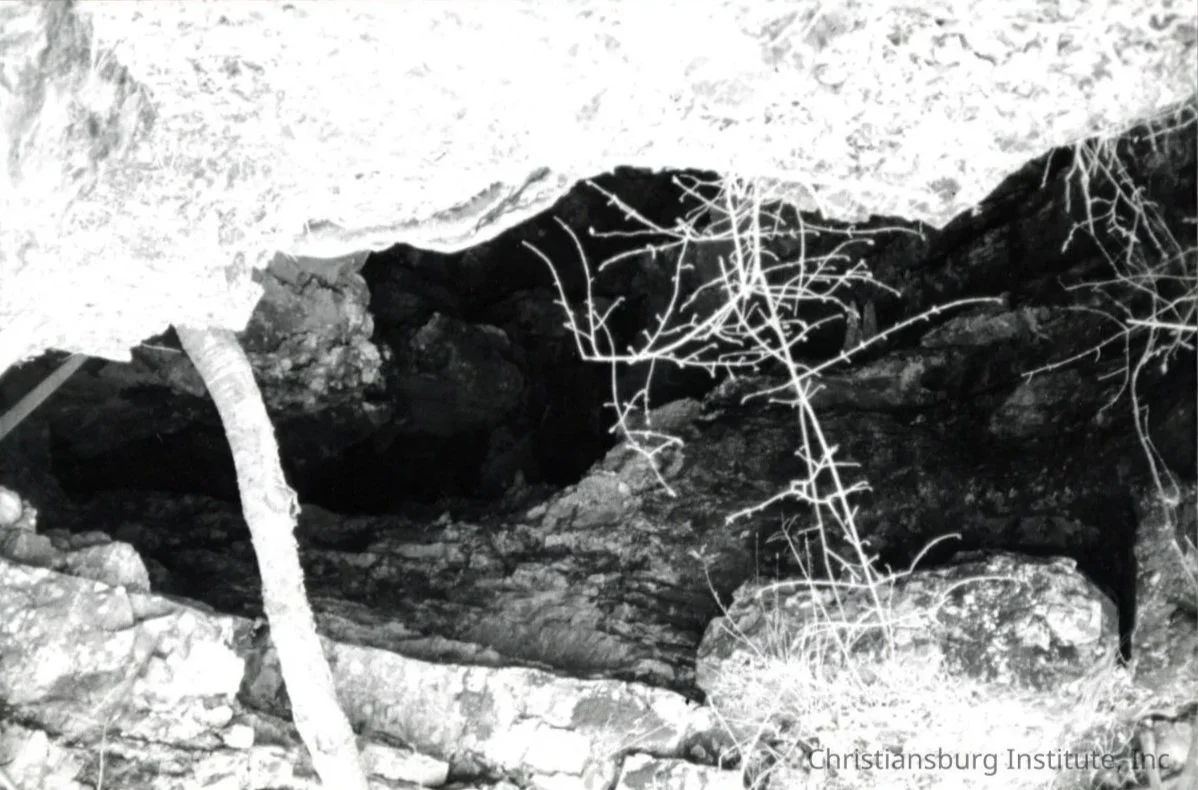
The cave at Nellie’s Cave
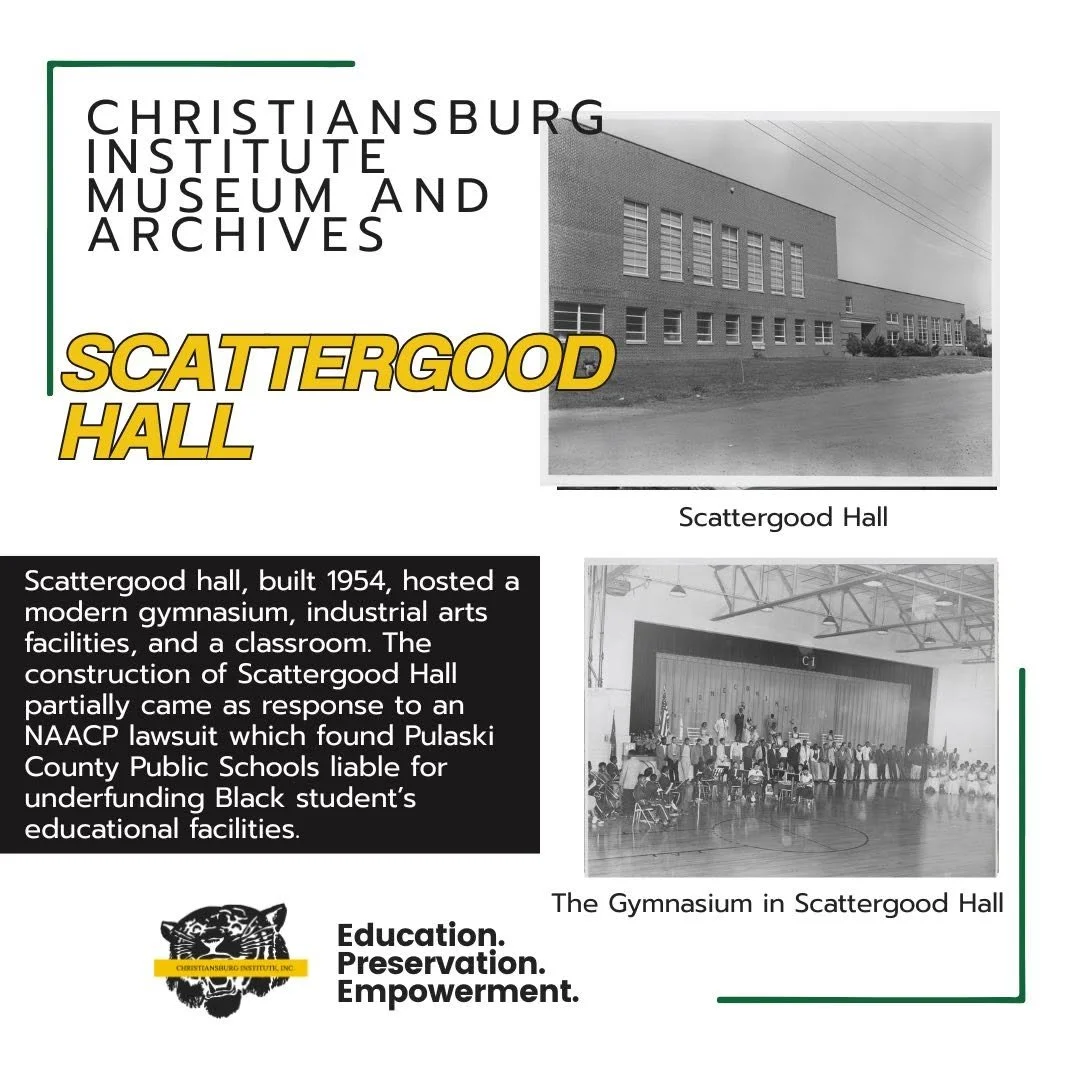
Scattergood Hall was built between 1953 and 1954 as a modern, multipurpose educational facility on the Christiansburg Industrial Institute (CII) campus, housing a gymnasium, industrial arts facilities, and classrooms. It was named after J. Henry Scatterhood, treasurer of the Friend’s Freedmen’s Association, who had owned CII from 1885 to 1947.
Preceding the construction of this building, the facilities at CII were markedly outdated and inadequate for the new set of vocational skills demanded in postwar America. This was compounded by a decade of relative financial neglect from Montgomery County Public Schools (MCPS), which diverted an uneven share of funding away from CII and toward local white schools. A high-profile lawsuit would ultimately change MCPS’s funding policy and push the construction of Scattergood Hall.
In 1947, Dr. Percy Corbin, an African American doctor in Pulaski County, VA, filed a joint lawsuit alongside 22 other Black parents in Pulaski County on behalf of their children against the Pulaski County School Board for failing to provide equal high school facilities for Black students. At the time, Pulaski County was sending its Black high school students to CII, which the NAACP lawyers who acted as legal counsel argued had inferior facilities and college preparatory opportunities compared to the white high school in Pulaski County. In 1949, after a lengthy legal battle, the judge ruled in favor of the parents and the NAACP. Montgomery County Public Schools, which operated CII through a regional board of control with Pulaski County Public Schools and Radford City Public Schools, were suddenly under increased pressure to invest in campus facilities. Shortly thereafter, Scattergood Hall was constructed.
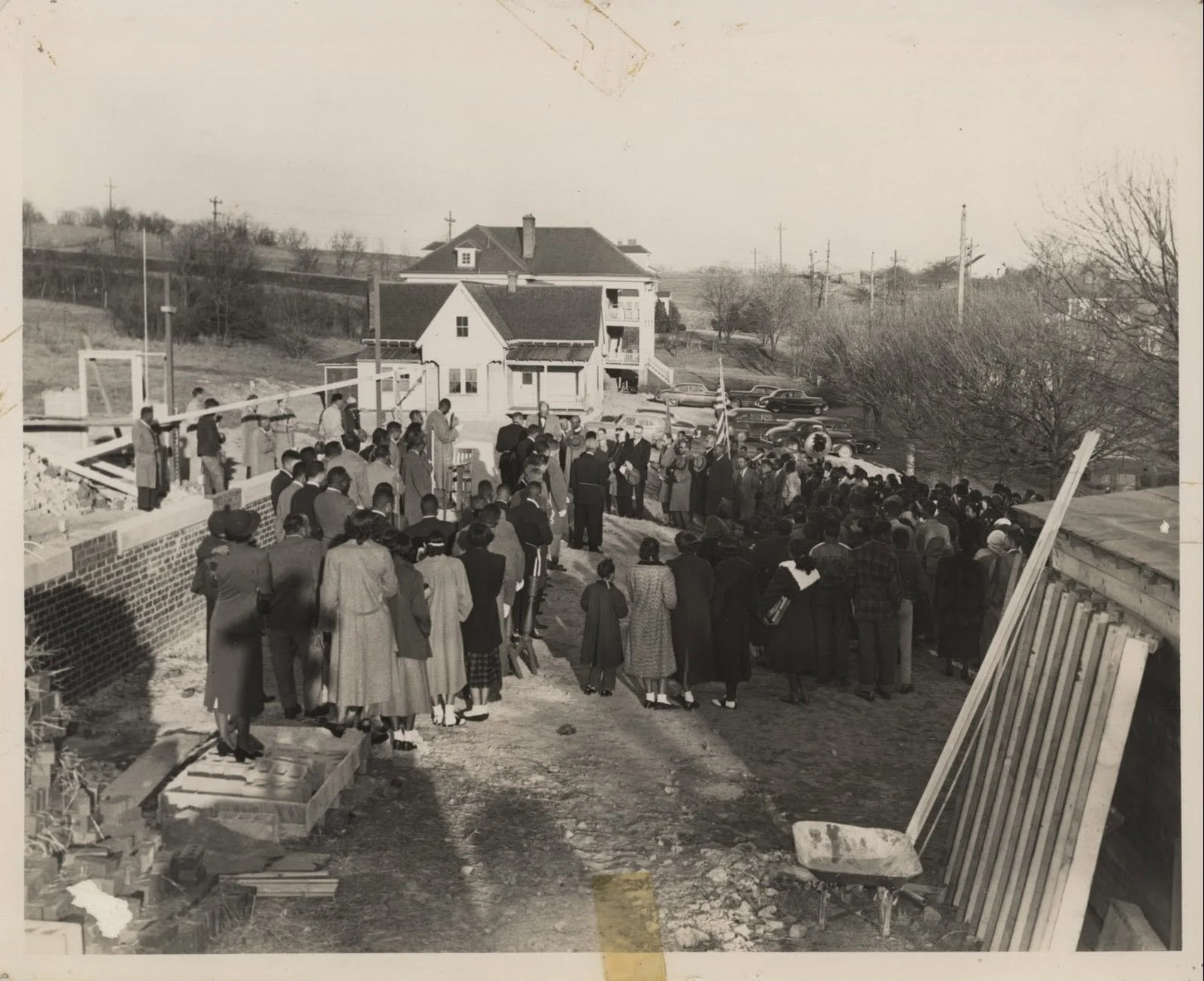
The object pictured is a time capsule that also served as the cornerstone of Scattergood Hall at the Christiansburg Industrial Institute. The accompanying picture depicts the laying of the cornerstone, marked with celebration and accompanied by speeches from many of the school’s administrators. The contents of the time capsule reflect what students at CII in the early 1950s wanted future generations to see: a small child’s shoe, coins, and a slate plaque inscribed with the names of students enrolled in a science class. We are left to wonder what the students were thinking as they chose which objects to part with for the future generation to discover. The Christiansburg Institute, Inc. recently gained possession of these artifacts after they were removed from the building by its current owner and donated to the museum.
For more information about Scattergood Hall and the time capsule, explore the John F. Banks Collection [1910–1979] in the Christiansburg Institute, Inc. Digital Archives (CIDA), or visit our museum in person to see what was placed inside.
Also check out the great work that the Calfee Community and Cultural Center is doing in Pulaski County around the history of African American education in the region, as well as their 2354 project which considers the history and impact of Corbin et al. v. County School Board of Pulaski County. Access their website here: https://calfeeccc.org/.
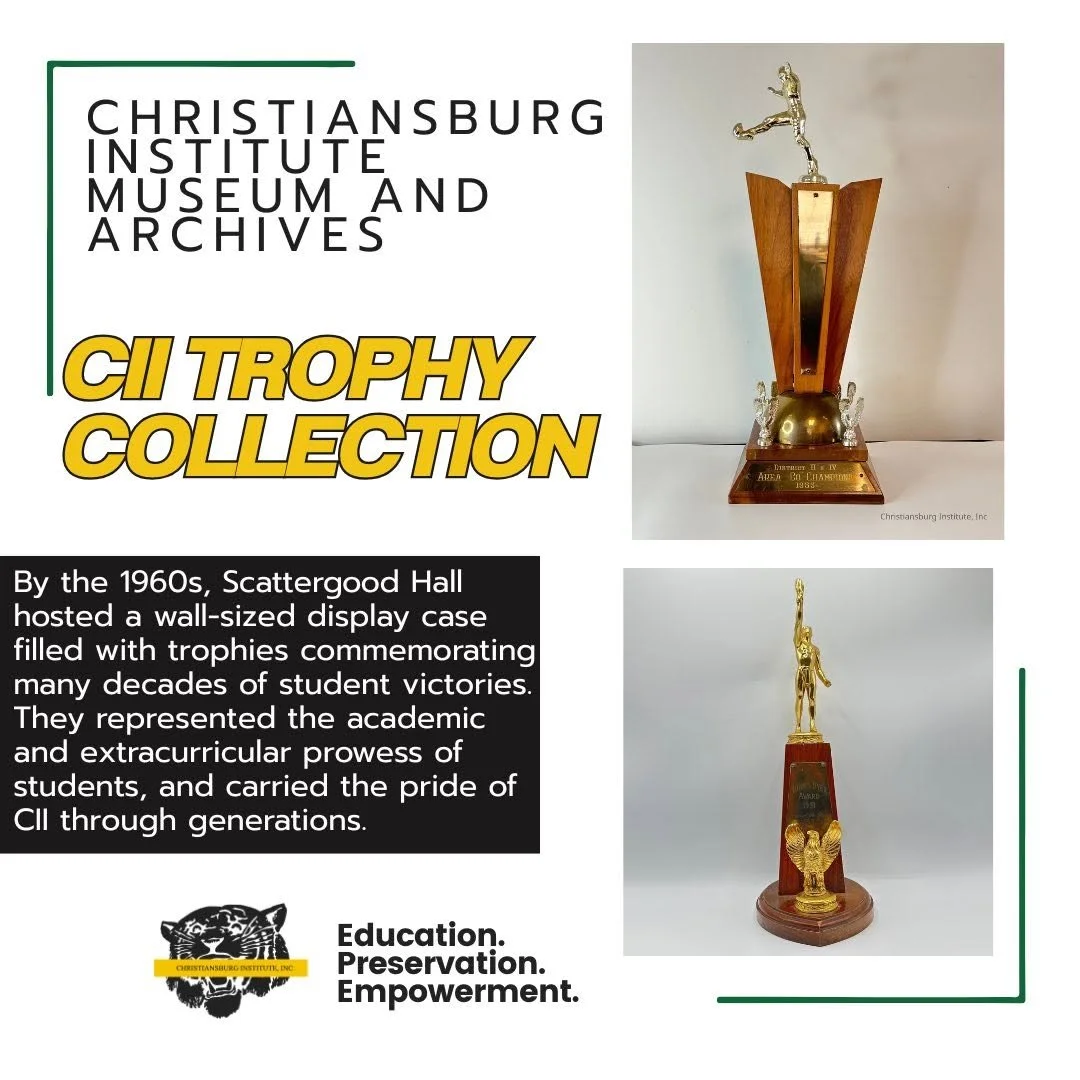
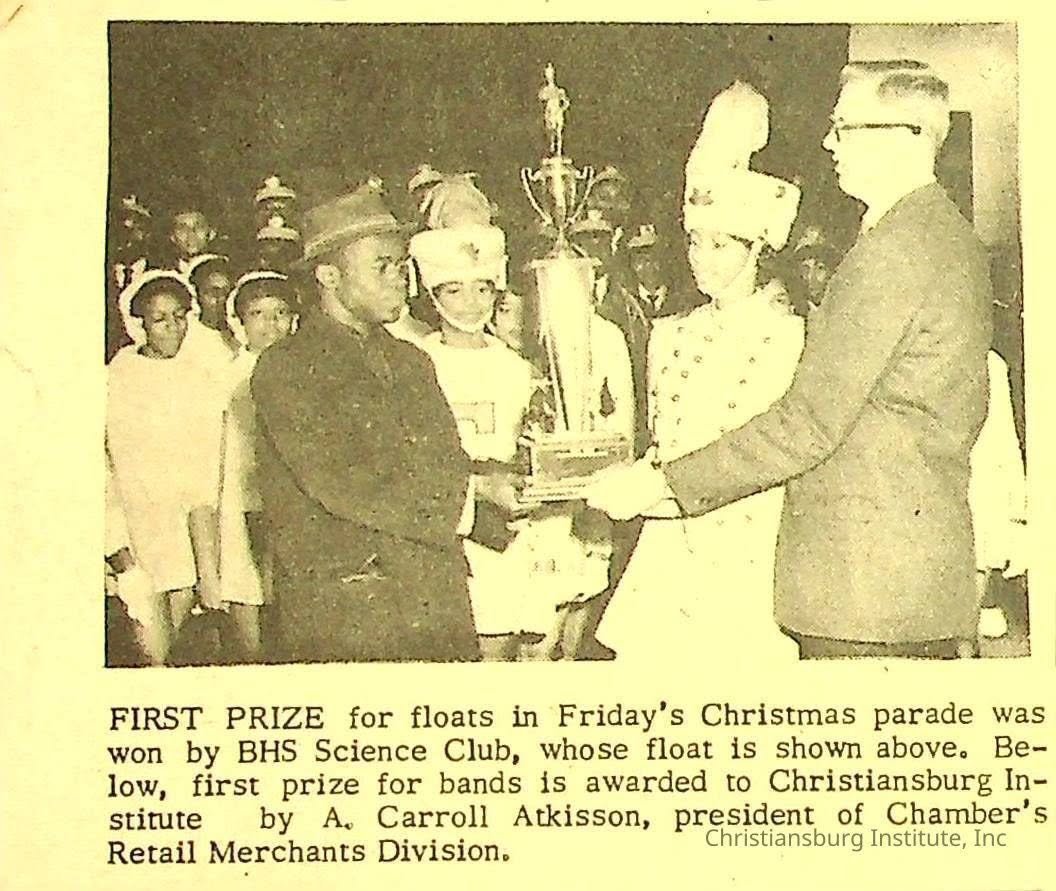
Graduates of the Christiansburg Industrial Institute frequently recall an entire display case full of trophies in Scattergood Hall. These trophies were the culmination of decades of students’ victories across disciplines at CII. There were trophies commemorating sports victories, high-steppers victories, parade float design contest winners, science fair winners, agricultural science competition winners, and many others. These trophies indicated the prowess and athleticism of students at the school in all of their endeavors, and invoked a sense of inter-generational pride in students and staff alike.
Today, only 6 of those trophies are held safely within the Christiansburg Institute Museum and Archives (CIMA). The rest of the trophies' whereabouts remain unknown.
If you would like to see some of these trophies for yourself, come to the museum at the Christiansburg Institute Museum and Archives (CIMA) or check out the Smokehouse Collection at the Christiansburg Institute Digital Archives (CIDA).
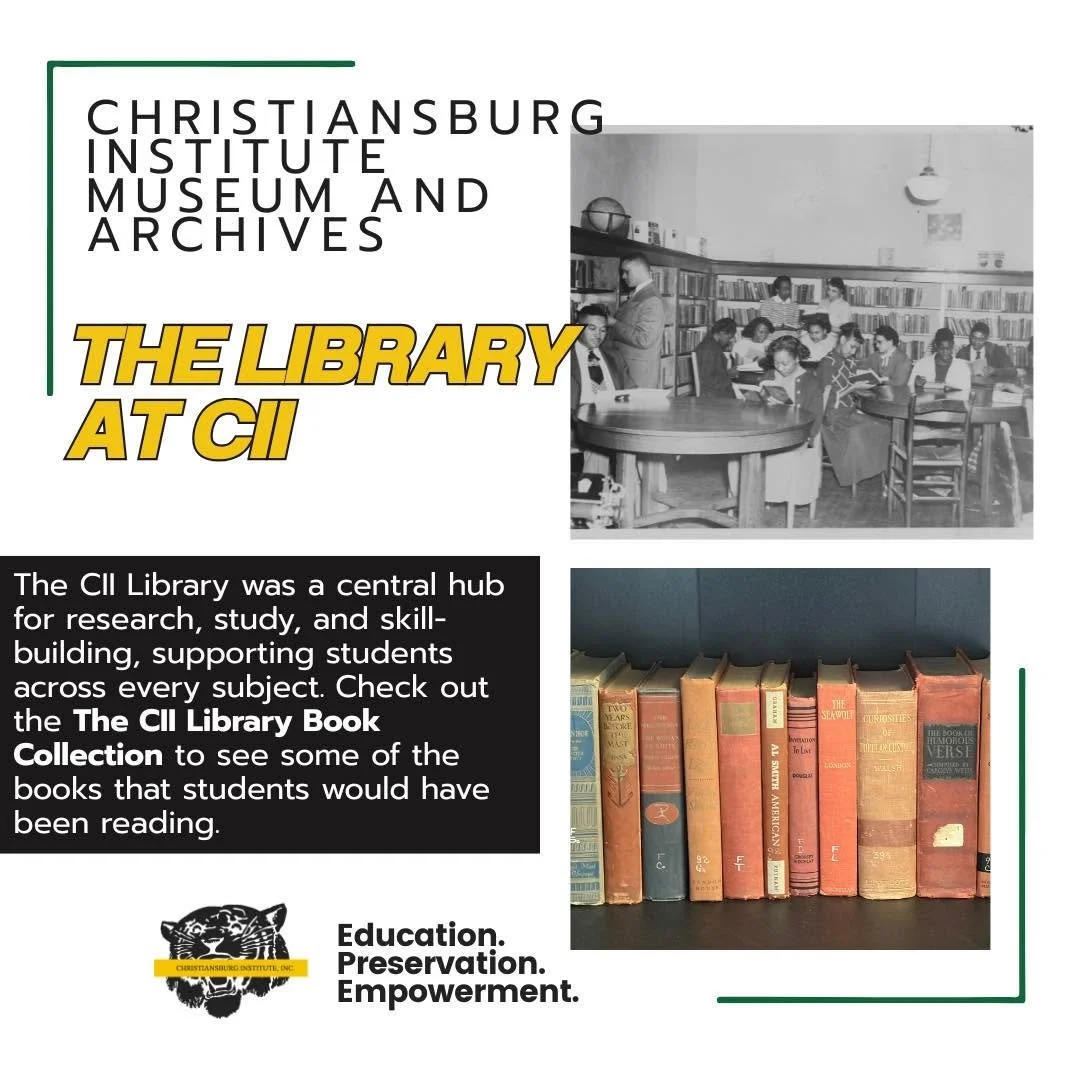
The library at the Christiansburg Industrial Institute (CII), was a vital academic space that supported student learning across disciplines. Located initially inside Baily-Morris Hall, and then moved next door to the Edgar Long building, the library was spacious, centrally located, and designed to be an essential resource for both students and faculty.
At CII, developing strong library skills was considered an important part of every student’s education. All students were required to take a semester of library science in the 8th grade, where they learned how to effectively navigate research materials and utilize library resources. Some students even assisted the librarian by filing catalog cards, gaining hands-on experience in organizing information.
The library was more than just a place to store books. It supplemented, complemented, and implemented classroom instruction, providing valuable resource materials for research and independent study. It also played a key role in helping students develop strong study habits, while encouraging critical, creative, and analytical thinking skills.
In addition to books, the library housed audiovisual equipment and materials, expanding the ways students could engage with information. It also offered dedicated study spaces where students could focus and collaborate.
In the 1960s, the library was overseen by librarian Mrs. N. Banks, who helped maintain this important academic hub.
If you would like to read some of the books that were held within the CII library, check out the CII Library Collection in-person at the Christiansburg Institute Museum and Archives (CIMA).
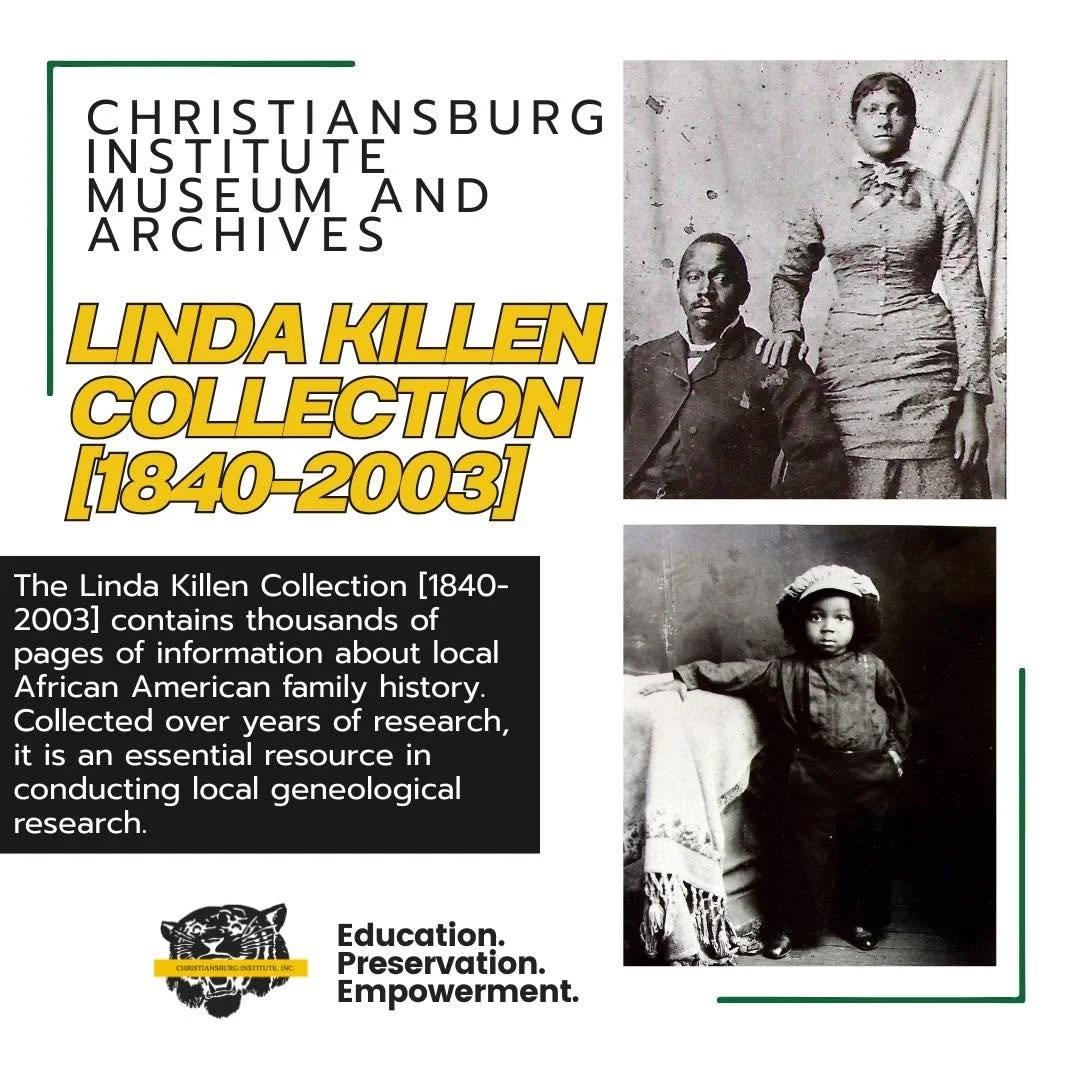
The Christiansburg Institute Digital Archives (CIDA) not only holds important local historical artifacts, but also a range of genealogical information. The Linda Killen Collection [1840–2003] includes thousands of pages of transcribed census data, marriage records, land records, and cemetery records documenting local African American history. With information dating back to the early 19th century and encompassing Radford City, Pulaski County, Floyd County, and Montgomery County, this collection is an invaluable tool for genealogical research.
Additionally, the collection contains hundreds of historical photographs, portraits, sketches, and paintings depicting African American life in Southwest Virginia.
Dr. Linda Killen, a professor of Russian history at Radford University, had a dedicated passion for local African American history. Much of what is preserved in the collection represents the raw data she gathered over years of meticulous research.
If you are interested in exploring local African American family history, visit the Linda Killen Collection [1840–2003] in CIDA.
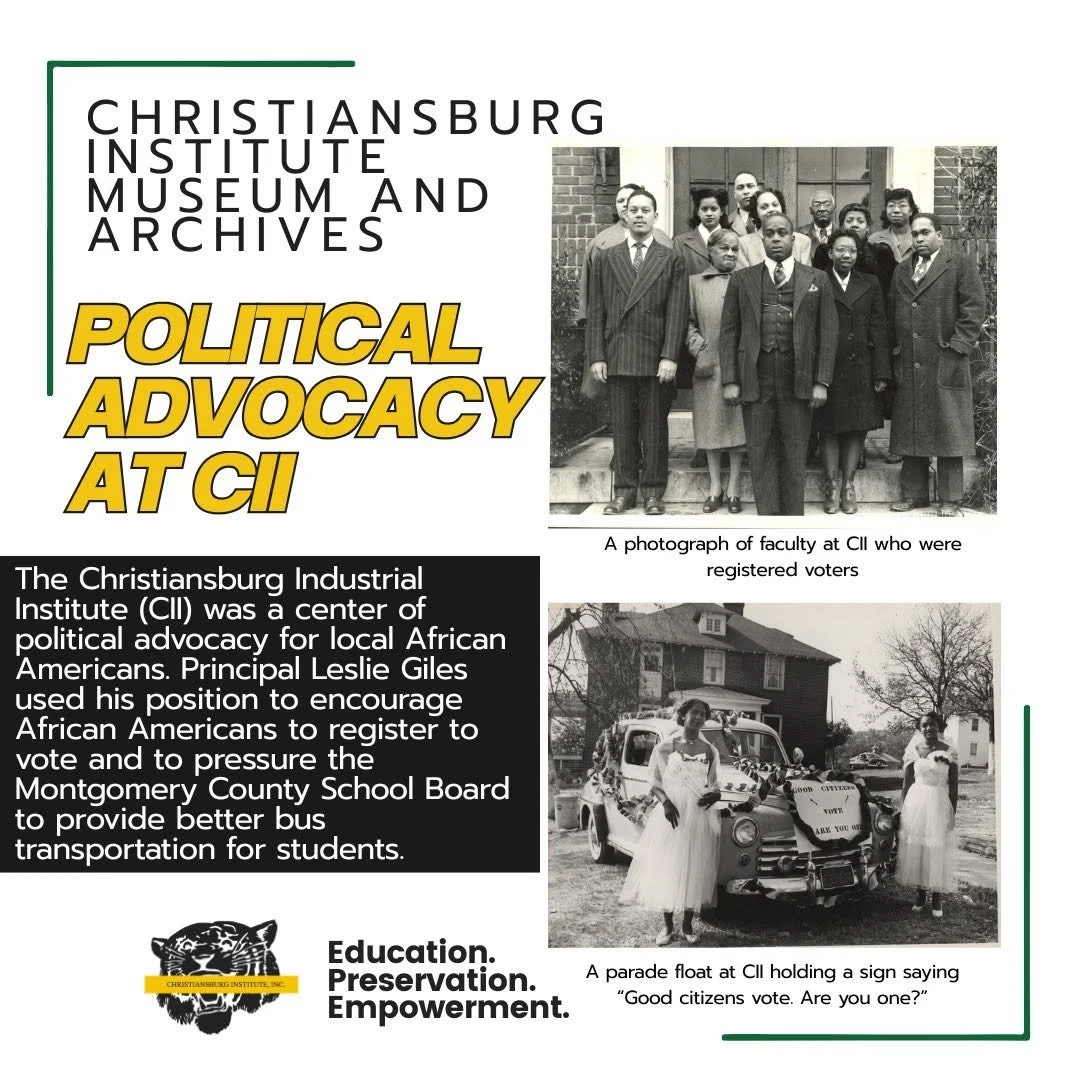
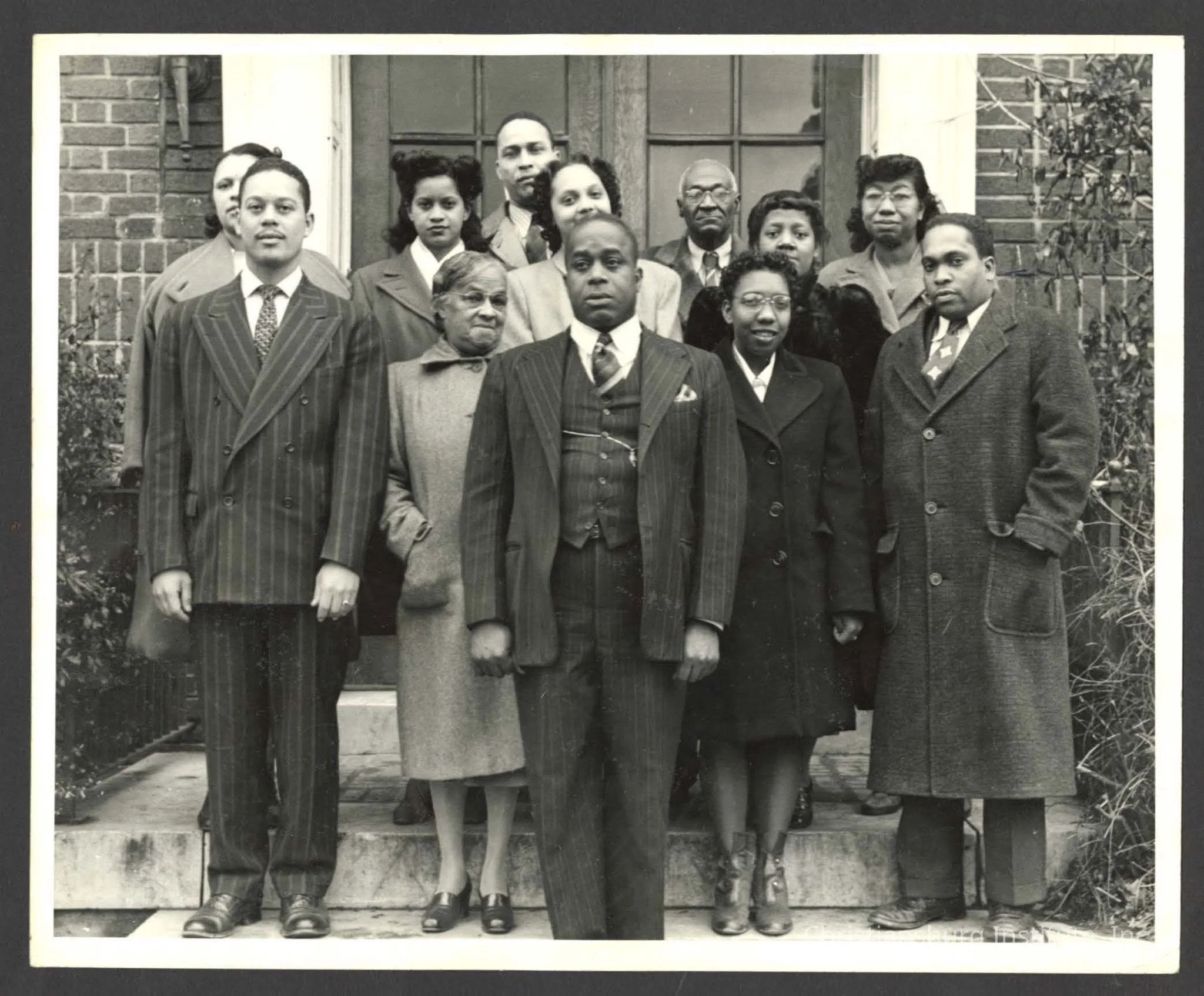
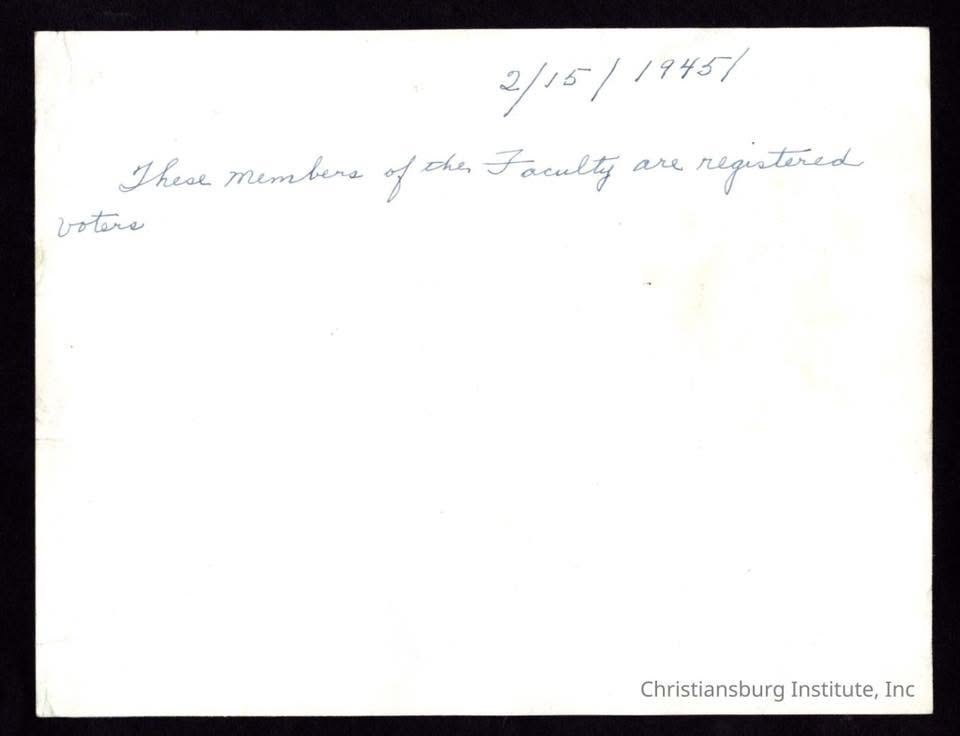
This photo, dated 1945, depicts Principal H. Leslie Giles and teachers at the Christiansburg Industrial Institute (CII) standing proudly. The reverse side of this photograph reads, “These members of the faculty are registered voters.”
This photograph gives us insight into how leadership at CII used their influence in the community to advocate for racial equality in local politics. In 1941, Principal H. Leslie Giles began the Montgomery-Pulaski Welfare Organization to increase the school’s involvement within the New River Valley. It consisted of teachers at CII and assorted Black community leaders. Importantly, to join, members had to register to vote and pay the required poll tax. This requirement was a strategic move on behalf of CII leadership to undermine Jim Crow laws, which heavily discouraged African Americans from voting through the use of poll taxes, unfair registration requirements, and physical intimidation.
Another example of Principal Giles using his role to politically advocate for Black community members is evident in the recorded recollections of Elaine Dow Carter, a 1948 CII graduate and founding Executive Director of Christiansburg Institute, Inc. (CI, Inc.) She states that in the 1940s, students in rural areas were not provided with a school bus to take them to CII. The only way to attend was to take expensive public transportation or drive, an impossibility for poorer children. In fact, only a few years earlier, in 1938, concerned citizens had to organize and fight the Montgomery County School Board to acquire even a single school bus for the transportation of children to CII.
Principal Giles quickly recognized that a lack of transportation to school continued to be a serious problem, but he was unable to sway the Montgomery County School Board single-handedly. Thus, he began to visit Black churches in the area to encourage people in the community to come to the MCPS superintendent’s office and demand that free transportation to school be offered for all local students. He even canvassed door-to-door, petitioning Black families to join the charge on behalf of their children. Evidently, the school board was forced to respond as by the 1950s multiple school buses were used to transport children to school, sometimes driven by the students themselves.
More information about Black activism in Montgomery County can be found in Tracy A. Martin’s Master’s Thesis, ‘Black Education in Montgomery County, Virginia, 1939-1966.’
The displayed photograph is held in The Christiansburg Institute Administrative Records Collection in the Christiansburg Institute Digital Archive (CIDA).
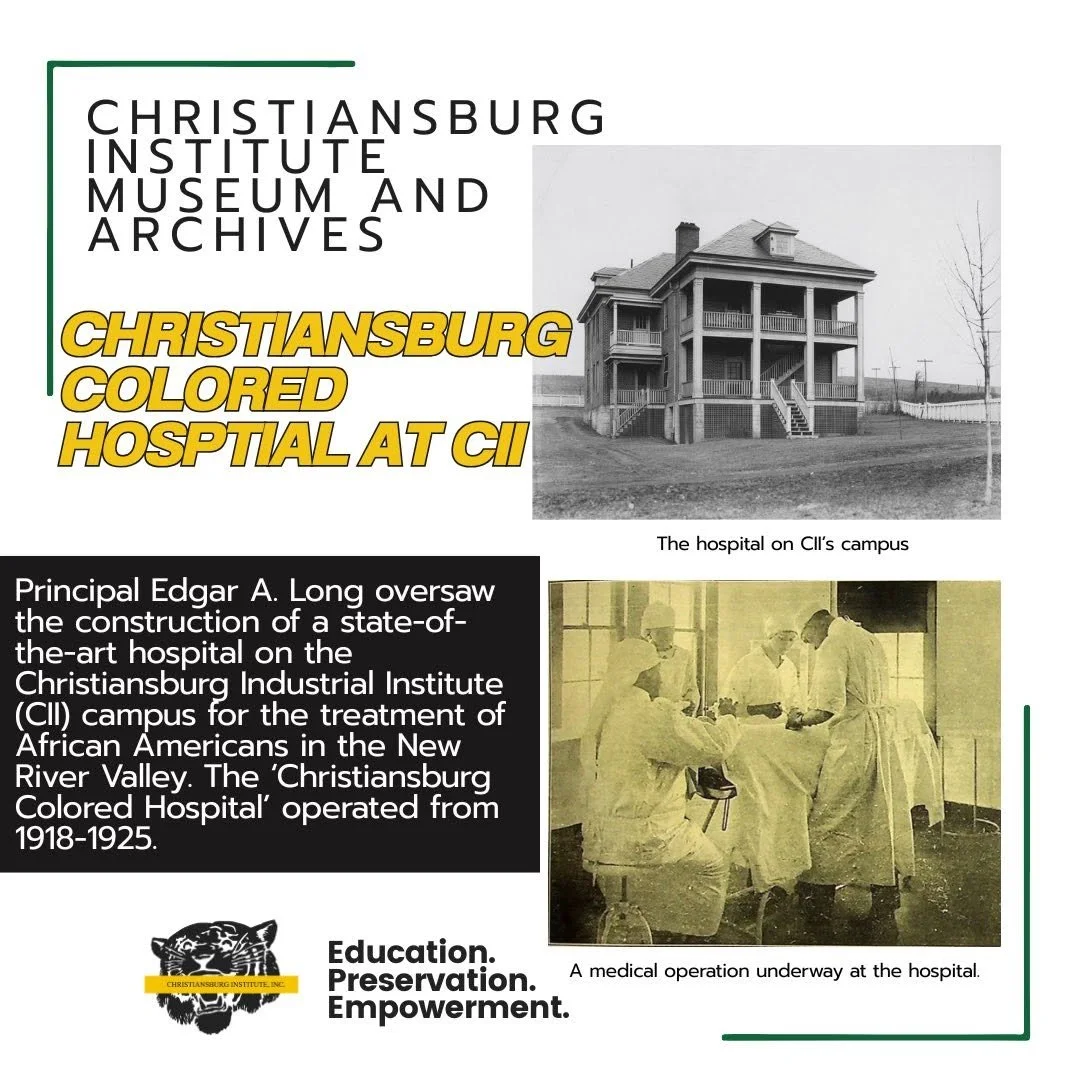
Did you know that the Christiansburg Industrial Institute (CII) had a state-of-the-art hospital on its campus, known as the Christiansburg Colored Hospital?
Before the construction of this hospital, as a result of race-based discrimination, all hospitals in the New River Valley refused Black patients. Thus, Black people were at a significantly higher risk of dying from preventable health problems.
This issue was known all too well by CII principal Edgar A. Long (1906-1924). His predecessor and close friend, Principal Charles Marshall, contracted appendicitis in 1906. After being refused treatment at the local hospital in Montgomery County and missing the day’s last train to a Black hospital in Roanoke, he succumbed to his illness.
Principal Marshall’s death catalyzed Principal Long’s mission to build a hospital for African Americans on the CII campus, which would be realized upon the completion of the hospital building in 1918. This hospital was fully equipped with the most modern equipment and facilities and was capable of offering a wide range of surgeries and health care services. The hospital was staffed by an interracial team of medical professionals. Dr. A. M. Showalter, the founding director of what would become LewisGale Hospital Montgomery, acted as the head surgeon and chief of staff. The hospital head nurse, Mayme L. Wilkins, was funded by the Auxiliary Board of Women, whose members were all white community members except for Anna P. Long, teacher at CII and Principal Long’s wife.
The hospital not only functioned to treat the ill, but also to educate CII students and the wider community about health and hygiene. Nurse Wilkins was tasked with holding a nurse-training class for female students attending CII and instructed them in nursing and hygiene.
In 1925, after a series of fires in the hospital, the Hospital Board and Auxiliary Board of Women decided that the costs of running the hospital were too high and decided to close the hospital only four years after its official opening. The building was converted into teachers’ residences.
Despite the closure of the hospital, the administration at CII continued to advocate for the health, education, and wellbeing of Black people within the New River Valley through a variety of community-facing programs up until the school’s closure in 1966.
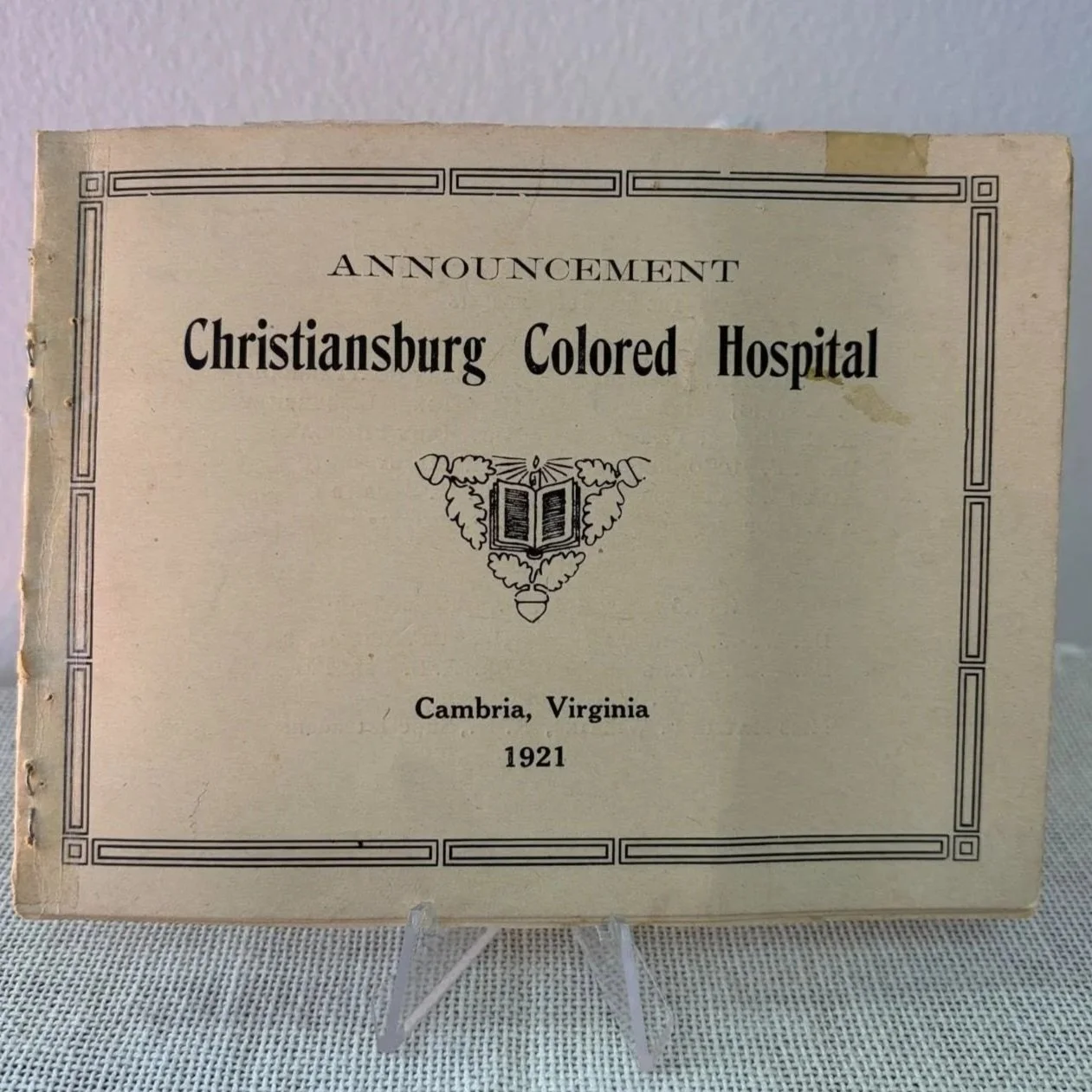
Pictured is an announcement program which introduces locals to the newly opened ‘Christiansburg Colored Hospital’. If you would like to look through this program, it is held in the Smokehouse Collection in the Christiansburg Institute Digital Archive (CIDA). You can also learn more about the hospital and see this program in person in our museum.
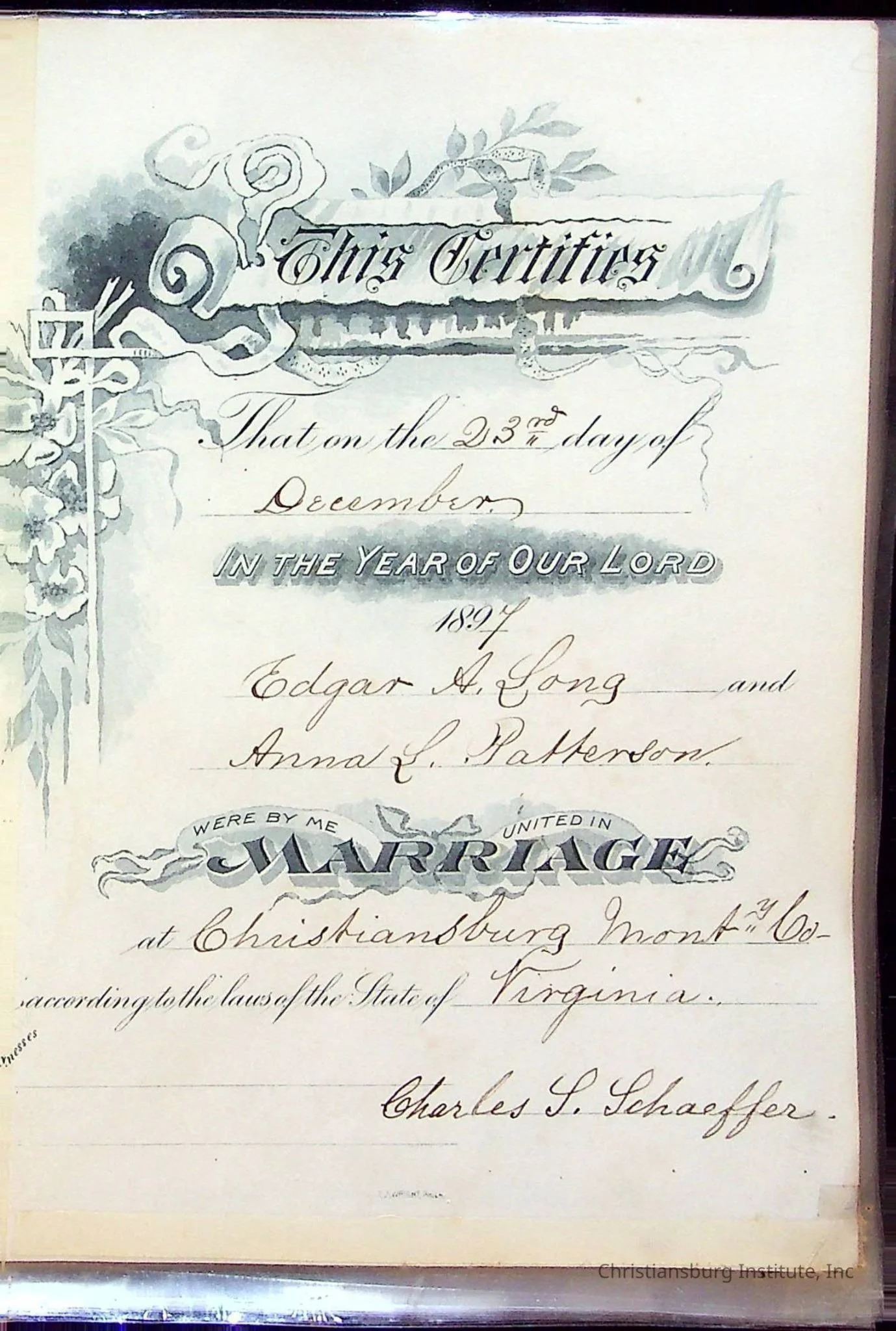
This is a page from Edgar A. Long and Anna P. Long’s wedding Bible which certifies their marriage, officiated by Capt. Charles S. Shaeffer.
It reads: “This certifies that on the 23rd day of December, in the year of our Lord 1897, Edgar A. Long and Anna L. Patterson were by me united in marriage at Christiansburg, Montgomery County, according to the laws of the State of Virginia. Charles S. Shaeffer.”
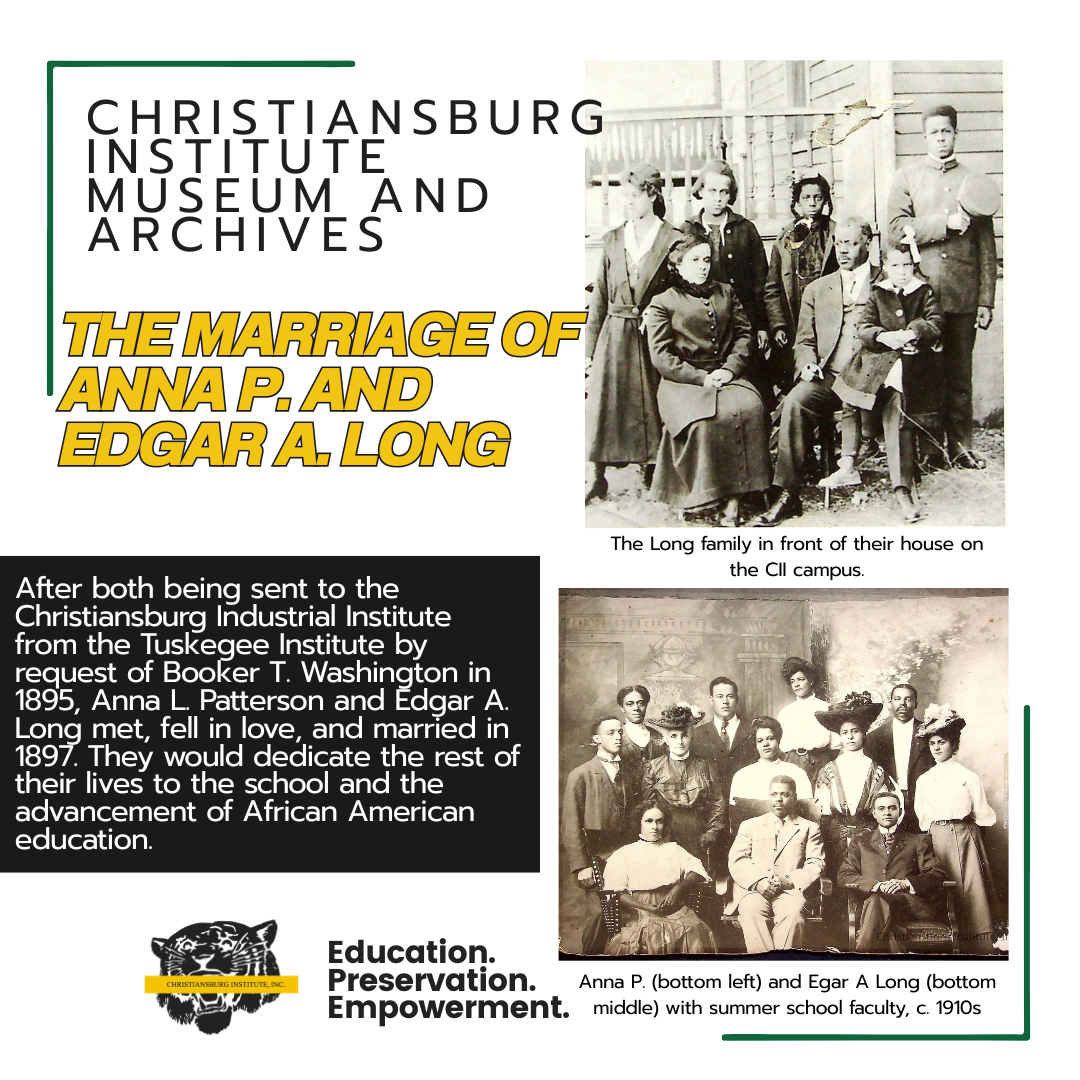
This page is likely the most star-studded document that we have in our collections at the Christiansburg Institute Museum and Archives (CIMA), and it marks an important moment in the Christiansburg Industrial Institute’s history (CII). Edgar A. Long was one of the most successful principals of the Christiansburg Industrial Institute, overseeing a period of massive growth for the school. Anna P. Long was a teacher at the school for nearly 50 years and was the first and only female principal of the school. Capt. Charles S. Shaeffer, an ex-Union lieutenant, Freedmen’s Bureau agent, and Baptist pastor, founded the Christiansburg Industrial Institute and the First African Baptist Church (now Schaeffer Memorial Baptist Church) in 1866.
The Longs met each other after both being sent to CII from the Tuskegee Institute in 1895 at the request of Booker T. Washington. This wedding Bible marks the moment that they both dedicated the rest of their lives not only to each other and their family, but to CII and the advancement of African American education. Edgar A. Long worked at CII until his death in 1924, and Anna P. Long worked at CII until 1942.
If you would like to see this important artifact for yourself, it is held in the Smokehouse Collection in the Christiansburg Institute Digital Archive (CIDA). You can also learn more about the leadership at CII and see this wedding Bible in person in our museum.
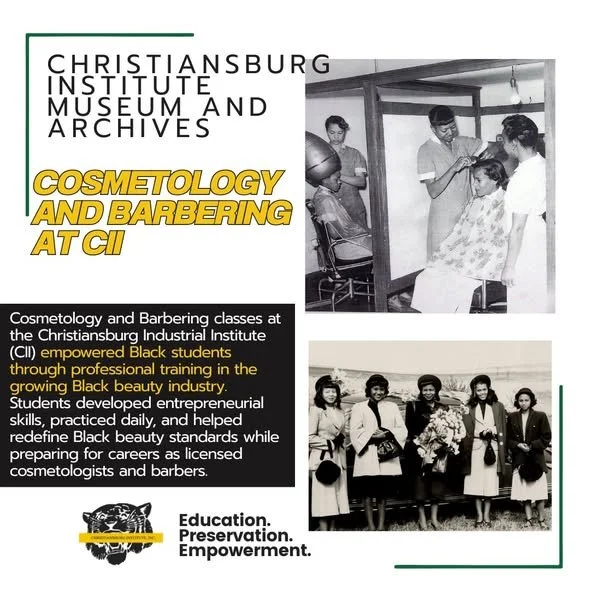
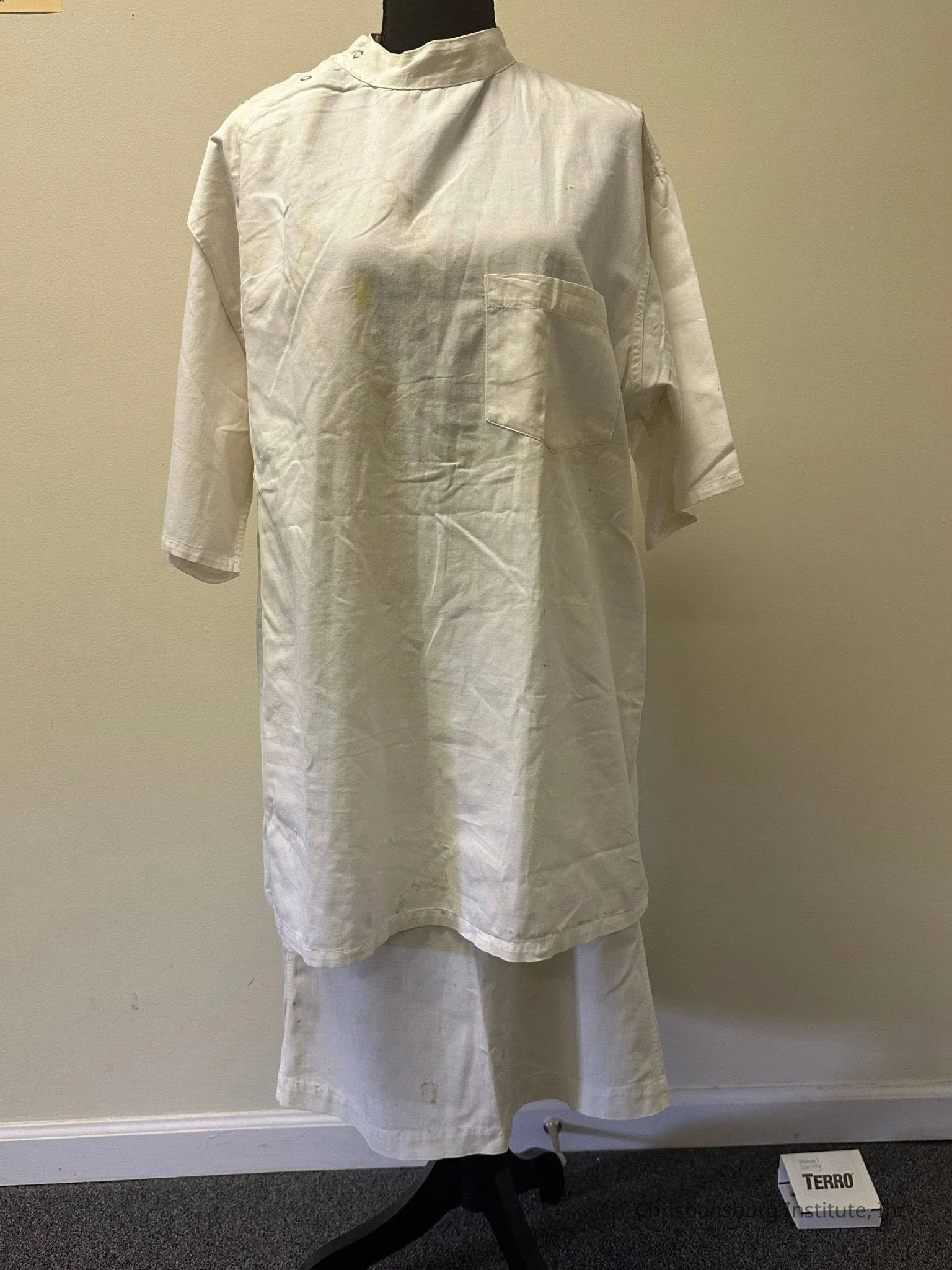
Pictured is Amanda DeHart’s uniform which she would wear to teach her Cosmetology class at the Christiansburg Industrial Institute (CII), held in the C.I. Uniform Collection in the Christiansburg Institute Digital Archive (CIDA), accessible at: https://hub.catalogit.app/.../amanda-deharts-cosmetology...
Cosmetology and Barbering at CII was not only a class, but part of a larger movement toward redefining Black beauty. In the early 20th century, beauty standards, as well as the beauty product industry, were largely controlled by white-owned businesses. This not only framed Black hair and features as undesirable, but also left the market largely devoid of products designed to properly care for them. In the early 20th century, the ‘New Negro Movement’ began to move Black beauty standards away from the predominant Eurocentric ideal. This created a space for Black people, especially women, to break into the industry and successfully market beauty products designed for Black people. This also opened up a larger market for Black people to operate their own beauty-oriented businesses and become successful entrepreneurs.
The operation of Cosmetology and Barbering classes at CII was a manifestation of the expanded Black beauty industry. Students of Cosmetology or Barbering were expected to practice their trade for three hours per day, every day. If they passed their state-board exams, they could legally open their own business.
The acumen and pride of the students in Barbering and Cosmetology classes are especially evident in photos of school parades, dances, and fashion shows, where students styled themselves to look their best.
To learn more, see our curated exhibit about Barbering and Cosmetology, come in person to our Museum at the Christiansburg Institute Museum and Archives (CIMA), open Tuesdays and Thursdays from 12pm to 5pm.
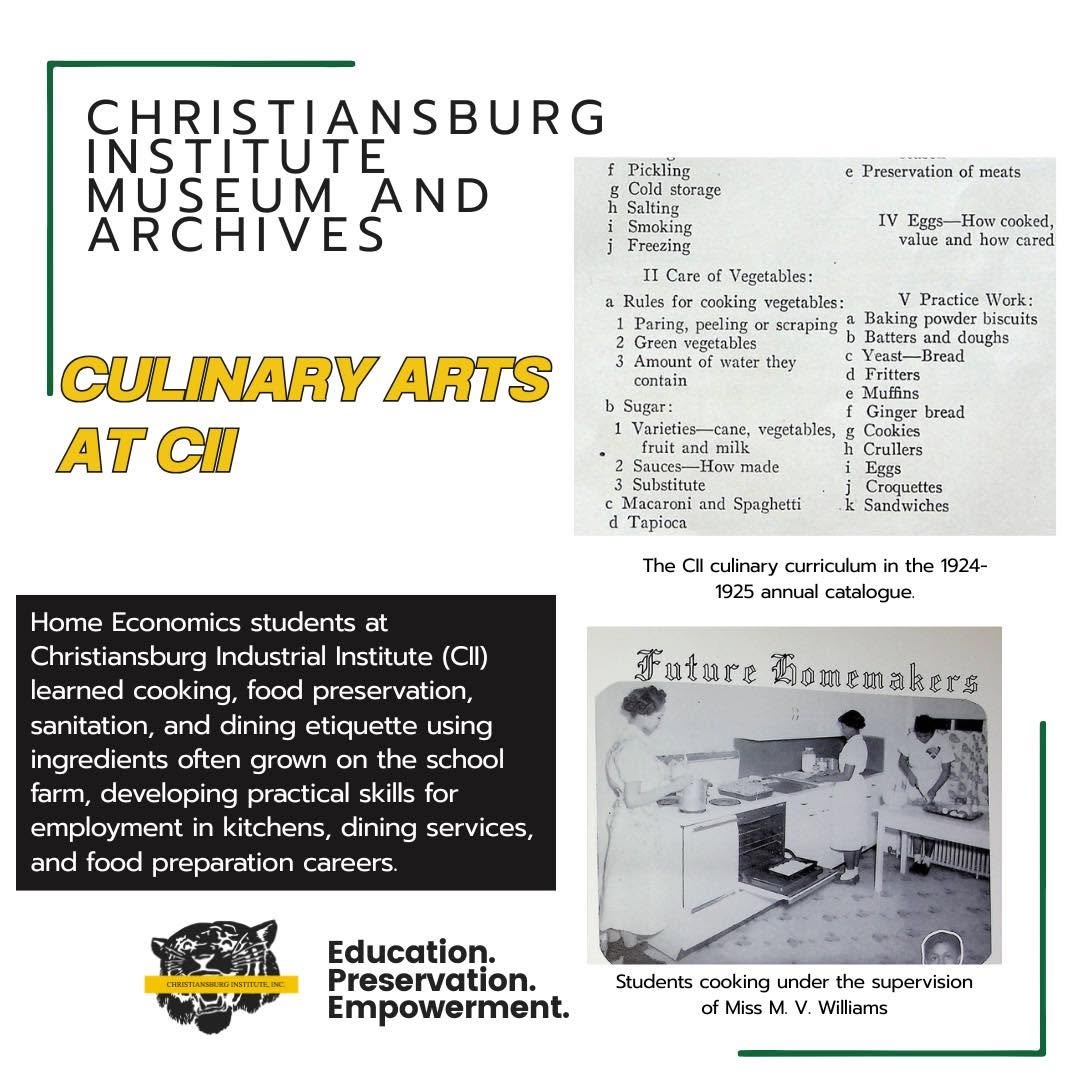
Food preparation was a major part of the Home Economics curriculum at the Christiansburg Industrial Institute (CII). Female students learned not only how to cook, but also how to plan meals, preserve food, arrange dining rooms, and practice proper mealtime etiquette. These lessons reflected the social and economic expectations of the era while providing students with practical skills in nutrition, household management, organization, and hospitality that could be applied in a variety of personal and professional settings.
During the early twentieth century, most meals were made from foods grown locally. This was especially true at CII, where the school's 185-acre farm supplied much of the produce, meat, and dairy used by the Home Economics department and boarding program. As a result, students learned to prepare dishes that reflected the agricultural traditions and flavors of the American South.
Students were trained in making breads, biscuits, cornbread, gingerbread, fritters, cookies, soups, puddings, custards, and a variety of meat and poultry dishes. They also learned essential food preservation techniques such as canning, drying, curing, pickling, salting, and smoking, skills that were especially important before refrigeration became common.
Beyond cooking, students studied sanitation, table service, and the preparation of different cuts of meat. The curriculum reflected the rich traditions of Southern African American cuisine, which blended West African and European foodways with ingredients available in the South. Through these lessons, CII students gained valuable skills while helping preserve a culinary heritage that remains influential today.
For more information on the Culinary Arts at CII, check out the CII 26th Annual Catalogue, 1924-1925 in the School Annuals Collection in the Christiansburg Institute Digital Archive (CIDA), available at: https://hub.catalogit.app/.../christiansburg-industrial...
If you would like to see African American recipes from the late 19th and early 20th centuries, check out The Historical Cookbook of the American Negro located in CI, Inc.’s Robert Henry Graham Legacy Library, open to the public Tuesdays and Thursdays from 12pm to 5pm.
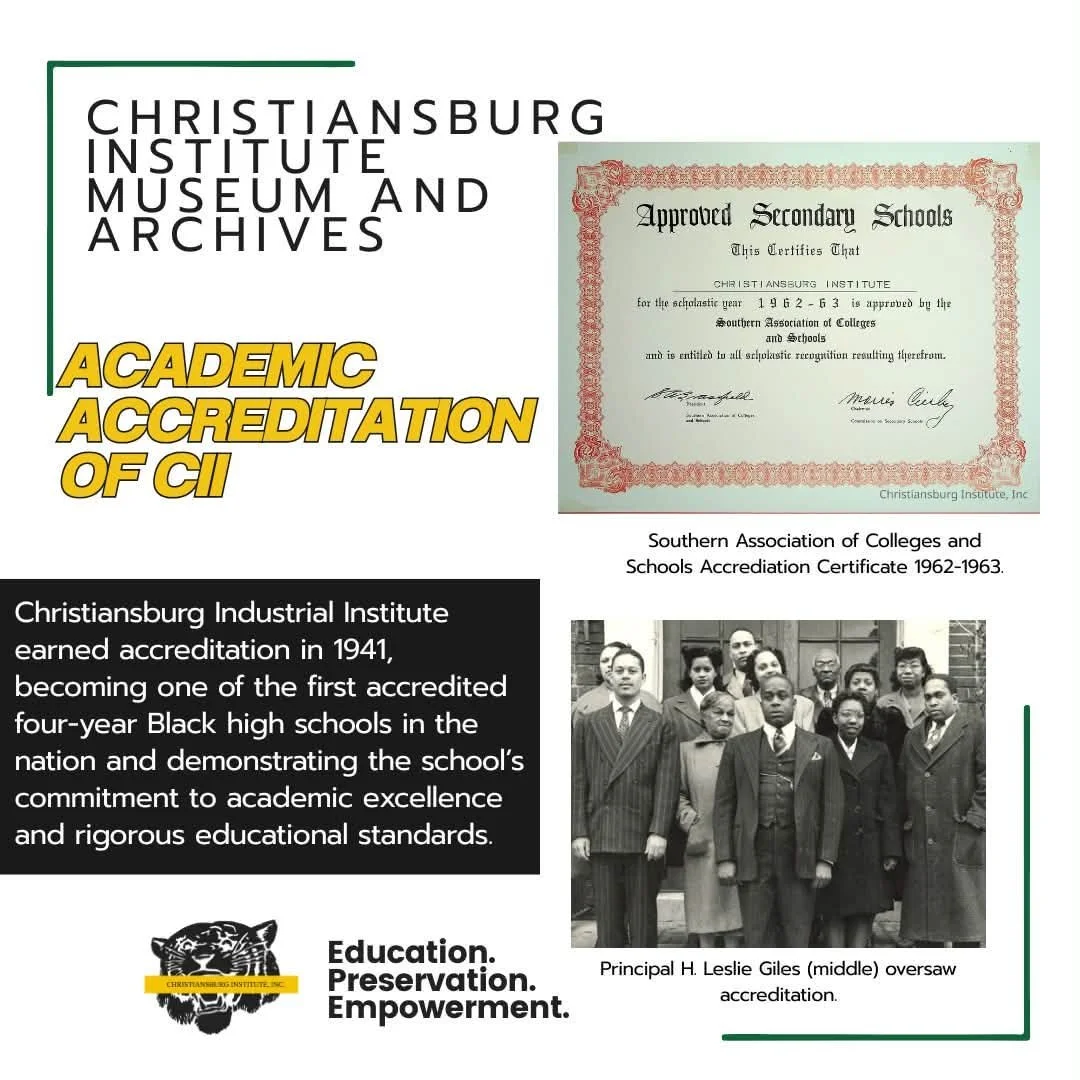
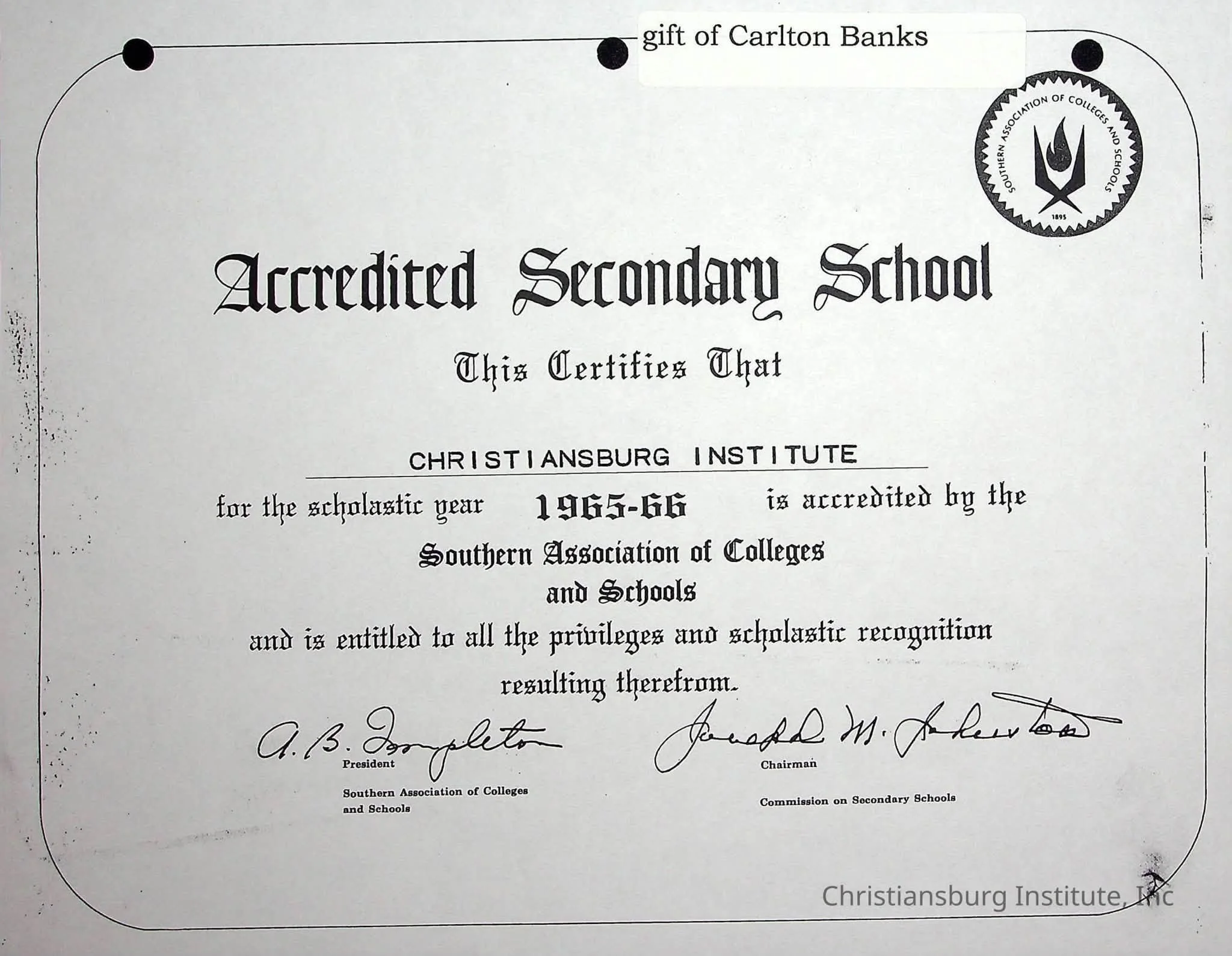
Pictured is a certificate of accreditation presented to the Christiansburg Industrial Institute (CII) by the Southern Association of Colleges and Schools in 1965. CII was first accredited by both the Southern Association and the Virginia Department of Education in 1941, becoming one of the first four-year Black high schools in the nation to achieve accreditation.
Accreditation came shortly after Montgomery County Public Schools assumed control of CII in 1934. Under this new leadership, the school’s curriculum shifted away from the vocationally centered Tuskegee model and became more closely aligned with the academic philosophy employed at local white high schools. CII’s early success in earning accreditation reflected the excellence and adaptability of its teachers and administrators, who continued to provide students with a rigorous, high-quality education.
Accreditation required schools to meet strict educational standards, including mandated instructional hours across academic and vocational subjects, adequate teacher-to-student ratios, funding for library services, and designated teacher planning periods. CII successfully fulfilled these requirements despite tight financial constraints, further demonstrating the institution’s commitment to educational excellence.
If you would like to learn more about the academic standards at CII, check out Christiansburg Institute Administrative Records Collection and the John F. Banks Collection [1910-1979] held in the Christiansburg Institute Digital Archives (CIDA), accessible at: https://hub.catalogit.app/.../christiansburg-institute... (https://hub.catalogit.app/.../christiansburg-institute...)
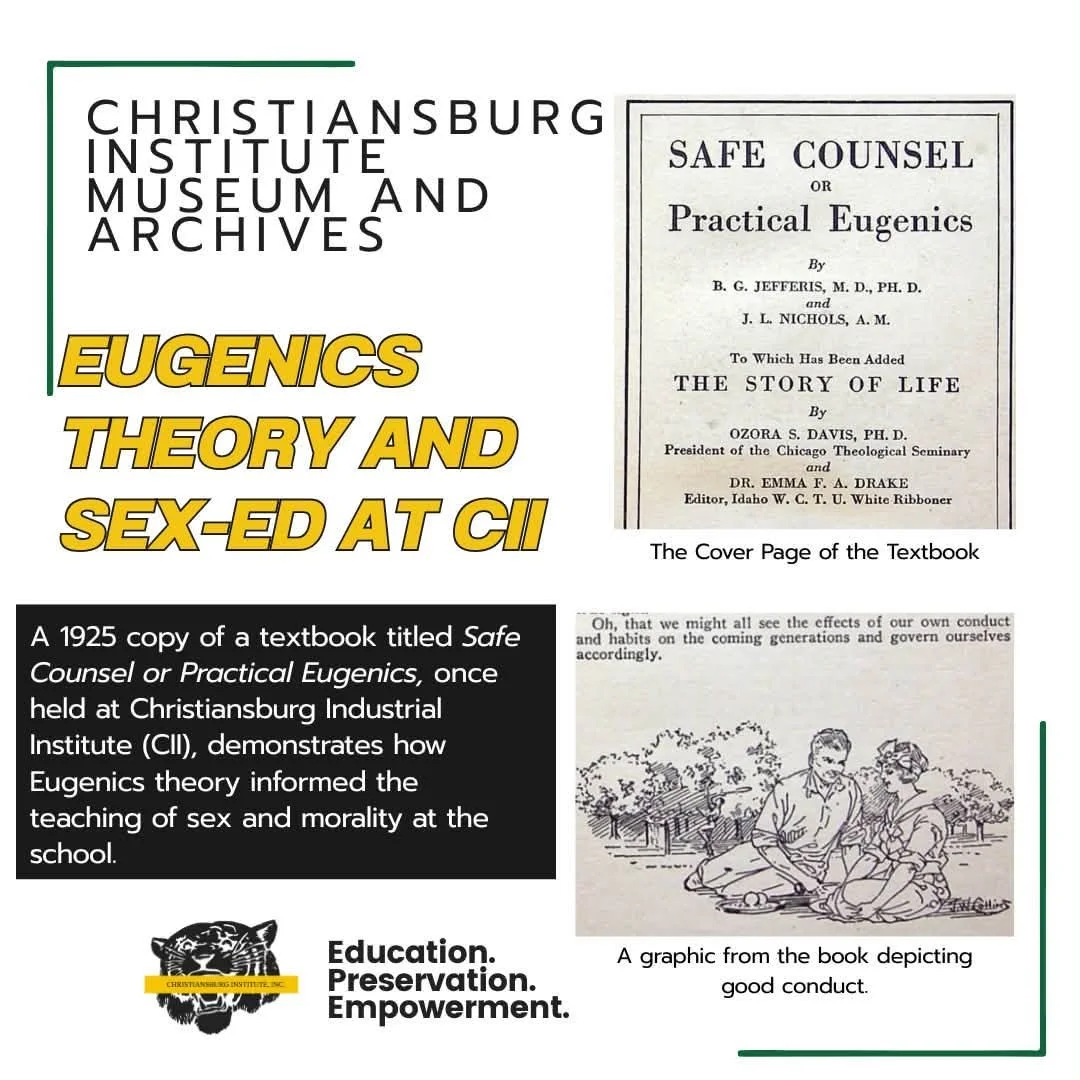
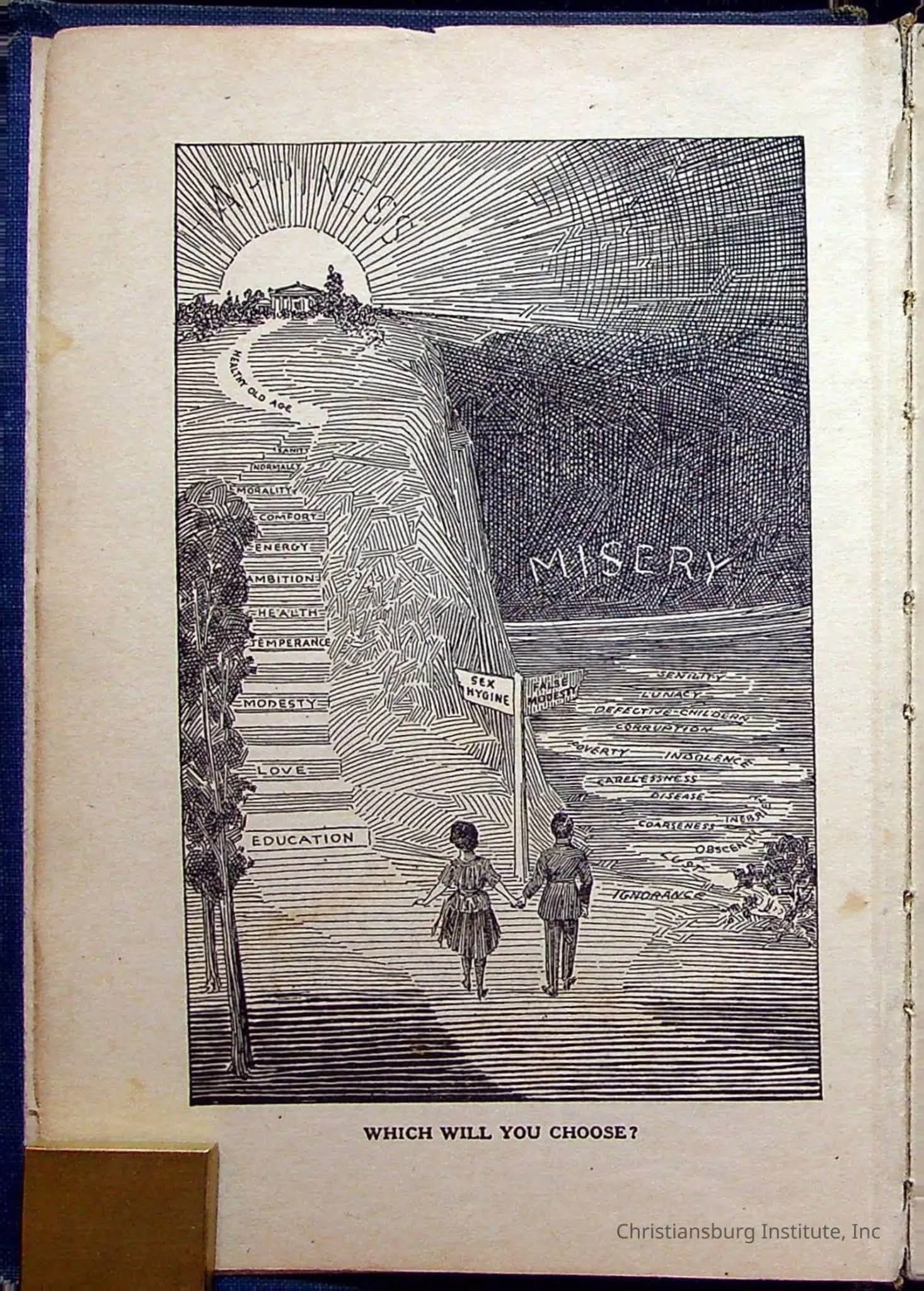
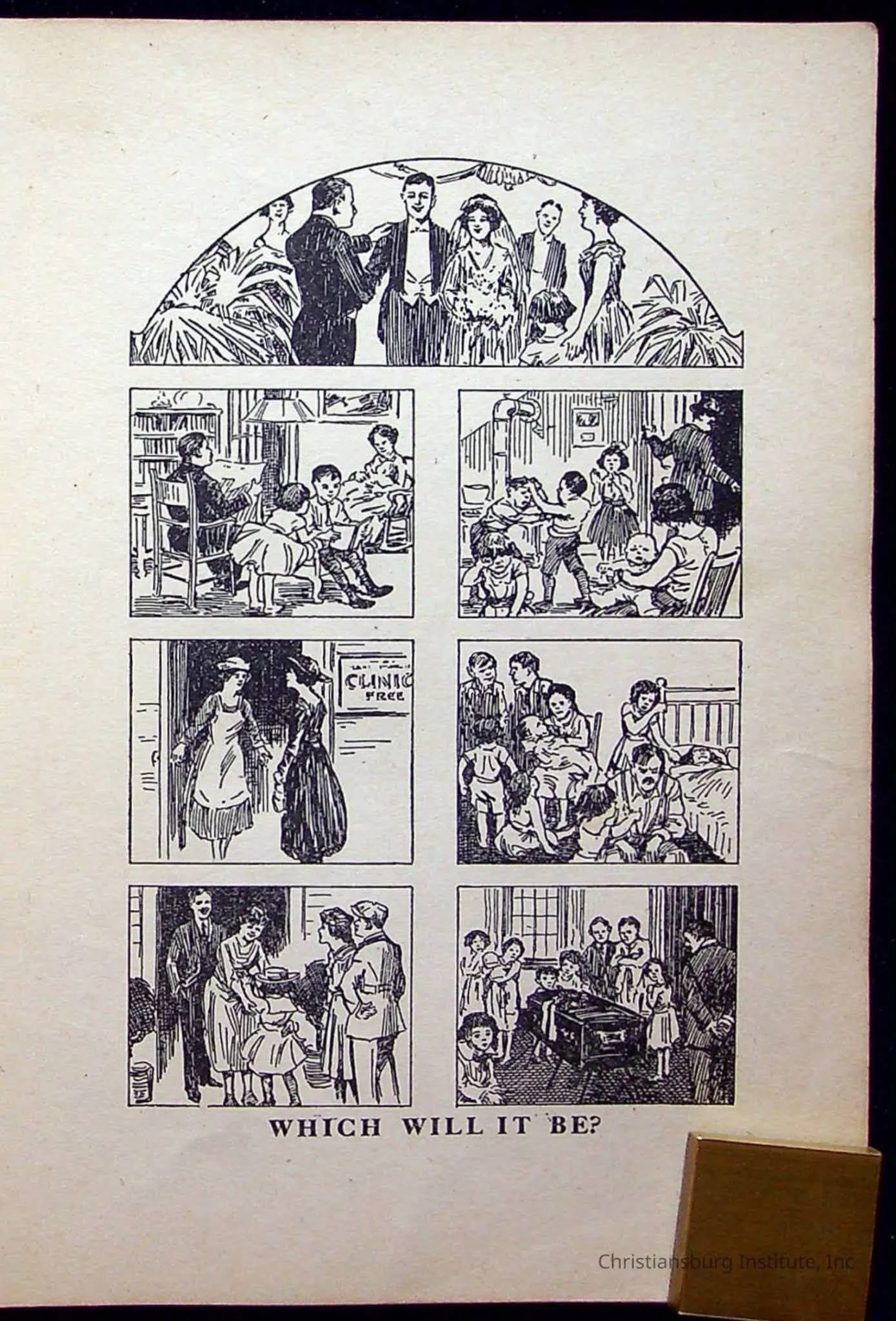
This textbook, titled Safe Counsel or Practical Eugenics and published in 1925, was once used for teaching at the Christiansburg Industrial Institute (CII). Given its promotion of eugenics theory, it is certainly a controversial artifact to be held within the Christiansburg Institute Digital Archive (CIDA).
The eugenics movement, from the late 19th century to the mid-20th century, was driven by the idea that “inferior” characteristics in a population could be bred out by controlling sexuality and fertility. At its core, eugenics embodied the ideals of white supremacy, in which disabled, ill, non-white, and impoverished people were seen as inherently and biologically inferior. Looking back on it now, it is safe to say that eugenicists fundamentally misunderstood the origins of social ills, attaching blame to a victim’s genetics rather than broader societal oppression. This movement justified the forced sterilization of many people seen as undesirable, disproportionately affecting people of color.
Despite this, many African American leaders in the early 20th century embraced eugenics theory. Records show that Booker T. Washington, the principal of the Tuskegee Institute and supervisor of CII, corresponded with the well-known eugenicist John Harvey Kellogg, attended his conferences, and requested eugenics literature for his schools. Black eugenicists believed that a necessary component of “racial uplift” was identifying characteristics, both moral and physical, that were seen as detrimental to the race. A core idea among Black eugenicists was that “poor morals” surrounding sexuality within the African American community contributed to the spread of disease and poverty.
The impact of the Black eugenics movement remains contested. On one hand, some modern scholars argue that it acted as a site of agency and power for Black people at the time. It provided a platform to scientifically disentangle illness from race, which had previously been understood as inseparable in leading scientific narratives, and helped justify public health initiatives for African Americans. Others argue that the core logic of eugenics, rooted in scientific racism, elitism, and white supremacy, was inherently detrimental to African American advancement.
It was under the auspices of eugenics that sexual education and family planning at the Christiansburg Industrial Institute was taught. Sexual conservatism and abstinence were presented as scientifically provable behaviors conducive to both personal success and the uplift of the race, for better or for worse.
To read this book for yourself, visit the Viola Charlton Collection at the Christiansburg Institute Digital Archive (CIDA), accessible at https://hub.catalogit.app/.../safe-counsel-or-practical...
To learn more about the Black Eugenics Movement, check out Liberation Eugenics: African Americans and the Science of Black Freedom Struggles, 1890-1970, by Ayah Nuriddin, accessible at: https://jscholarship.library.jhu.edu/.../c145e147.../content